
What JJK Character Are You Quiz
How the Scales are Structured
Who Usually Takes This Test?
See How You Compare
Below is a preview of how scores are typically distributed across each scale.
Example Questions From the Test
- Spending uninterrupted time on a quiet personal interest.
- Exploring shops, food, or a lively neighborhood on my own terms.
- Trying an amusing challenge with someone who can keep up.
- Sharing a meal and something entertaining with close friends.
- Suggest an unconventional experiment and see what it reveals.
- Ask the blunt question everyone else seems to be avoiding.
- Keep people motivated so the group does not lose momentum.
- Study the variables and propose the most efficient workable plan.
- Reaffirm who I am now rather than letting the past define me.
- Examine the decision privately so I can avoid repeating it.
- Turn what I learned into guidance I can offer other people.
- Make it a personal promise to reduce someone else’s suffering.
What JJK Character Are You Quiz - Description and methodology of the test
Fans of Jujutsu Kaisen who want to connect their own choices with a familiar fictional world can use the What JJK Character Are You Quiz as a light character-affinity exercise. It considers reactions to pressure, conflict, responsibility, identity, and friendship, helping readers see which JJK character you are through patterns of behavior rather than a fixed personality label.
What This Assessment Explores
Across the scenarios, the questionnaire examines responsibility, self-expression, conflict, uncertainty, loyalty, and care for others. It suits fans seeking a reflective character match and addresses which Jujutsu Kaisen character you are through recurring tendencies rather than surface preferences. The highest scale is the strongest affinity; scales within one point indicate a blended result. The four dimensions are:
- Megumi Fushiguro (0-12) reflects reserved strategy and selective responsibility: More expressive approach (0-4), Quiet alignment (5-8), and Strong Megumi affinity (9-12).
- Nobara Kugisaki (0-12) reflects candid independence and defended identity: Quieter self-expression (0-4), Confident connection (5-8), and Strong Nobara affinity (9-12).
- Satoru Gojo (0-12) reflects playful experimentation and confidence: Grounded conventionality (0-4), Independent spark (5-8), and Strong Gojo affinity (9-12).
- Yuji Itadori (0-12) reflects warmth, resilience, and shared burden: Different instinct (0-4), Shared heart (5-8), and Strong Yuji affinity (9-12).
Methodology and Scientific Basis
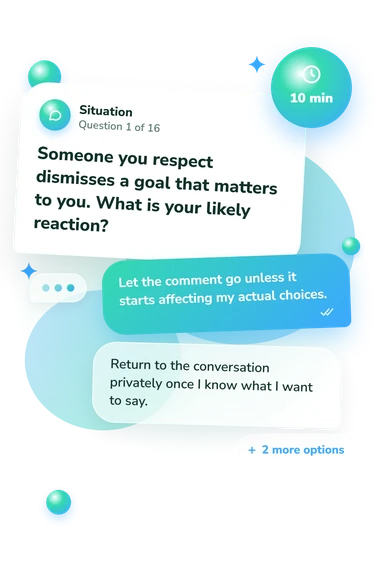
Each item presents an everyday situation with four response options covering decisions, boundaries, social style, support, teamwork, and reactions to flawed systems. Choosing the response that feels most like you keeps the result rooted in self-report.
The scoring compares accumulated affinity across four profiles; the highest displayed scale is the strongest match, while close scores can indicate a blend. This makes the format useful for the personal question of which JJK character fits me without treating one answer as a complete personality. The ranges are internal comparison bands, not population norms or clinical thresholds.
Rarity et al. (2022) offers the closest supporting framework: identification with media characters can relate to perceived overlap in personality traits. Cohen (2001) further explains identification as an audience’s psychological connection with a character. Akutami’s official guide supplies the canonical character context. These sources support the interpretive approach, but this questionnaire is not an adaptation of their published measures.
Because responses reflect imagined or recent situations, mood, self-awareness, and answer desirability can affect the outcome. It also speaks to the question of what Jujutsu Kaisen character am I, while keeping the result a reflection prompt rather than proof of fixed real-world behavior.
- Rarity, Erica C., Matthew R. Leitao, and Abraham M. Rutchick. “Identification With Characters in Parasocial Relationships Predicts Sharing Their Personality Traits.” Psychology of Popular Media, vol. 11, no. 2, 2022, pp. 111-116. 10.1037/ppm0000389
- Akutami, Gege. Jujutsu Kaisen: The Official Character Guide. VIZ Media LLC, 2024. ISBN 978-1-9747-4381-0.
- Cohen, Jonathan. “Defining Identification: A Theoretical Look at the Identification of Audiences With Media Characters.” Mass Communication and Society, vol. 4, no. 3, 2001, pp. 245-264. 10.1207/S15327825MCS0403_01