
Should I Text My Ex Quiz
How the Scales are Structured
Who Usually Takes This Test?
See How You Compare
Below is a preview of how scores are typically distributed across each scale.
Example Questions From the Test
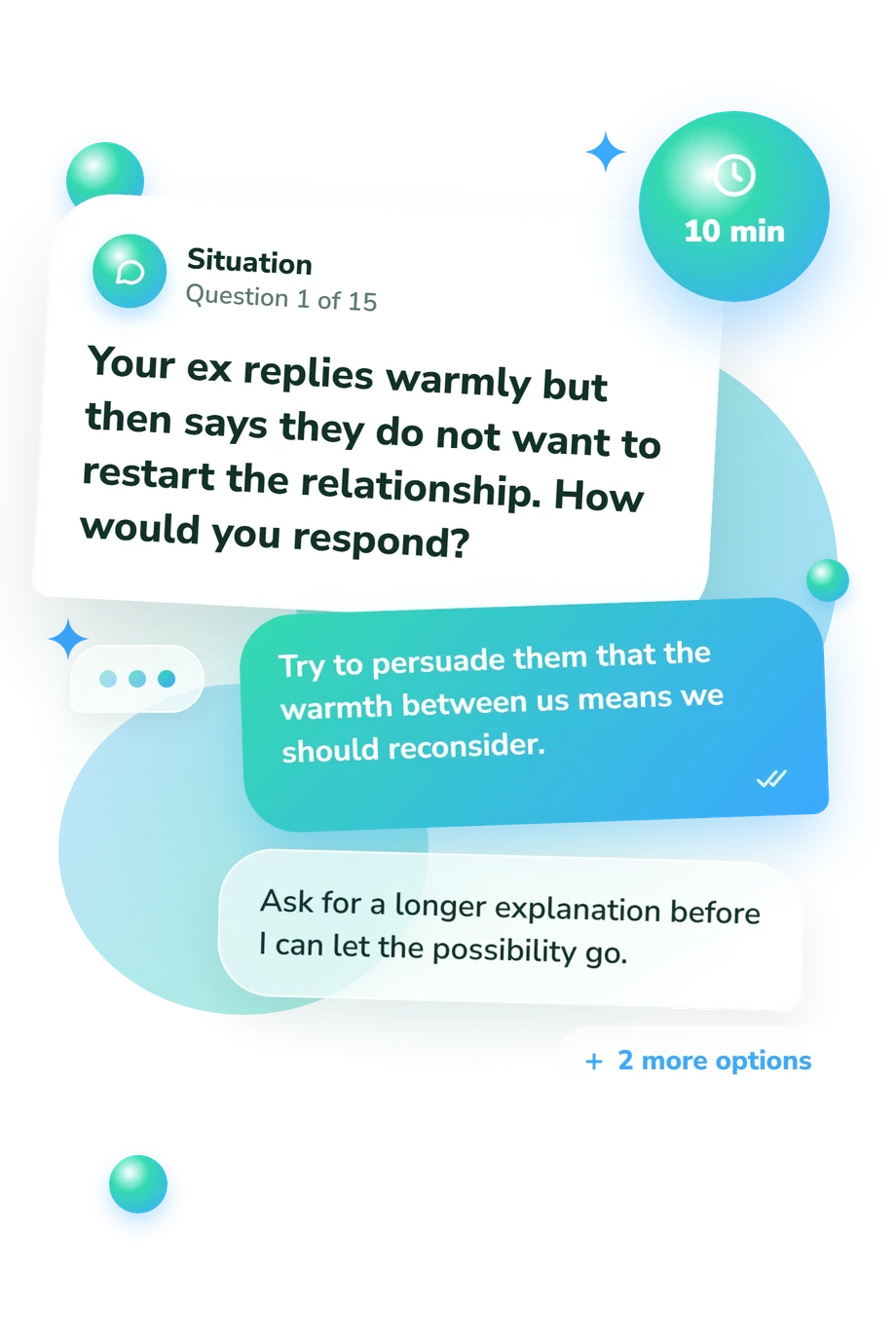
- Try to persuade them that the warmth between us means we should reconsider.
- Ask for a longer explanation before I can let the possibility go.
- Acknowledge the answer and take time before deciding whether friendship is realistic.
- Accept the boundary without treating their warmth as an invitation to keep pursuing them.
- I miss them and want immediate relief from the feeling.
- I hope their response will show that they still think about me.
- I would like a friendly exchange, though I have not defined what I want after that.
- I have a specific, calmly considered purpose that does not require a particular emotional response.
- It covers several old feelings and asks questions I hope they can resolve.
- It uses a casual opening, but I mainly hope to spark curiosity or longing.
- It gives an honest brief reason for saying hello, though the next step is not fully clear.
- It states one clear reason for contact without hiding a different desired outcome.
Should I Text My Ex Quiz - Description and methodology of the test
Because texting an ex after a breakup can be driven by hope or uncertainty, the assessment frames the decision around emotional closure, your purpose for contact, and respect for boundaries. The Should I Text My Ex Quiz is intended for anyone weighing a message after a breakup, especially when loneliness, hope, or uncertainty shapes the urge. Its result describes readiness patterns rather than predicting reconciliation.
What This Assessment Explores
These situations map onto three areas that help answer whether to text an ex:
- Boundary and Outcome Readiness (0-15) measures respect for limits and capacity to handle silence, refusal, or ambiguity. Outcome-Dependent (0-5) suggests distress may intensify; Conditional Readiness (6-10) suggests preparation may help; Flexible & Respectful (11-15) indicates acceptance without escalation.
- Emotional Closure (0-15) measures how settled you feel about the breakup, not whether you are completely over your ex. Emotionally Pulled (0-5) signals longing or pain; Mixed Ground (6-10) shows partial distance; More Settled (11-15) suggests greater emotional balance.
- Purpose for Contact (0-15) measures clarity about why you want to reach out. Relief-Seeking (0-5) points to immediate soothing; Partly Defined (6-10) shows a reaction-dependent aim; Grounded Purpose (11-15) indicates a specific reason that does not depend on your ex's response.
Methodology and Evidence Base
Each item presents a breakup-contact situation with four response options. Choose what fits you now, rather than what sounds most mature. The options contrast urgency, reassurance-seeking, hoped-for reconciliation, pausing, clear purpose, and respect for boundaries.
Responses feed the three dimensions, and the result assigns each a corresponding band. Because no item-level formula is published, do not infer equal points for every answer. A clear request for no contact should be respected regardless of the score.
The method is structured self-report reflection. Mason's study of contact with an ex-partner and post-breakup adjustment is the closest relevant published study. Dailey's work on post-dissolution ambivalence and reconciliation, with Fagundes's attachment-theory analysis, adds context for these themes. This questionnaire is an online self-reflection tool conceptually consistent with that work, not an adaptation; its scoring has not been standardized or validated by those studies.
The result offers a snapshot when considering contacting an ex after a breakup. Loneliness, social-media triggers, wishful thinking, and limited self-awareness can shape responses. It cannot establish what your ex will do or whether renewed contact will improve the relationship.
- Mason, Ashley E., David A. Sbarra, Amanda E. B. Bryan, and Lauren A. Lee (2012). Staying connected when coming apart: The psychological correlates of contact and sex with an ex-partner. Journal of Social and Clinical Psychology, 31(5), 488-507. 10.1521/jscp.2012.31.5.488
- Dailey, René M., Lingzi Zhong, Rudy Pett, and Sarah Varga (2020). Post-dissolution ambivalence, breakup adjustment, and relationship reconciliation. Journal of Social and Personal Relationships, 37(5), 1604-1625. 10.1177/0265407520906014
- Fagundes, Christopher P. (2012). Getting over you: Contributions of attachment theory for postbreakup emotional adjustment. Personal Relationships, 19(1), 37-50. 10.1111/j.1475-6811.2010.01336.x
Updated: