
Should I Get My Nipples Pierced Quiz
How the Scales are Structured
Who Usually Takes This Test?
See How You Compare
Below is a preview of how scores are typically distributed across each scale.
Example Questions From the Test
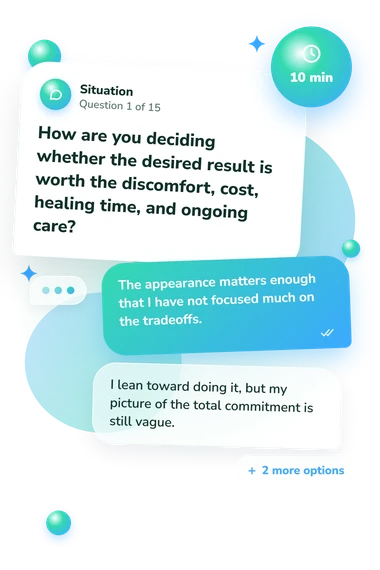
- The appearance matters enough that I have not focused much on the tradeoffs.
- I lean toward doing it, but my picture of the total commitment is still vague.
- I have weighed the main benefits and burdens, although a few questions remain.
- I can name my priorities and dealbreakers and would accept either a yes or no decision after weighing them.
- I would mostly keep my routine unchanged and see whether the snagging settles down.
- I would improvise adjustments after each snag, without changing much in advance.
- I would modify clothing and habits, monitor the area, and contact the piercer if irritation continued.
- I am prepared to prevent common snags, make sustained routine changes, and seek timely guidance rather than repeatedly disturbing the piercing.
- I have considered the advertised procedure price only.
- I have included basic jewelry but little room for later costs.
- I have allowed for quality jewelry, gratuity where customary, and a planned follow-up or downsizing visit.
- I have budgeted for the full process, including consultation, appropriate jewelry, follow-up, replacement supplies, and an unexpected professional visit.
Should I Get My Nipples Pierced Quiz - Description and methodology of the test
People considering an intimate body modification may want to separate a personal wish from outside pressure, idealized expectations, and practical readiness. The Should I Get My Nipples Pierced Quiz is intended for readers deciding whether to book and wanting to examine discomfort, healing, consent, cost, and changes in advance. It functions as a nipple piercing decision guide, showing what feels settled and what deserves more thought.
What This Assessment Explores
Questions focus on personal motivation, outside influence, discomfort, uncertain appearance or sensation, aftercare, activity conflicts, anatomy, and consent. As a should-I-get-nipple-piercings quiz, it treats readiness as more than enthusiasm: the result shows whether the choice feels personal and realistic.
The three dimensions are:
- Decision Clarity (0-15) reflects personal ownership, realistic expectations, and defined limits: 0-5 Pause & clarify; 6-10 Taking shape; 11-15 Grounded choice.
- Healing Routine Capacity (0-15) reflects whether habits and schedules can support months of variable healing: 0-5 Routine not established; 6-10 Partly prepared; 11-15 Sustainable plan.
- Professional Piercing Plan (0-15) reflects provider selection, consent, boundaries, budgeting, follow-up, and relevant disclosure: 0-5 Planning needed; 6-10 Building a plan; 11-15 Well prepared.
Together, these results show what is settled and what needs attention; a high score is not a recommendation.
Methodology and Scientific Basis
This is a structured self-report questionnaire. Each item presents a concrete scenario-such as jewelry snagging, travel or exercise conflicts, studio choice, consent, or worsening symptoms-and offers four response positions from less prepared to more considered. The should-I-pierce-my-nipples quiz format captures judgment in context rather than a general attitude.
Answers feed the three dimensions, but the questionnaire does not state how many points each option contributes or whether dimensions are equally weighted. The displayed ranges and bands are interpretive profile categories, not a scoring rule to reverse-engineer. Population norms, reliability estimates, and clinical cutoffs are not stated for this online version.
Its approach is conceptually consistent with Armstrong et al. (1995), which emphasizes informed decision-making in body piercing. Armstrong et al. (2007) and Holbrook et al. (2012) address risk reduction, hygiene, jewelry, complications, and healing. Garbin et al. (2009) adds a nipple-specific consideration concerning abnormal milk production and breastfeeding. This questionnaire is not a reproduction or validated adaptation of those publications.
Interpretation depends on honest answers and current circumstances; mood, social pressure, self-awareness, and changing plans can affect results. A profile cannot establish anatomical suitability or medical fitness, and rapidly worsening symptoms require clinical attention.
- Armstrong, Myrna L., Elaine Ekmark, and Barbara Brooks. "Body piercing: Promoting informed decision making." The Journal of School Nursing, 11(2), 20-25, 1995.
- Armstrong, Myrna L., Jerome R. Koch, Jana C. Saunders, Alden E. Roberts, and Donna C. Owen. "The hole picture: Risks, decision making, purpose, regulations, and the future of body piercing." Clinics in Dermatology, 25(4), 398-406, 2007. 10.1016/j.clindermatol.2007.05.019
- Holbrook, Jaimee, Julia Minocha, and Anne Laumann. "Body piercing: Complications and prevention of health risks." American Journal of Clinical Dermatology, 13(1), 1-17, 2012. 10.2165/11593220-000000000-00000
- Garbin, Catherine P., Jane P. Deacon, Marnie K. Rowan, Peter E. Hartmann, and Donna T. Geddes. "Association of nipple piercing with abnormal milk production and breastfeeding." JAMA, 301(24), 2550-2551, 2009. 10.1001/jama.2009.877