
Planet Quiz
How the Scales are Structured
Who Usually Takes This Test?
See How You Compare
Below is a preview of how scores are typically distributed across each scale.
Example Questions From the Test
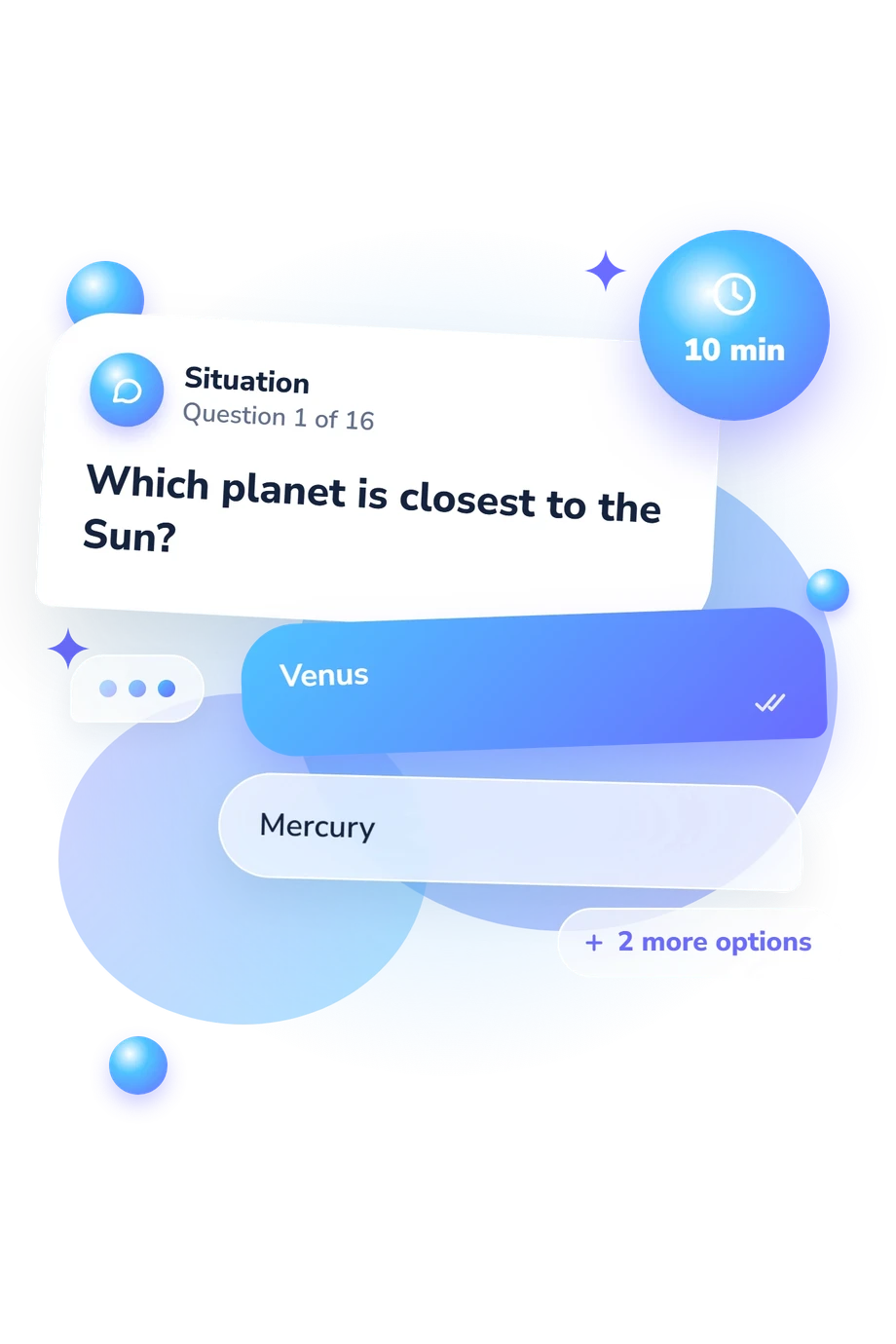
- Venus
- Mercury
- Earth
- Mars
- Jupiter
- Saturn
- Neptune
- Earth
- Neptune
- Saturn
- Jupiter
- Uranus
Planet Quiz - Description and methodology of the test
Students, curious adults, and anyone revising basic astronomy can use this assessment to check how securely they recognize the planets and their defining properties. The planet quiz turns familiar Solar System facts into a focused knowledge check. The questions in this astronomy knowledge quiz connect planetary names with order, size, composition, atmospheres, motion, rings, moons, and surface features. Results indicate an overall knowledge band and whether further review may be useful.
What This Assessment Measures
The content centers on factual recognition and comparison across the Solar System. Direct choices and short scenarios cover order, size, composition, temperature, rotation, tilt, weather, rings, moons, and surface landmarks. This planetary knowledge quiz focuses on recognizing planets, their classifications, and defining features.
The main themes are:
- Order and classification show how accurately you place planets and distinguish rocky, giant, and dwarf worlds.
- Physical properties connect atmospheres, motion, weather, rings, moons, and geology to the correct planet.
- Solar System landmarks test recognition of the Great Red Spot, Titan, Olympus Mons, and Pluto’s classification.
Planet Knowledge is scored from 0-16, with one point for each correct answer. Foundation Building (0-6) indicates emerging familiarity; Developing Knowledge (7-12) shows a useful foundation; Strong Planet Knowledge (13-16) reflects broad, accurate command of the tested properties. This educational score does not measure scientific ability.
Methodology and Evidence Base
Each item presents four answer choices, with several framed as observation or mission scenarios. This format asks you to retrieve a fact and apply it to a description, such as matching atmospheric chemistry, orbital timing, a storm, or a geological feature with the correct planet. The format suits a Solar System knowledge test.
Scoring is transparent: the total is the number of correct responses, with no stated weighting by topic or difficulty. Together, the items require recognition of planetary order, classification, physical properties, orbital and rotational behavior, atmospheric clues, and named features; they do not ask respondents to perform extended calculations or use specialist equipment.
The questionnaire is a separate online knowledge check whose content is conceptually consistent with the ASSCI and TOAST, but it is not an adaptation of either instrument.
The Pluto item follows the International Astronomical Union’s 2006 planet definition, particularly the requirement that a planet clear its orbital neighborhood. The result is best treated as a snapshot influenced by prior study, attention, guessing, and interpretation of wording.
- Sadler, Philip M., Harold Coyle, Jaimie L. Miller, Nancy Cook-Smith, Mary Dussault, and Roy R. Gould. "The Astronomy and Space Science Concept Inventory: Development and Validation of Assessment Instruments Aligned with the K-12 National Science Standards." Astronomy Education Review 8, no. 1 (2010): 010111-1. 10.3847/AER2009024
- Slater, Stephanie J. "The Development And Validation Of The Test Of Astronomy STandards (TOAST)." Journal of Astronomy & Earth Sciences Education 1, no. 1 (2015): 1-22. 10.19030/jaese.v1i1.9102
- International Astronomical Union. "Resolution B5: Definition of a Planet in the Solar System." XXVI General Assembly, Prague, 2006.
Updated: