
Evolution Quiz
How the Scales are Structured
Who Usually Takes This Test?
See How You Compare
Below is a preview of how scores are typically distributed across each scale.
Example Questions From the Test
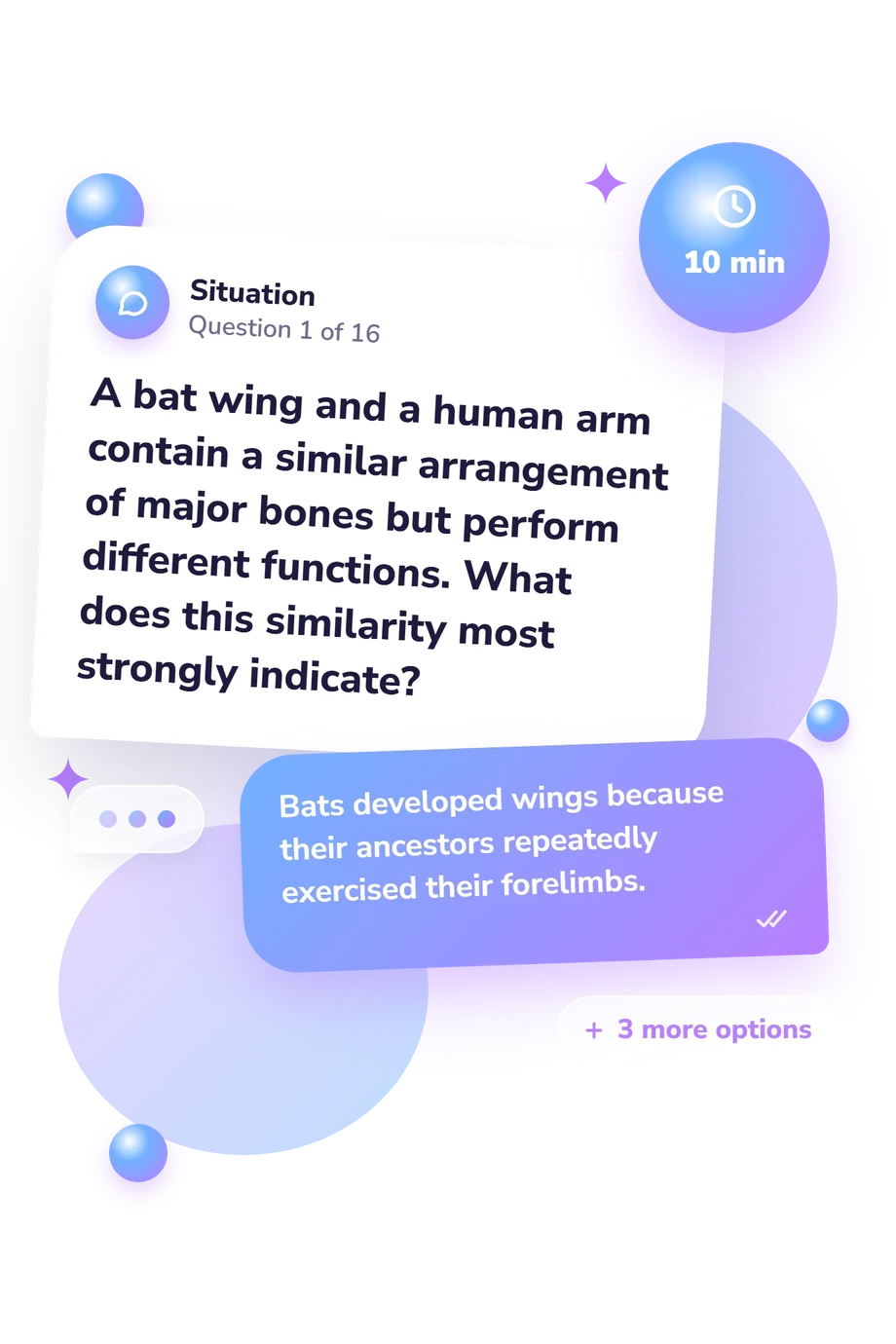
- Bats developed wings because their ancestors repeatedly exercised their forelimbs.
- The structures were inherited from a common ancestor and modified along different lineages.
- The structures evolved independently and only happen to share the same internal pattern.
- Humans and bats experience identical environmental pressures.
- Inheritance of the streamlined shape from a recent shared species
- Gene flow between shark and dolphin populations
- Convergent evolution under similar environmental pressures
- Genetic drift occurring in the same direction in both groups
- Both populations stopped evolving after their separation.
- The populations became genetically identical through gene flow.
- Reproductive isolation developed, indicating that speciation occurred.
- Natural selection always produces organisms with greater complexity.
Evolution Quiz - Description and methodology of the test
People who want to check whether core evolutionary ideas fit together can use this evolution quiz as a focused knowledge exercise. It suits learners, teachers, and curious readers who want to examine natural selection, inheritance, common ancestry, and population change. An evolution online quiz format provides a concise profile of understood concepts and points toward topics that may deserve further review.
What This Assessment Explores
Questions examine whether you can distinguish mechanisms that change allele frequencies from individual changes acquired during life. They cover common ancestry and homology, convergent evolution, speciation and reproductive isolation, fitness, gene flow, genetic drift, bottlenecks, founder effects, mutation, and forms of natural selection. As an evolution biology quiz, it asks you to apply definitions to short scenarios rather than recall isolated vocabulary.
The Evolution Knowledge scale spans 0-16 and is shown in three bands:
- Foundations to Build (0-6) indicates that you recognize some evolutionary ideas but may need to connect variation, inheritance, and population change more clearly.
- Developing Knowledge (7-12) shows that many core concepts are available to you, although some mechanisms may still be confused.
- Strong Knowledge (13-16) reflects a well-developed understanding of natural selection and related evolutionary processes.
Methodology and Scientific Basis
The questionnaire presents four answer choices for each item, with one best answer distinguishing related explanations. Its evolution-quiz questions and answers use short scenarios about populations, inheritance, evidence, and selection; you identify the mechanism that best fits each case. The result summarizes performance across selected answers. No separate weighting rule is stated, so individual contributions should not be inferred.
This is an educational concept-inventory approach rather than a personality or symptom scale. It is conceptually consistent with KAEVO 2.0 (Kuschmierz et al., 2020), a published instrument for assessing evolution knowledge. Anderson, Fisher, and Norman provide a related natural-selection concept inventory, while Furrow and Hsu (2019) discuss the teaching value of such inventories. The format keeps attention on core mechanisms instead of specialist terminology, making this a quiz about bio evolution for focused review. The questionnaire is not identified as an adaptation or standardized administration of those instruments.
Results can show secure concepts and useful review targets, but performance may vary with prior study, wording interpretation, self-awareness, and test-taking context. This is a snapshot of conceptual knowledge, not a normed measure of ability or a clinical assessment.
- Kuschmierz, Paul, Anna Beniermann, and Dittmar Graf. "Development and evaluation of the knowledge about evolution 2.0 instrument (KAEVO 2.0)." International Journal of Science Education, 42(15), 2601-2629 (2020). 10.1080/09500693.2020.1822561
- Anderson, Dianne L., Kathleen M. Fisher, and Gregory J. Norman. "Development and evaluation of the conceptual inventory of natural selection." Journal of Research in Science Teaching, 39(10), 952-978 (2002). 10.1002/tea.10053
- Furrow, Robert E., and Jeremy L. Hsu. "Concept inventories as a resource for teaching evolution." Evolution: Education and Outreach, 12, Article 2 (2019). 10.1186/s12052-018-0092-8
Updated: