
Active and Passive Voice Quiz
How the Scales are Structured
Who Usually Takes This Test?
See How You Compare
Below is a preview of how scores are typically distributed across each scale.
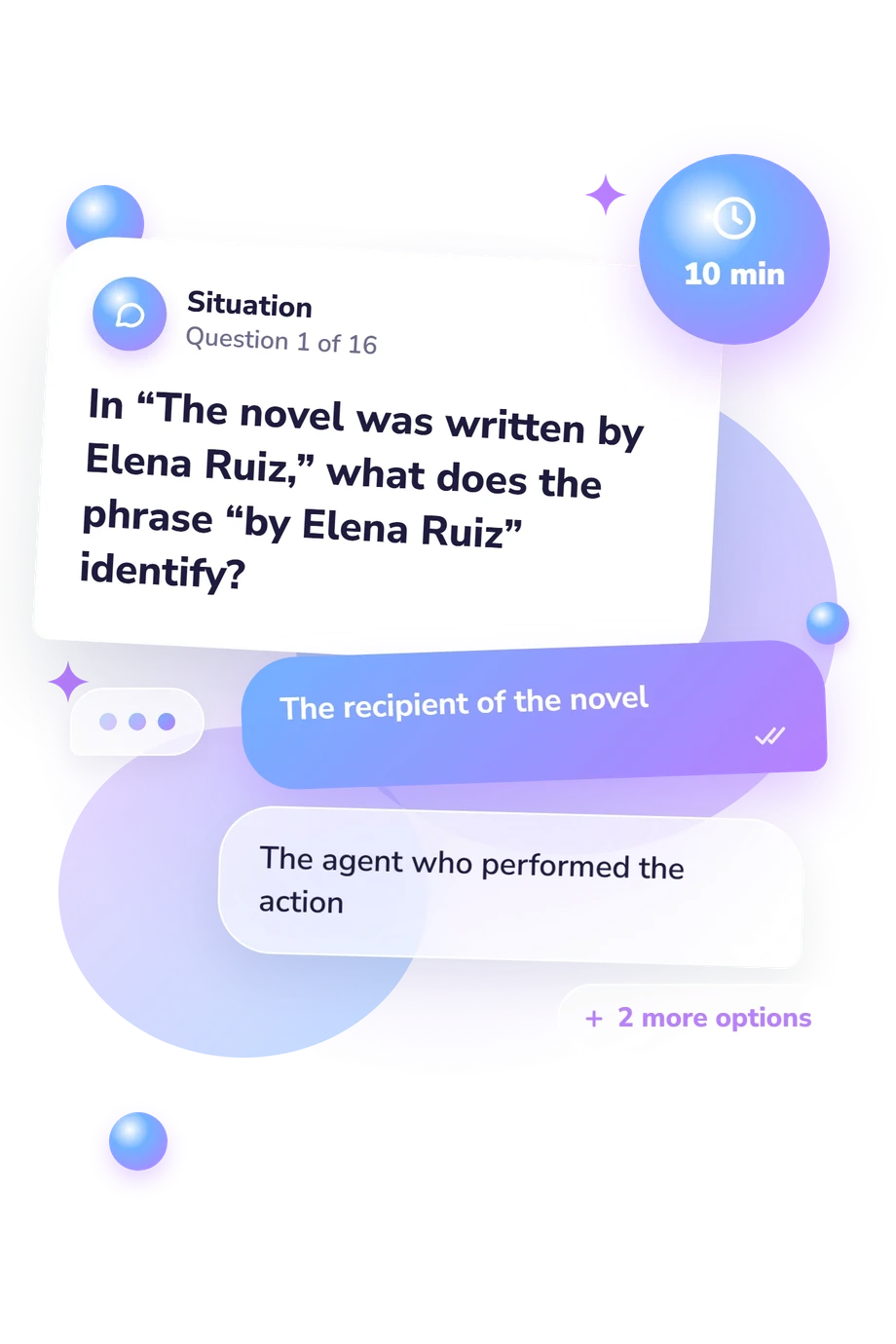
Example Questions From the Test
- The recipient of the novel
- The agent who performed the action
- The instrument used to perform the action
- The location where the action occurred
- They have completed the work ahead of schedule.
- The work has been completed ahead of schedule.
- The invitations were mailed on Monday.
- The road is being repaired this week.
- The baby slept peacefully.
- Maya opened the parcel.
- The team discussed the proposal.
- The audience applauded the performer.
Active and Passive Voice Quiz - Description and methodology of the test
Learners who want to check how accurately they identify and transform English sentence patterns can use this active and passive voice quiz as a focused grammar exercise. The active vs passive voice quiz asks them to connect an action with its participants and tense, making those relationships easier to inspect. The result points to grammar areas that deserve further practice, whether the goal is clearer writing, editing, or classroom revision.
What This Assessment Explores
Voice knowledge is tested through practical decisions, not terminology alone. Items ask learners to identify agents, recipients, objects, and when passive constructions are possible, while preserving tense and aspect in progressive, perfect, and modal forms.
Information focus is also examined: in this quiz on active and passive voice, some sentences foreground the affected participant, while others name the agent. The displayed scale, Active and Passive Voice Knowledge (0-16), has three bands:
- Foundations to build (0-6) means basic roles and voice changes need review.
- Developing control (7-12) means common patterns are recognized, but tense or omitted agents may still cause difficulty.
- Strong command (13-16) means structures are recognized and transformed accurately across varied contexts.
The assessment gives a focused profile of sentence-level grammar, not overall English ability.
Methodology and Scientific Basis
The questionnaire uses selected-response items: each prompt has four alternatives. Some questions require preserving tense and meaning in a voice change; others require identifying voice, agents, grammatical roles, or sentence structure. The items also address action versus state, transitive and intransitive verbs, and stated or omitted agents.
Scoring uses the number of correct answers, so the result reports performance on these grammar decisions. For learners using this voice grammar quiz, the score can indicate whether work is needed with verb forms, sentence roles, or information focus.
The Bielak et al. (2013) study provides the closest conceptual evidence base, linking voice teaching with a cognitive-grammar view of events and participant roles. This questionnaire is conceptually consistent with that work, not an adaptation of its study instrument. Huddleston and Pullum, together with Quirk and colleagues, support the distinctions used here, including voice, transitivity, tense, and aspect.
Taken together, the score records how successfully the learner handles the tested choices, including tense, participant roles, and voice. Selected answers cannot capture spontaneous speech or writing, and performance may vary with attention, terminology familiarity, or sentence interpretation.
- Bielak, Jakub, Mirosław Pawlak, and Anna Mystkowska-Wiertelak. "Teaching the English active and passive voice with the help of cognitive grammar: An empirical study." Studies in Second Language Learning and Teaching, vol. 3, no. 4, 2013, pp. 581-619. 10.14746/ssllt.2013.3.4.7
- Huddleston, Rodney D., and Geoffrey K. Pullum. The Cambridge Grammar of the English Language. Cambridge University Press, 2002. ISBN 978-0-521-43146-0
- Quirk, Randolph, Sidney Greenbaum, Geoffrey Leech, and Jan Svartvik. A Comprehensive Grammar of the English Language. Longman, 1985. ISBN 0-582-51734-6
Updated: