
Street Smart Quiz
How the Scales are Structured
Who Usually Takes This Test?
See How You Compare
Below is a preview of how scores are typically distributed across each scale.
Example Questions From the Test
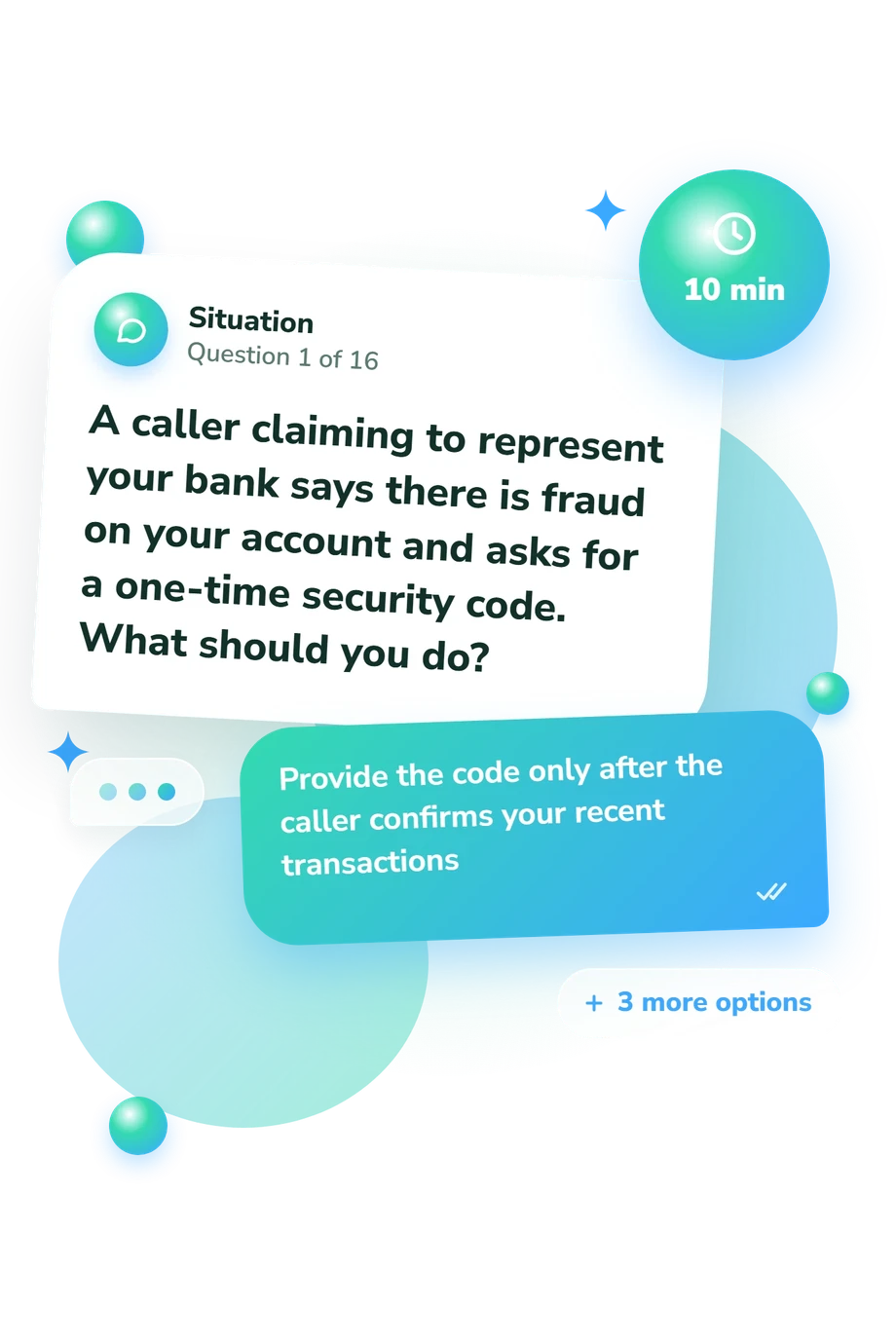
- Provide the code only after the caller confirms your recent transactions
- Ask the caller to send an email containing the bank’s logo first
- End the call and contact the bank through the number on your card or its official app
- Give an incorrect code to test whether the caller already knows it
- Use the public network but close every other app first
- Use mobile data or wait for a trusted connection instead of accessing the account on open Wi-Fi
- Proceed in a private browser window so the connection cannot view the traffic
- Use the network only if its name matches the venue’s name
- In an outer backpack pocket so it is easy to reach
- In a back trouser pocket covered by a jacket
- In a closed front pocket or zipped bag held close and in view
- In your hand so you can continually check that it is there
Street Smart Quiz - Description and methodology of the test
People who want to strengthen everyday judgment can use this assessment to examine how they respond when information is incomplete, pressure is present, or a situation feels unfamiliar. The Street Smart Quiz focuses on practical safety choices rather than academic ability. It asks whether you are street smart through a focused quiz on the situations presented, rather than making a general claim about conduct.
What This Assessment Explores
The questionnaire examines practical safety knowledge: spotting warning signs, choosing lower-risk actions, and knowing when to verify, create distance, or seek help. Scenarios fit travel, social events, errands, and unfamiliar settings.
The questions cover these scenario themes:
- Scam recognition covers pressure tactics that can signal fraud.
- Digital and financial security covers protection of accounts, cards, and devices.
- Public-space awareness covers managing belongings, drinks, and crowds.
- Navigation and contingency planning covers preparation for weak service or low battery.
- Emergency and transport judgment covers verifying requests and choosing official help.
A result may help answer the personal question of whether I am street smart in this quiz, but this assessment is narrower. It describes safety knowledge in these scenarios. Street Smart Knowledge is reported as 0-16: Foundation (0-6), Developing (7-12), or Strong (13-16). Stronger performance suggests more consistent recognition of precautions; the educational score cannot guarantee safety when circumstances differ.
Methodology and Scientific Basis
Each item presents a brief everyday scenario with four possible actions. The respondent identifies the option that is most appropriate, safest, or most sensible in that situation, so the format examines applied judgment rather than factual recall.
The closest conceptual reference is the Xiong et al. safety-cognition assessment framework. This questionnaire is conceptually consistent with that framework’s emphasis on recognizing hazards and selecting protective responses. Wagner and Sternberg’s practical-intelligence research, together with Sternberg, Wagner, Williams, and Horvath’s common-sense work, provides a compatible framework for understanding knowledge expressed through action.
The questionnaire reports one displayed overall result rather than separate scores for the scenario themes. Its format as a personal safety quiz keeps the interpretation tied to practical safety knowledge in the presented scenarios, not general intelligence. Because the questionnaire has no stated standardization or diagnostic validation, the score is not a population norm or clinical threshold.
Hypothetical choices can be influenced by current attention, stress, memory, and confidence about likely behavior, and may not predict conduct in real situations. The result is best read as a structured reflection on preparation, verification, and appropriate help-seeking in the situations presented.
- Xiong, Y., Zhang, C., Qi, H., Zhang, R., and Zhang, Y. (2022). How to Measure the Safety Cognition Capability of Urban Residents? An Assessment Framework Based on Cognitive Progression Theory. Frontiers in Psychology, 13, 707172. 10.3389/fpsyg.2022.707172
- Wagner, R. K., and Sternberg, R. J. (1985). Practical intelligence in real-world pursuits: The role of tacit knowledge. Journal of Personality and Social Psychology, 49(2), 436-458. 10.1037/0022-3514.49.2.436
- Sternberg, R. J., Wagner, R. K., Williams, W. M., and Horvath, J. A. (1995). Testing common sense. American Psychologist, 50(11), 912-927. 10.1037/0003-066X.50.11.912
Updated: