
METAR Quiz
How the Scales are Structured
Who Usually Takes This Test?
See How You Compare
Below is a preview of how scores are typically distributed across each scale.
Example Questions From the Test
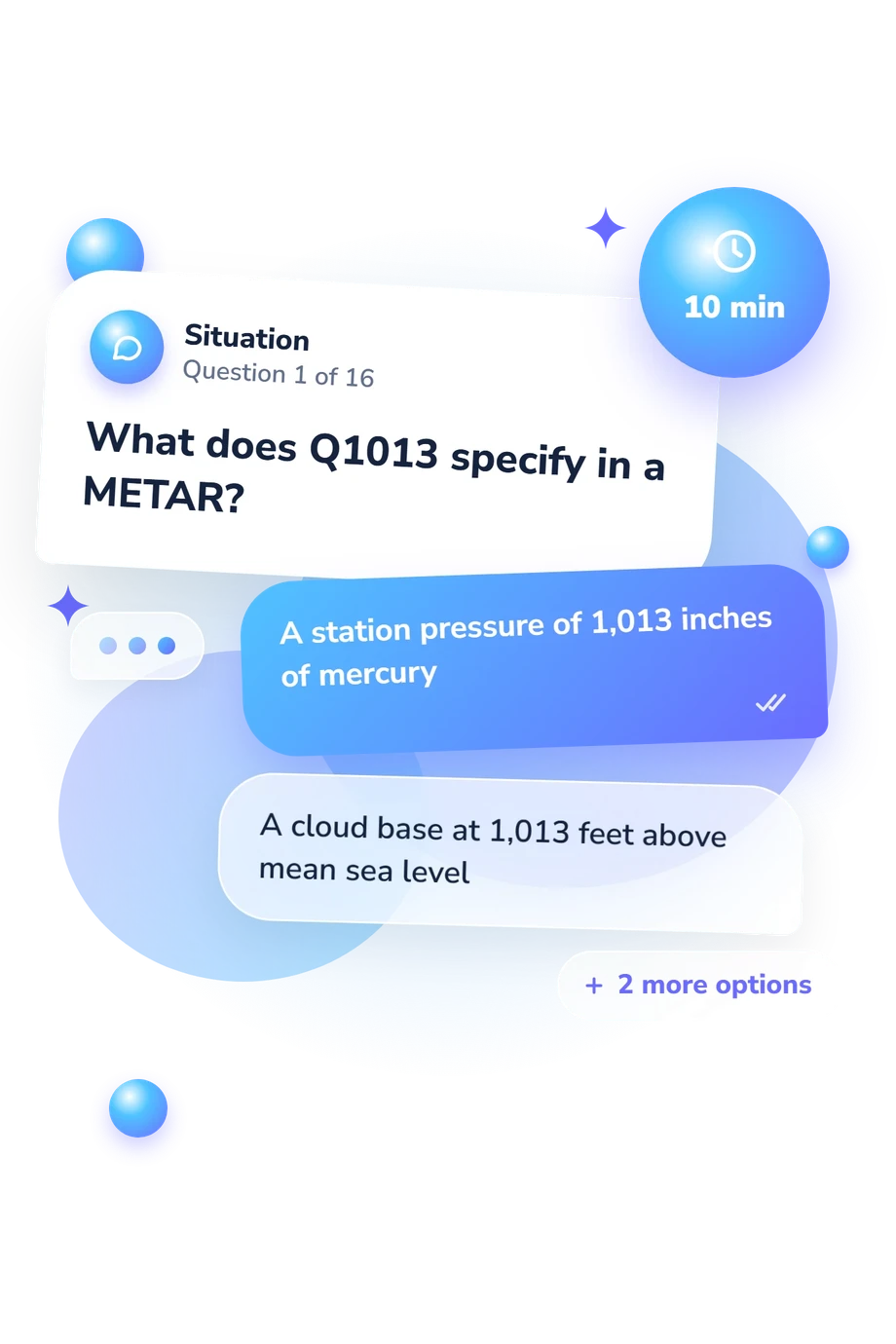
- A station pressure of 1,013 inches of mercury
- A cloud base at 1,013 feet above mean sea level
- A pressure tendency increase of 10.13 hectopascals
- A QNH altimeter setting of 1,013 hectopascals
- The station elevation is 2,992 feet
- The altimeter setting is 2,992 hectopascals
- The altimeter setting is 29.92 inches of mercury
- The pressure has risen 29.92 hectopascals
- To publish permanent information about an airport
- To forecast expected aerodrome weather over several hours
- To report observed weather at an aerodrome at a specified time
- To warn only of hazardous weather along an entire route
METAR Quiz - Description and methodology of the test
Pilots, aviation students, and weather enthusiasts who want to read aerodrome reports more confidently can use the METAR Quiz as a focused check of practical decoding skills. As a METAR knowledge test, it examines how well you recognize standard groups and apply them to routine observations, from wind and visibility to pressure, cloud, temperature, and trend information. The result points to areas that deserve further study.
What This Assessment Measures
The questionnaire covers the conventions used to interpret observed aerodrome weather. This METAR decoding quiz tests whether you can connect coded groups with their meaning and distinguish similar formats.
METAR Knowledge is the sole scale, scored from 0-16. Its bands are Foundation to build (0-6), Developing interpreter (7-12), and Strong METAR knowledge (13-16). A higher result indicates more consistently correct recognition of the tested codes.
The main content areas are:
- Wind and time groups show whether you can read direction, speed, gusts, and UTC time.
- Visibility and RVR groups cover prevailing visibility, runway visual range, and trend symbols.
- Cloud and obscuration groups test coverage, height, CAVOK, and vertical visibility.
- Pressure, temperature, weather, and automation groups cover QNH, altimeter formats, negative values, dew point, AUTO, and NOSIG.
Methodology and Evidence Base
Each item offers four answer choices, and the respondent selects the interpretation that best matches the METAR group. One point is awarded for each correct answer, so the total summarizes performance across the tested knowledge areas rather than a weighted profile. Missed items can indicate code families worth revisiting.
Its evidence base is conceptually aligned with Aviation Weather Knowledge Assessment, which examined aviation-weather knowledge and pilots’ interpretation of weather products. The questionnaire is an online educational check whose score is presented for learning, not as a standardized operational examination. ICAO reporting conventions and examples also align with the TAF/METAR/SPECI assessment and FAA guidance on METAR structure and coded elements.
Performance on this METAR practice quiz may vary with recent study, familiarity with U.S. or ICAO formats, attention, and testing context. The bands are educational labels rather than an operational qualification; use the result to guide study and verify real aviation weather with current official products and applicable guidance.
- Blickensderfer, Beth; Lanicci, John; Guinn, Thomas A.; et al. (2019). Combined Report: Aviation Weather Knowledge Assessment & General Aviation (GA) Pilots’ Interpretation of Weather Products. Embry-Riddle Aeronautical University.
- Novotny, J., Dejmal, K., Repal, V., Gera, M., & Sladek, D. (2021). Assessment of TAF, METAR, and SPECI Reports Based on ICAO ANNEX 3 Regulation. Atmosphere, 12(2), 138. 10.3390/atmos12020138
- Federal Aviation Administration. (2026). Aviation Weather Handbook, FAA-H-8083-28B. U.S. Department of Transportation.
- Federal Aviation Administration. (2026). Aeronautical Information Manual, Chapter 7, Section 1, Paragraph 7-1-28: Key to Aerodrome Forecast and Aviation Routine Weather Report (METAR).
Updated: