
Am I Addicted to Video Games Quiz
How the Scales are Structured
Who Usually Takes This Test?
See How You Compare
Below is a preview of how scores are typically distributed across each scale.
Example Questions From the Test
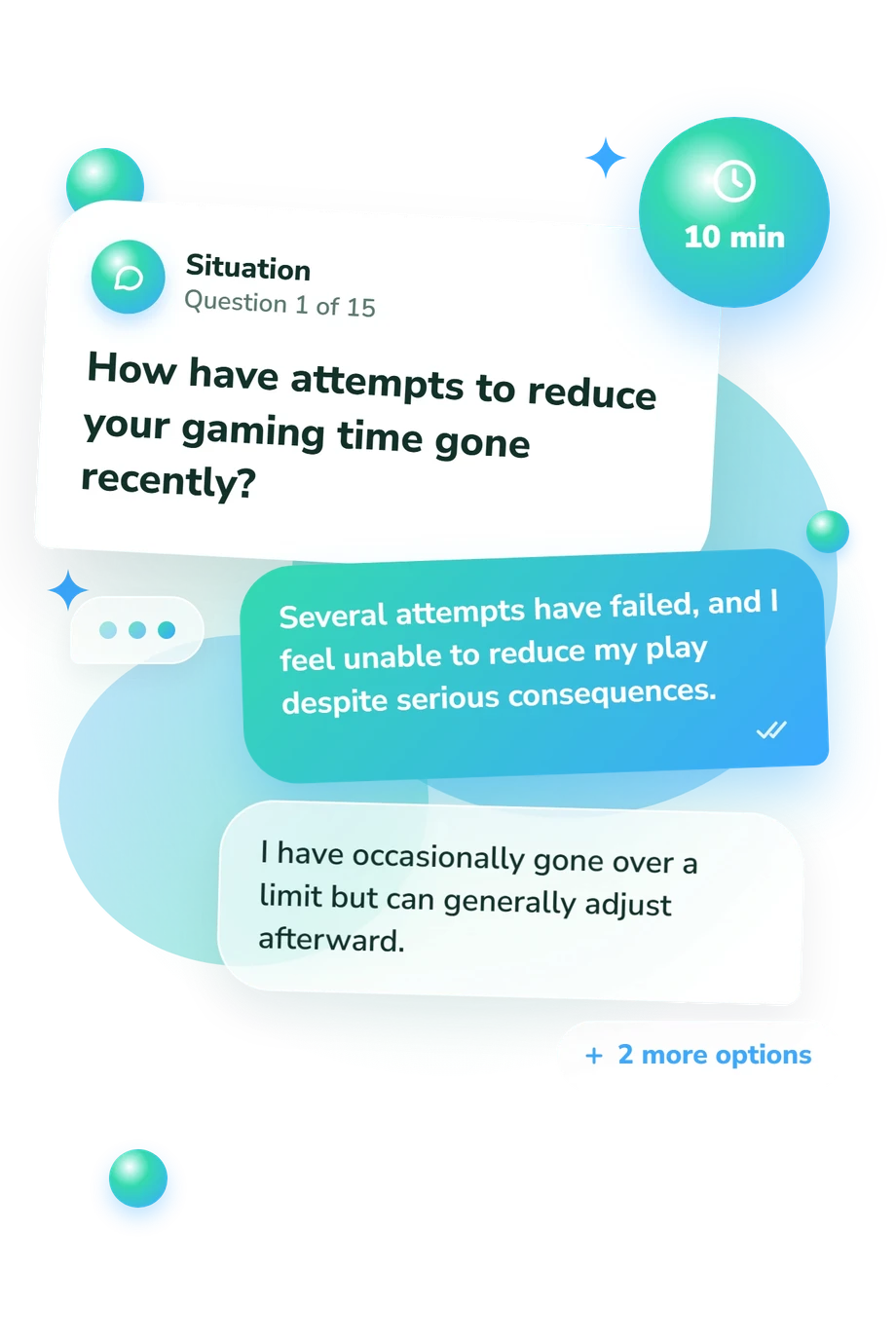
- Several attempts have failed, and I feel unable to reduce my play despite serious consequences.
- I have occasionally gone over a limit but can generally adjust afterward.
- The limits I choose are generally manageable for me.
- I repeatedly break my limits and find reducing play much harder than expected.
- I can describe it fairly accurately without needing to hide the extent.
- I sometimes round the time down because I feel awkward about it.
- I regularly conceal sessions, purchases, or consequences to prevent others from knowing.
- I have used serious deception, threats, or another person's resources to keep my gaming hidden or available.
- I usually stop around the planned time without much internal struggle.
- I sometimes continue for a short while before stopping.
- I often play much longer than planned and have trouble pulling away.
- I repeatedly cannot stop even when an urgent obligation or safety need requires it.
Am I Addicted to Video Games Quiz - Description and methodology of the test
People who are worried that gaming is becoming difficult to control can use the Am I Addicted to Video Games Quiz to organize what they are noticing. It suits someone reflecting on their own play, especially when gaming competes with responsibilities, relationships, sleep, or emotional coping. This gaming addiction quiz can turn vague concern into a clearer profile of patterns worth examining.
What This Assessment Explores
The questions focus on when play becomes hard to regulate or begins to displace other needs. By asking about control, coping, and consequences, this video game addiction quiz produces a three-part profile rather than reducing concern to one label.
The dimensions report these patterns:
- Control and Preoccupation (0-15) shows difficulty limiting play, stopping as intended, or redirecting gaming thoughts; Review complete (0), Some signal (1-2), Action signal (3-15).
- Coping and Continued Use (0-15) reflects gaming for emotional escape and continuing, hiding, or escalating play despite consequences; Review complete (0), Some signal (1-2), and Action signal (3-15).
- Daily Life Impact (0-15) captures effects on sleep, responsibilities, relationships, physical needs, and valued activities; Review complete (0), Some signal (1-2), Action signal (3-15).
Read the profile with the situations behind the answers: a concerning experience can matter even if another area is low.
Methodology and Scientific Basis
As a structured self-report, each item presents four response choices describing increasing levels of difficulty, consequence, or loss of flexibility. The result screen presents separate scores for the three dimensions. A single response scored 3 overrides the total and is treated as an action signal within its dimension, so totals should not erase a serious endorsed experience.
The questionnaire is conceptually consistent with the Gaming Disorder Test (GDT; Pontes et al., 2021), and its themes overlap with the IGDS9-SF developed by Pontes and Griffiths (2015). It is not presented as an adaptation, reproduction, or validation of either published instrument. This gaming disorder self-assessment is an online reflective profile with unvalidated bands, not a standardized diagnostic measure.
Interpretation should account for response bias, current stress, sleep, responsibilities, and the respondent’s self-awareness when reporting concealment or consequences. Examine the individual answers to identify which routines, relationships, or coping patterns need attention, then choose one practical change to try first.
- Pontes, H. M., Schivinski, B., Sindermann, C., Li, M., Becker, B., Zhou, M., & Montag, C. (2021). Measurement and Conceptualization of Gaming Disorder According to the World Health Organization Framework: the Development of the Gaming Disorder Test. International Journal of Mental Health and Addiction, 19, 508-528. DOI 10.1007/s11469-019-00088-z
- Pontes, H. M., & Griffiths, M. D. (2015). Measuring DSM-5 internet gaming disorder: development and validation of a short psychometric scale. Computers in Human Behavior, 45, 137-143. DOI 10.1016/j.chb.2014.12.006
Updated: