
What Pride Flag Am I Quiz
How the Scales are Structured
Who Usually Takes This Test?
See How You Compare
Below is a preview of how scores are typically distributed across each scale.
Example Questions From the Test
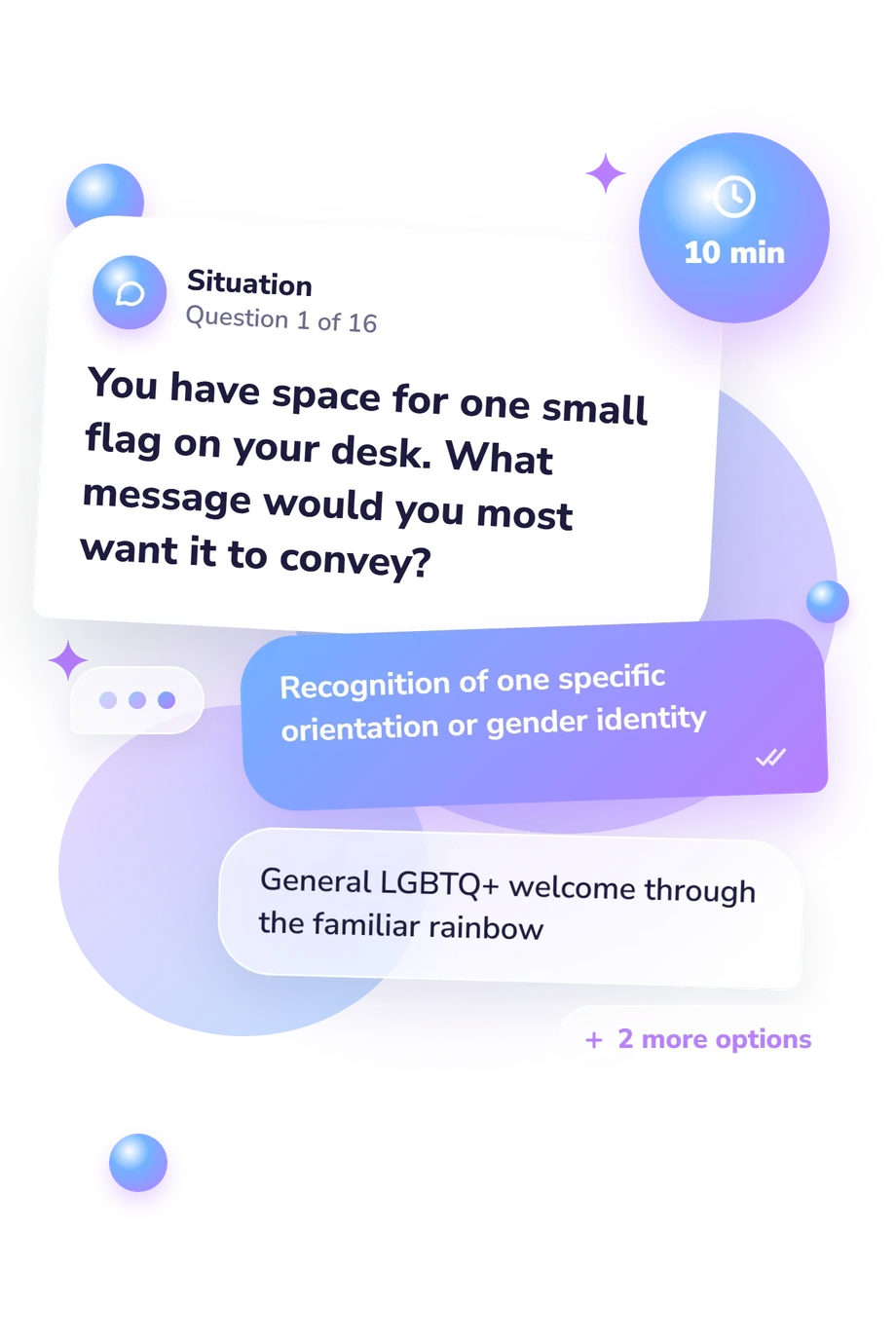
- Recognition of one specific orientation or gender identity
- General LGBTQ+ welcome through the familiar rainbow
- A personal mixture of tradition, identity, and changing community stories
- Broad pride with explicit attention to inclusion, solidarity, and progress
- My main connection to Pride comes through attraction, not gender
- I value gender diversity while preferring a different symbol for myself
- I appreciate room to question or move beyond fixed gender expectations
- Gender outside or beyond an exclusively male-or-female framework feels personally significant
- Colors linked to my orientation rather than my gender
- A broad rainbow without a specific gender message
- A personal palette that leaves room for gender exploration
- The yellow, white, purple, and black of the nonbinary flag
What Pride Flag Am I Quiz - Description and methodology of the test
People who want to connect a Pride symbol with personal experience can use the What Pride Flag Am I Quiz as a guided reflection on identity, visibility, and community meaning. It suits anyone curious about which designs feel resonant, whether they already use a label or are still exploring. It works as a what lgbtq flag am i quiz by focusing on symbolic connection.
What This Assessment Explores
The questionnaire examines which Pride designs feel meaningful in situations involving attraction, gender, visibility, belonging, inclusion, solidarity, and progress. Its result maps your strongest symbolic connections, answering the what pride flag are you quiz question without turning them into an identity label.
The four displayed scales are:
- Bisexual Pride Flag (0-12) reflects attraction beyond one gender; bands: Other-symbol connection (0-4), Meaningful overlap (5-8), Bisexual flag affinity (9-12).
- Nonbinary Pride Flag (0-12) reflects gender flexibility beyond a strict binary; bands: Different identity focus (0-4), Beyond-binary resonance (5-8), Nonbinary flag affinity (9-12).
- Progress Pride Flag (0-12) reflects inclusion, solidarity, visibility, and progress; bands: Different focal point (0-4), Inclusive connection (5-8), Progress-centered affinity (9-12).
- Rainbow Pride Flag (0-12) reflects broad LGBTQ+ welcome; bands: Specific-symbol pull (0-4), Umbrella resonance (5-8), Rainbow anchor (9-12).
Methodology and Evidence Base
Each item presents a Pride-related situation with four choices covering attraction, gender, umbrella belonging, layered identity, or progress. The online questionnaire does not publish a point-by-point conversion rule; its 0-12 results therefore function as descriptive bands, not population norms.
This structure makes the which pride flag am i quiz result a comparison of symbolic affinity rather than a label. It uses structured self-report and Pride semiotics, asking how a symbol’s message fits your experience.
Wolowic et al. (2017) is the closest conceptual anchor for its focus on how LGBTQ youth interpret Pride symbols. Matsick et al. (2020) links rainbow symbolism with belonging and attitudes online, while Kruk et al. (2026) examines Pride flags as identity-safety cues. The questionnaire is conceptually consistent with these findings, but it is an online reflection rather than a reproduction of their published instruments.
Because self-report is shaped by current experiences, familiarity with flag histories, and self-awareness, interpret the outcome as a snapshot that can inform reflection on community messages or symbol choice, not as a determination of your orientation, gender, or values.
- Wolowic, Jennifer M., Laura V. Heston, Elizabeth M. Saewyc, Carolyn Porta, and Marla E. Eisenberg. Chasing the rainbow: lesbian, gay, bisexual, transgender and queer youth and pride semiotics. Culture, Health & Sexuality 19, no. 5 (2017): 557-571. 10.1080/13691058.2016.1251613
- Matsick, Jes L., Lizbeth M. Kim, and Mary Kruk. Facebook LGBTQ Pictivism: The Effects of Women’s Rainbow Profile Filters on Sexual Prejudice and Online Belonging. Psychology of Women Quarterly 44, no. 3 (2020): 342-361. 10.1177/0361684320930566
- Kruk, Mary, Emerson Todd, Jude T. Sullivan, and Jes L. Matsick. Pride or Profit: Assessing the Authenticity of the Pride Flag as an Identity Safety Cue for LGBTQ+ Americans. Journal of Social Issues 82, no. 2 (2026): e70062. 10.1111/josi.70062
Updated: