
AP Psych Quiz
How the Scales are Structured
Who Usually Takes This Test?
See How You Compare
Below is a preview of how scores are typically distributed across each scale.
Example Questions From the Test
- Confirmation bias
- The availability heuristic
- Functional fixedness
- The representativeness heuristic
- Performing a well-practiced motor skill
- Maintaining automatic heart and breathing functions
- Detecting basic edges in the visual field
- Forming new explicit long-term memories
- State-dependent memory
- Retroactive interference
- Proactive interference
- The spacing effect
AP Psych Quiz - Description and methodology of the test
Students reviewing introductory psychology can use the AP Psych Quiz to check how securely they recognize core concepts before planning further study. Learners preparing for class assessments can use this AP psychology quiz to revisit foundational units and judge whether more review is needed. The result summarizes sampled knowledge across research methods, biological processes, learning, memory, development, and social behavior.
What This Assessment Explores
Items sample recognition and application in introductory psychology: research methods, biological bases, learning, memory, development, and social behavior. As a psychology concept quiz, it favors choosing the best explanation from four options, so the result reflects performance on the concepts represented here rather than written expression or every topic in the course.
The result uses one scale, AP Psychology Knowledge (0-16), with these displayed bands:
- Foundation to Build (0-6) shows that core ideas need more review and application practice.
- Developing Command (7-12) shows understanding of many concepts with some areas still needing targeted review.
- Strong Command (13-16) shows broad applied understanding of the sampled concepts and a basis for continued course-wide practice.
Methodology and Evidence Base
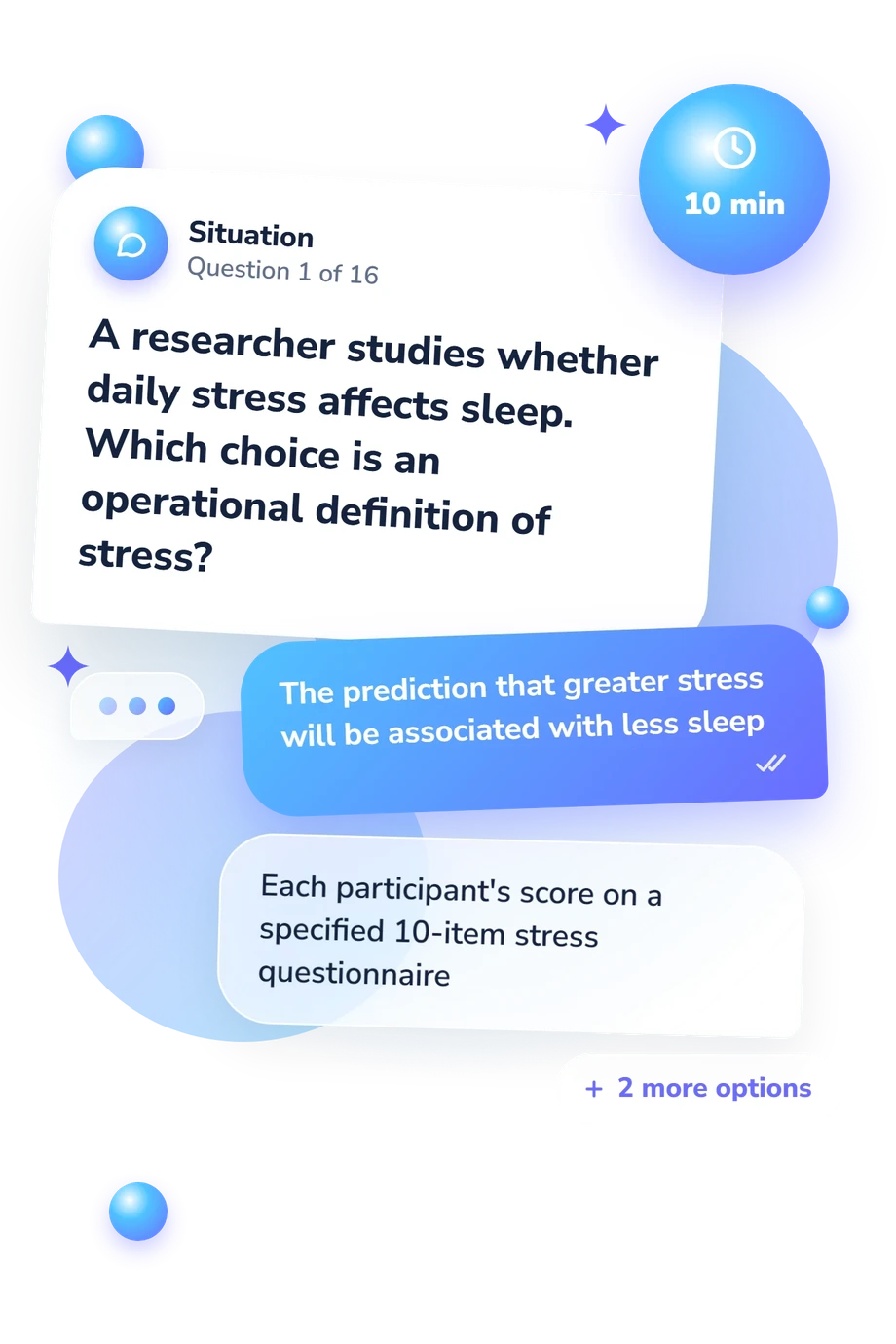
Each item presents a scenario, definition, or research finding with four answer choices. The groups cover scientific inquiry, biological bases, learning, memory, development, and social behavior, asking you to distinguish related terms or apply a principle to an example. Learners can use the four-choice format as an AP psychology practice quiz because it requires recognition and application of concepts to brief examples.
The questionnaire reports one result but states no weighting, penalty, or correction rule. It can guide review without implying an exam grade or probability of success.
The sampled concepts are conceptually consistent with the AP Psychology Test discussed in Stricker and Emmerich’s study. The 2024 College Board course framework, Myers’ AP course textbook, and American Psychological Association’s curriculum standards provide curricular context rather than validation of this questionnaire.
The aggregate score shows how accurately you answered the sampled content, but it cannot represent the full course or predict performance on every AP task. Results can vary with prior coursework, recent study, familiarity with examples, and attention on the day. This practice result is not an official AP score or exam-score prediction.
- Stricker, Lawrence J., and Walter Emmerich. (1997). Possible Determinants of Gender DIF on the Advanced Placement Psychology Test: Familiarity, Interest, and Emotional Reaction. ETS Research Report Series, 1997(2), i-51. 10.1002/j.2333-8504.1997.tb01745.x
- College Board. (2024). AP Psychology Course and Exam Description (Course Framework V.1). College Board.
- Myers, David G., C. Nathan DeWall, and Elizabeth Yost Hammer. (2024). Myers' Psychology for the AP Course (4th ed.). Macmillan Learning.
- American Psychological Association. (2022). National Standards for High School Psychology Curricula. American Psychological Association.
Updated: