
Magazine Quiz
How the Scales are Structured
Who Usually Takes This Test?
See How You Compare
Below is a preview of how scores are typically distributed across each scale.
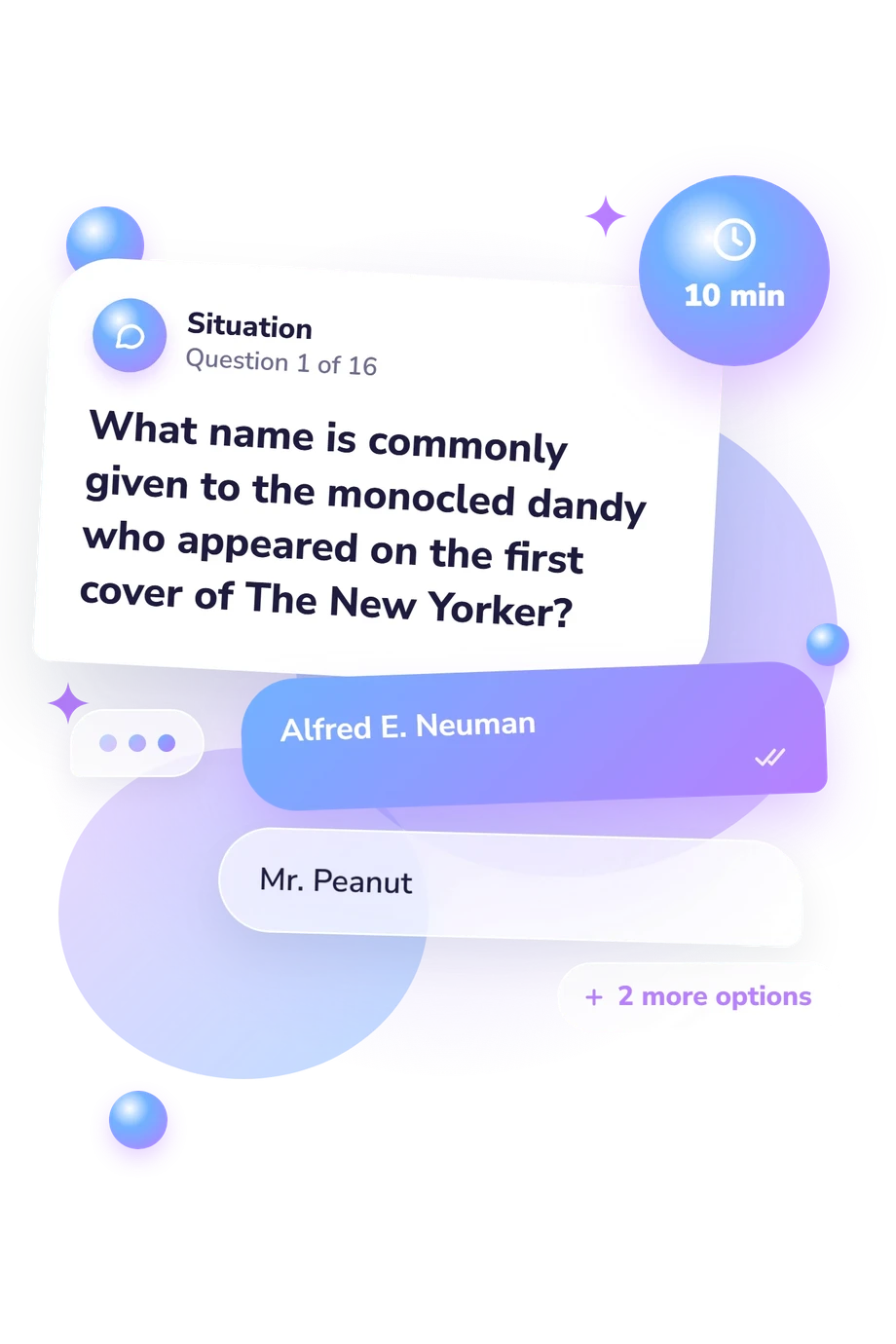
Example Questions From the Test
- Alfred E. Neuman
- Mr. Peanut
- Eustace Tilley
- Uncle Sam
- A byline
- A deck
- A running head
- A cover line
- The New Yorker
- The Atlantic Monthly
- The American Mercury
- The New York Review of Books
Magazine Quiz - Description and methodology of the test
Readers who want a quick, structured way to check their familiarity with magazines can use this magazine quiz as a knowledge-focused self-assessment. It suits curious readers, students, aspiring editors, writers, librarians, and publishing professionals who want to identify what they know and what deserves review. As a magazine trivia quiz, it offers a practical snapshot of recall and recognition without turning the result into a personality judgment.
What This Assessment Measures
Questions span notable publications, magazine history, editorial vocabulary, issue organization, and practical conventions linking publishers, readers, and advertisers. A magazine knowledge quiz like this checks recall and applied understanding across the field rather than expertise in one title or job.
The main areas represented are:
- Publication history identifies titles, dates, notable covers, mascots, and recurring features.
- Editorial vocabulary tests terms such as cover lines, departments, mastheads, and letters to the editor.
- Publishing practice covers serial identifiers, schedules, media kits, cover dates, and issue planning.
- Cultural recognition addresses familiar magazine traditions and influential publications.
The combined result shows how confidently you recognize the language and conventions tested here. A higher score indicates broader command of these facts and concepts; a lower score highlights topics for further reading rather than a fixed ability or professional ranking.
Methodology and Evidence Base
Each item presents four answer choices and asks for a specific identification, definition, historical association, or publishing practice. In a magazine publishing quiz of this format, the task measures selected knowledge rather than agreement with statements about the respondent.
The response pattern is summarized on one Magazine Knowledge scale from 0-16. Its bands are Browsing the basics (0-6), Informed reader (7-12), and Publication expert (13-16). These labels describe the breadth of knowledge shown, not clinical categories or formal professional credentials.
The content is conceptually consistent with publishing principles discussed by Johnson and Prijatel (2013), including magazine structure, editorial roles, production, circulation, and audiences. McKay (2013) adds a professional framework for terminology, planning, and commercial practice. These sources support the tested subject matter, but the online questionnaire is not presented as a standardized adaptation of either book.
Interpretation depends on honest recall and familiarity with English-language magazine culture and industry conventions. Education, current interests, and exposure to particular titles can affect performance, while fixed choices cannot capture every publishing variation. Treat the result as a learning snapshot, with individual answers providing more direction than the band alone.
- Johnson, Sammye, and Patricia Prijatel. The Magazine from Cover to Cover. 3rd ed. New York: Oxford University Press, 2013. ISBN 9780199829842.
- McKay, Jenny. The Magazines Handbook. 3rd ed. London: Routledge, 2013. DOI 10.4324/9781315110714.
Updated: