
Who Is My Crush Quiz
How the Scales are Structured
Who Usually Takes This Test?
See How You Compare
Below is a preview of how scores are typically distributed across each scale.
Example Questions From the Test
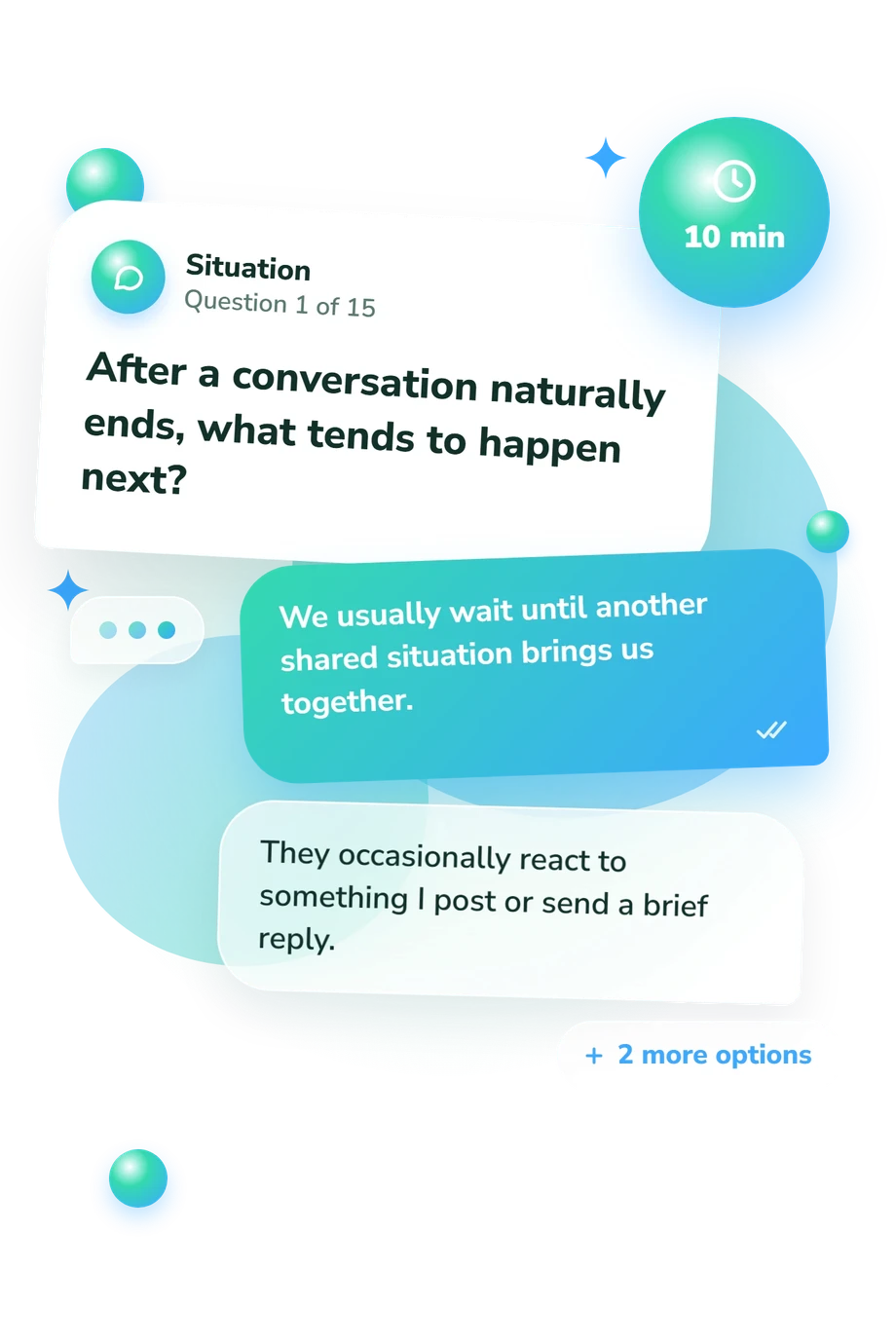
- We usually wait until another shared situation brings us together.
- They occasionally react to something I post or send a brief reply.
- They sometimes follow up with something connected to our conversation.
- They regularly begin a fresh conversation or invent a reason to reconnect.
- Their attention is often divided between me and what is happening around us.
- They focus on me while I am speaking, then return to the wider setting.
- They stay oriented toward me and maintain engaged attention.
- They repeatedly seek eye contact, shared smiles, or comfortable closeness with me.
- I start nearly all of them.
- I start most, though they occasionally reach out first.
- We initiate conversations in roughly equal measure.
- They often reach out first or find a reason to contact me.
Who Is My Crush Quiz - Description and methodology of the test
Readers making sense of developing attraction can use the Who Is My Crush Quiz to organize observable behavior instead of treating one memorable exchange as proof. It is designed for anyone interpreting mixed signals in dating situations, including conversations, group settings, changing contact, and tentative plans with someone they like. The result separates patterns from moments shaped by friendliness or circumstance, giving you a clearer basis for respectful communication.
What This Assessment Explores
Rather than producing a yes-or-no verdict, this questionnaire organizes romantic behavior patterns described by the items into three related dimensions. The prompts examine attention, eye contact, humor, personal disclosure, follow-up, planning, consistency, and directness. Together, these themes separate ordinary friendliness from recurring, reciprocal signs that may support romantic potential.
The three result dimensions are:
- Clarity and Follow-Through (0-15) shows whether words, plans, contact, and direct communication form a consistent pattern: Little evidence (0-5), Encouraging but unclear (6-10), or Clear and consistent (11-15).
- Personal Warmth and Chemistry (0-15) reflects whether interactions feel neutral, personally warm, or mutually flirtatious: Friendly/Neutral (0-5), Possible Spark (6-10), or Noticeable Chemistry (11-15).
- Reciprocal Initiative (0-15) indicates how much the other person helps create contact and shared time: Mostly prompted (0-5), Shared momentum (6-10), or Strong initiative pattern (11-15).
Methodology and Scientific Basis
Methodologically, this questionnaire is a self-report tool using concrete social situations and reciprocal interest signals. Each prompt offers four ordered answer choices, moving from little or unclear evidence toward more direct, consistent, or reciprocal behavior. The format asks you to judge a recurring pattern rather than one isolated moment, while allowing for friendship, context, and differing communication styles.
Results are summarized across three displayed scales. Their bands are descriptive guideposts, not certainty, consent, population norms, or diagnostic cutoffs; because this questionnaire is not standardized or validated as a population measure, read the dimensions together rather than treating one area as decisive.
The questionnaire is conceptually consistent with the Romantic Chemistry (RoCh) Scale (Tu et al., 2026), but is neither adapted from nor a direct administration of that instrument. Reis, Regan, and Lyubomirsky (2022) connect chemistry with observable interaction and felt connection. Jolink and Algoe (2024) show why early social behavior can relate to later relationship development. Self-report is still shaped by memory, hopes, context, and communication style, so use the result as an interpretation of reported patterns.
- Tu, Eric, Alexandra Liepmann, Jenny Diem Van Le, Harry Reis, and Amy Muise. 2026. "Components of Connection: Development and Validation of the Romantic Chemistry (RoCh) Scale in Single and Partnered Community Samples." OSF Preprints. 10.31234/osf.io/6cxdn_v1
- Reis, Harry T., Annie Regan, and Sonja Lyubomirsky. 2022. "Interpersonal Chemistry: What Is It, How Does It Emerge, and How Does It Operate?" Perspectives on Psychological Science, 17(2), 530-558. 10.1177/1745691621994241
- Jolink, Tatum A., and Sara B. Algoe. 2024. "What Happens in Initial Interactions Forecasts Relationship Development: Showcasing the Role of Social Behavior." Social Psychological and Personality Science, 15(2), 142-156. 10.1177/19485506231153438
Updated: