
Words That Describe Me Quiz
How the Scales are Structured
Who Usually Takes This Test?
See How You Compare
Below is a preview of how scores are typically distributed across each scale.
Example Questions From the Test
- A topic or style I already know I enjoy
- A familiar theme presented from a somewhat different angle
- An intriguing idea that stretches beyond my usual interests
- A strange premise or unfamiliar world that could surprise me
- Introduce myself to one or two people nearby
- Find a quieter spot and stay close to someone familiar
- Move around the room and start several conversations
- Take in the scene and join a conversation if invited
- Often, especially when someone crosses my mind
- Rarely; I usually let other people make the first move
- Occasionally, when I have a clear reason to reach out
- Very often; keeping conversations active comes naturally
Words That Describe Me Quiz - Description and methodology of the test
For readers who want a concise way to reflect on everyday tendencies, the Words That Describe Me Quiz turns familiar choices into a three-part personal profile. It is useful when you want a quiz about words to describe me grounded in real situations rather than a vague label. The result highlights preferences in exploring ideas, organizing activity, and showing up socially, supporting thoughtful self-reflection without reducing personality to one fixed identity.
What This Assessment Explores
The questionnaire suits people who want a practical snapshot of how they approach novelty, structure, and social contact. It describes tendencies rather than fixed identities; context, priorities, and energy can influence how they answer. The quiz can provide adjectives that describe me in context. Its three displayed dimensions are:
- Curiosity & Imagination (0-15) shows whether you favor familiar practicality in Grounded & Familiar (0-5), relevant discovery in Selectively Curious (6-10), or unfamiliar ideas in Broadly Exploratory (11-15).
- Planning Style (0-15) shows whether you prefer freedom in Spontaneous Adapter (0-5), adaptable structure in Flexible Planner (6-10), or ordered preparation in Systematic Planner (11-15); none is inherently better.
- Social Expressiveness (0-15) shows whether you connect quietly in Quietly Reserved (0-5), adjust to context in Socially Adaptable (6-10), or express energy openly in Openly Expressive (11-15).
Methodology and Evidence Base
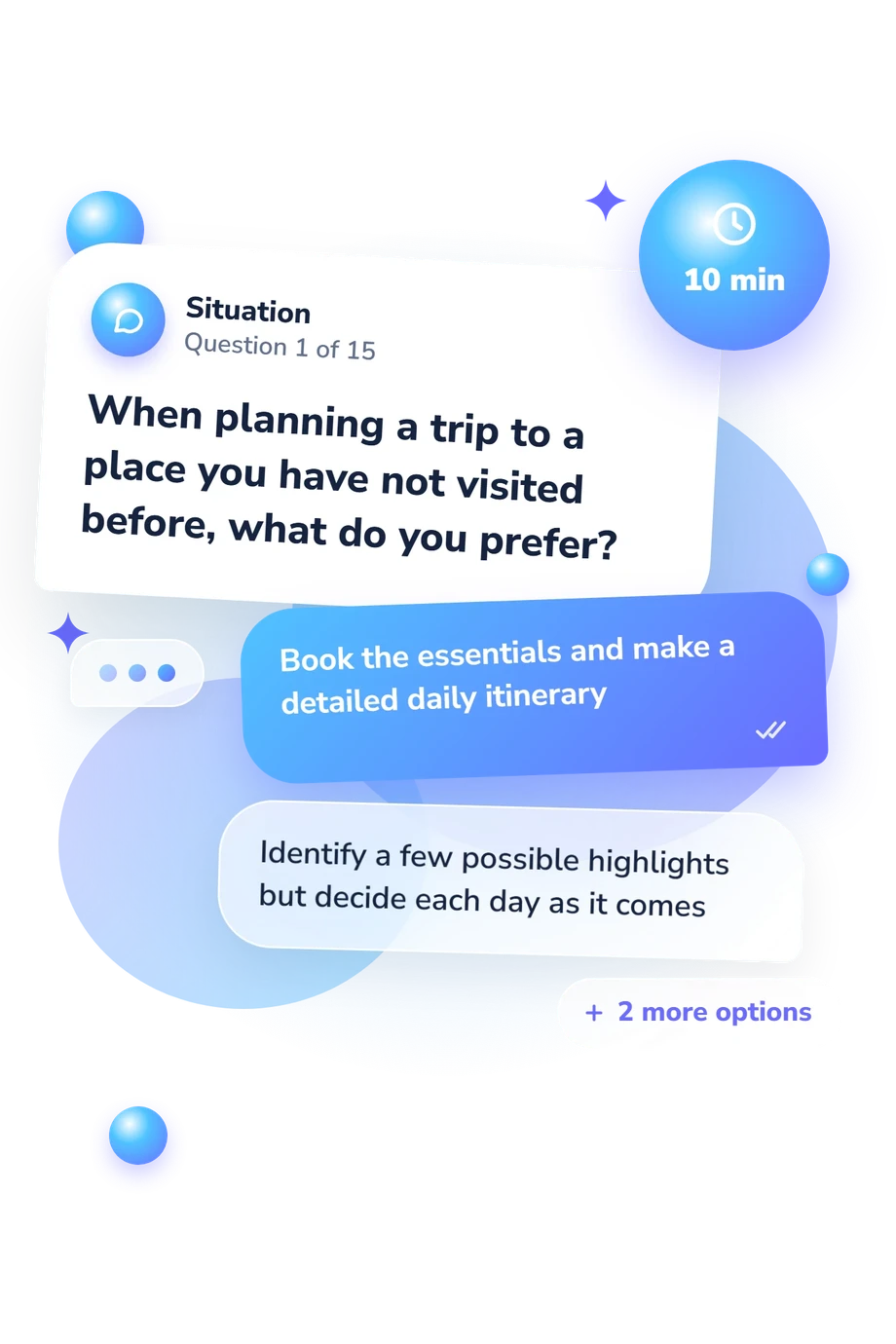
Each item describes a situation and offers four response options. The choices cover planning, novelty, problem solving, and social interaction; the respondent selects the option closest to their usual response. This format measures preferences, not skill or performance.
Responses are combined into three dimensions and read through descriptive bands. Rather than a quiz seeking one word to describe me, the profile shows how tendencies coexist, and no point conversion beyond the questionnaire’s scoring should be assumed.
Conceptually, the structure is consistent with the Big Five Inventory-2 (Soto & John, 2017) and DeYoung, Quilty, and Peterson’s (2007) account of narrower aspects within broad domains. Soto and John’s short-form research supports compact trait measurement, but this online questionnaire is not an adaptation of those instruments; it uses related dimensions and its own wording.
Those sources explain the organization, not the psychometric status of this version. The displayed bands are descriptive rather than population norms or clinical cutoffs, and self-report can vary with self-awareness, interpretation, and current circumstances. Use the result as a structured snapshot for reflection, not a definitive personality judgment.
- Soto, C. J., & John, O. P. (2017). The next Big Five Inventory (BFI-2): Developing and assessing a hierarchical model with 15 facets to enhance bandwidth, fidelity, and predictive power. Journal of Personality and Social Psychology, 113(1), 117-143. 10.1037/pspp0000096
- Soto, C. J., & John, O. P. (2017). Short and extra-short forms of the Big Five Inventory-2: The BFI-2-S and BFI-2-XS. Journal of Research in Personality, 68, 69-81. 10.1016/j.jrp.2017.02.004
- DeYoung, C. G., Quilty, L. C., & Peterson, J. B. (2007). Between facets and domains: 10 aspects of the Big Five. Journal of Personality and Social Psychology, 93(5), 880-896. 10.1037/0022-3514.93.5.880
Updated: