
Future Boyfriend Quiz
How the Scales are Structured
Who Usually Takes This Test?
See How You Compare
Below is a preview of how scores are typically distributed across each scale.
Example Questions From the Test
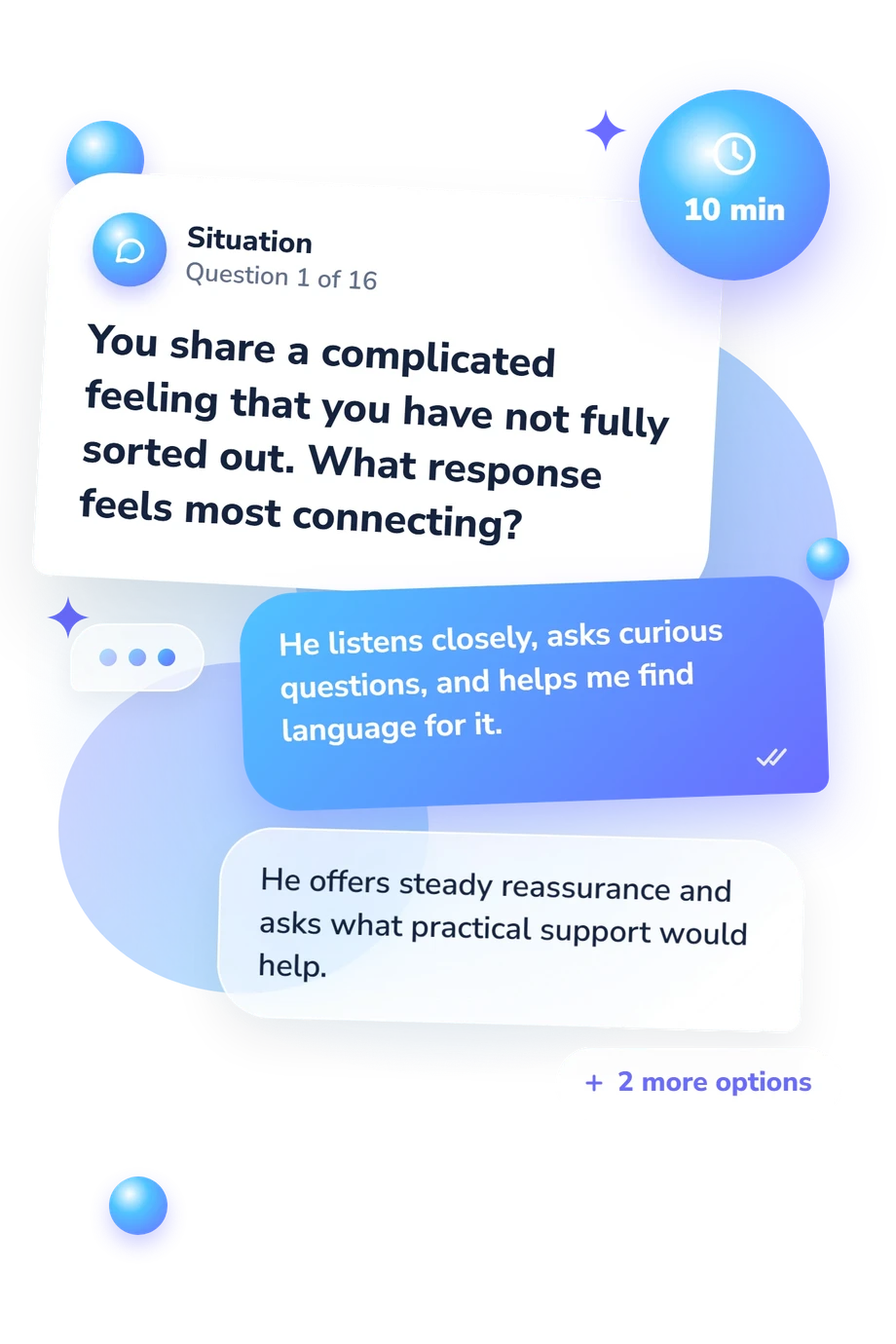
- He listens closely, asks curious questions, and helps me find language for it.
- He offers steady reassurance and asks what practical support would help.
- He gently shifts the mood so I do not become stuck in the feeling.
- He helps me identify a constructive next step.
- He plans an energetic surprise to take my mind off it.
- He invites me into a long conversation about what the week meant to me.
- He helps me decide what to tackle next so I can regain momentum.
- He checks what I need, handles a small practical task, and stays close without pressure.
- A sincere note describing something he appreciates about our connection.
- A funny voice message followed by an invitation to do something unexpected.
- A reminder that he completed the errand he promised to handle.
- An update celebrating progress toward a plan we made together.
Future Boyfriend Quiz - Description and methodology of the test
People who want to reflect on the qualities they value in a romantic partner can use the future bf quiz to compare four imagined relationship styles. It is especially useful when you are curious about attraction patterns rather than trying to predict a specific person. A future boyfriend quiz result turns preferences about care, ambition, adventure, and emotional depth into a clear profile for reflection.
What This Assessment Explores
The questions focus on partner responses, daily rhythms, and shared plans. Scenarios involving disclosure, stress, gifts, disagreement, travel, routines, and open time reveal which connection styles appeal most. The result describes preference patterns, not universally better partners.
Here, the my future boyfriend quiz result shows which of four imagined styles draws you most strongly. The displayed scales are:
- Alex - Steady Supporter (0-12) measures dependable affection, calm communication, and practical care: Different rhythm (0-4), Supportive spark (5-8), Steady affinity (9-12).
- Ethan - Driven Builder (0-12) measures ambition, purposeful planning, and mutual growth: Present-focused path (0-4), Builder spark (5-8), Growth affinity (9-12).
- Leo - Playful Adventurer (0-12) measures spontaneity, humor, novelty, and lively experiences: Quieter compass (0-4), Adventurous spark (5-8), Playful affinity (9-12).
- Noah - Thoughtful Dreamer (0-12) measures emotional depth, creativity, curiosity, and reflective conversation: Concrete connection (0-4), Thoughtful spark (5-8), Dreamer affinity (9-12).
Methodology and Evidence Base
Each item presents a relationship situation with four response options, each emphasizing one of the four styles. Choosing the most connecting response creates a comparative self-report profile of attraction to imagined everyday qualities.
Each style receives a score from its associated choices. The highest score marks the strongest affinity, while any result within one point of it joins a blended result; no tie-breaker forces a single winner. For reflection, the my next boyfriend quiz result is useful for noticing combinations, such as steadiness with novelty.
The design is conceptually consistent with Fletcher et al. (1999) on ideals in intimate relationships and Fletcher and Simpson (2000) on ideal standards as organized preferences guiding relationship judgments. It also fits Eastwick and Finkel (2008), who distinguished stated mate preferences from preferences expressed in lived interactions. Rather than naming a person, the result gives the who is my future boyfriend quiz question a style-based answer. Since this online questionnaire has no stated normative standardization or clinical validation, scores describe self-reported ideals that can shift with mood, recent experiences, and self-awareness rather than guarantee compatibility.
- Fletcher, Garth J. O., Jeffry A. Simpson, Geoff Thomas, and Louise Giles. “Ideals in Intimate Relationships.” Journal of Personality and Social Psychology 76, no. 1 (1999): 72-89. 10.1037//0022-3514.76.1.72
- Fletcher, Garth J. O., and Jeffry A. Simpson. “Ideal Standards in Close Relationships: Their Structure and Functions.” Current Directions in Psychological Science 9, no. 3 (2000): 102-105. 10.1111/1467-8721.00070
- Eastwick, Paul W., and Eli J. Finkel. “Sex Differences in Mate Preferences Revisited: Do People Know What They Initially Desire in a Romantic Partner?” Journal of Personality and Social Psychology 94, no. 2 (2008): 245-264. 10.1037/0022-3514.94.2.245
Updated: