
RBT Quiz
How the Scales are Structured
Who Usually Takes This Test?
See How You Compare
Below is a preview of how scores are typically distributed across each scale.
Example Questions From the Test
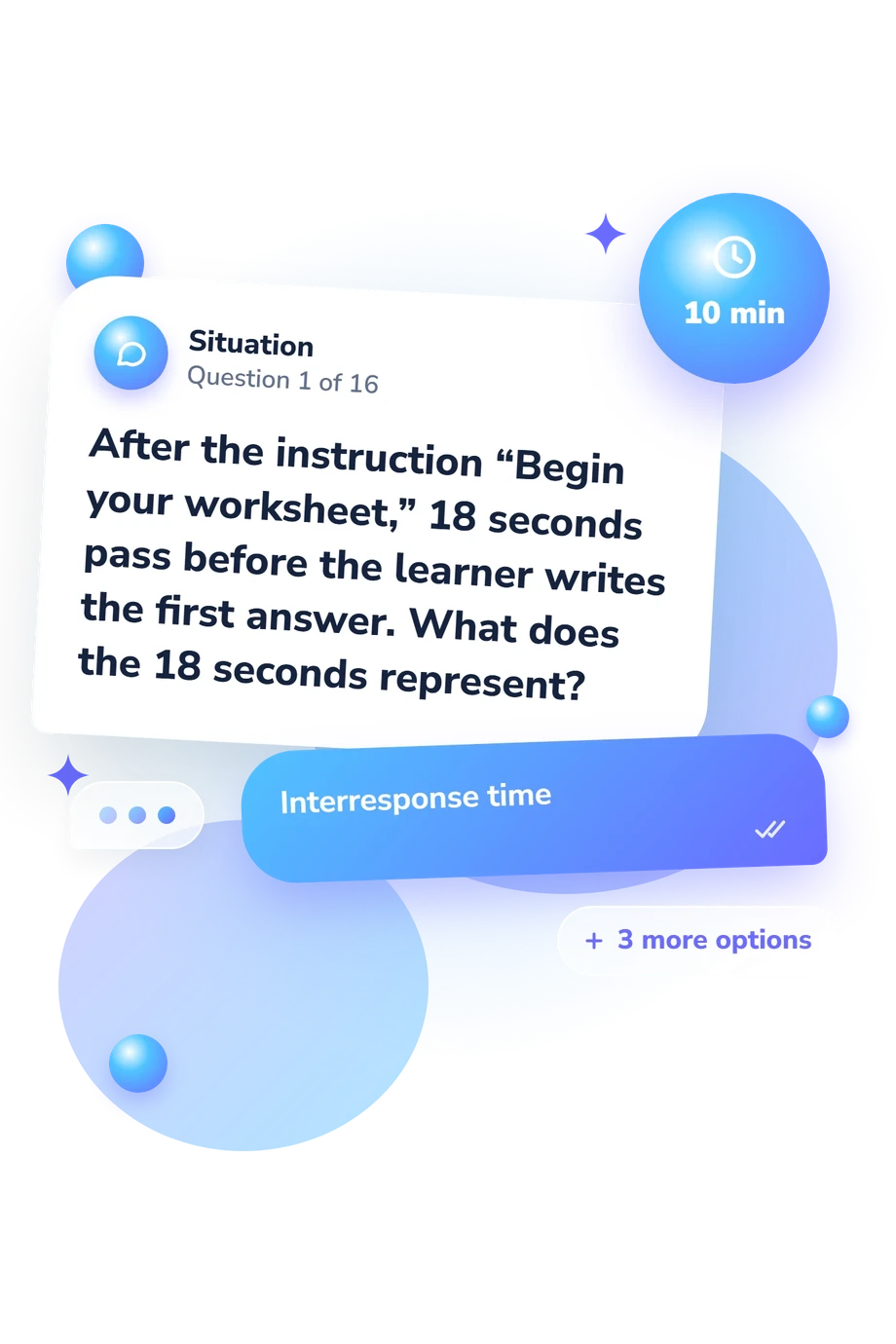
- Interresponse time
- Duration
- Latency
- Rate
- The consequence is unpleasant to most people.
- The consequence reduces the future frequency of the behavior.
- The consequence is delivered immediately after behavior.
- The person delivering it intends to discourage behavior.
- Instruction, learner response, consequence, brief pause
- Reinforcer, instruction, response, prompt
- Learner response, instruction, pause, consequence
- Prompt, consequence, instruction, learner response
RBT Quiz - Description and methodology of the test
For people preparing to work as Registered Behavior Technicians, the rbt quiz offers a focused way to check recognition of foundational behavior-analytic concepts. As an RBT practice quiz, it can support learners reviewing coursework, candidates organizing study, or technicians refreshing familiar material. The result identifies areas for targeted review without treating a short self-check as a complete measure of professional readiness.
What This Assessment Explores
The questionnaire samples practical decisions in entry-level behavior analysis: defining behavior, measuring responses, identifying antecedents and consequences, recognizing reinforcement and punishment, using prompts and fading, and following ethical and safety procedures. It is intended for learners and technicians reviewing foundational RBT material.
Rather than testing isolated vocabulary, the assessment questions place concepts in brief workplace situations. They cover themes such as latency, interval recording, reinforcement, teaching in natural settings, confidentiality, and operational definitions.
The displayed result uses these bands:
- RBT Knowledge, 0-16, summarizes recognition of the foundational content sampled.
- Foundation to build, 0-6, signals a need to review core terms and observable applications.
- Developing knowledge, 7-12, indicates many recognized principles alongside areas needing targeted practice.
- Strong knowledge, 13-16, indicates solid grasp of the sampled foundations.
Methodology and Scientific Basis
Each item presents a short scenario with four answer choices, asking the respondent to select the concept or action that best fits. The format checks terminology, applied behavior analysis, teaching procedures, measurement, professional conduct, and safe decision-making.
The content is conceptually consistent with the RBT Test Content Outline (3rd ed.) and the RBT Task List (2nd ed.). Cooper, Heron, and Heward support the behavior-analytic framework for reinforcement, punishment, prompting, and measurement; Baer, Wolf, and Risley describe defining features of applied behavior analysis. These sources support the subject matter but do not establish that this online questionnaire is an adaptation or validated form of those works.
Scoring is shown as a displayed total mapped to the catalogue’s three bands. The result is an unofficial educational summary, not a credentialing decision or prediction of examination performance; the online format is not presented as an independently standardized certification measure.
As a Registered Behavior Technician practice test, it can identify review priorities, but the result remains sensitive to current study, attention, and honest self-report. Read it as one focused snapshot alongside coursework and qualified supervision.
- Behavior Analyst Certification Board. (2023). RBT test content outline (3rd ed.). Littleton, CO: Author.
- Behavior Analyst Certification Board. (2018). RBT task list (2nd ed.). Littleton, CO: Author.
- Cooper, John O., Timothy E. Heron, and William L. Heward. (2020). Applied Behavior Analysis (3rd ed.). Hoboken, NJ: Pearson. ISBN 9780134752556.
- Baer, Donald M., Montrose M. Wolf, and Todd R. Risley. (1968). Some current dimensions of applied behavior analysis. Journal of Applied Behavior Analysis, 1(1), 91-97. 10.1901/jaba.1968.1-91
Updated: