
Customer Service Quiz
How the Scales are Structured
Who Usually Takes This Test?
See How You Compare
Below is a preview of how scores are typically distributed across each scale.
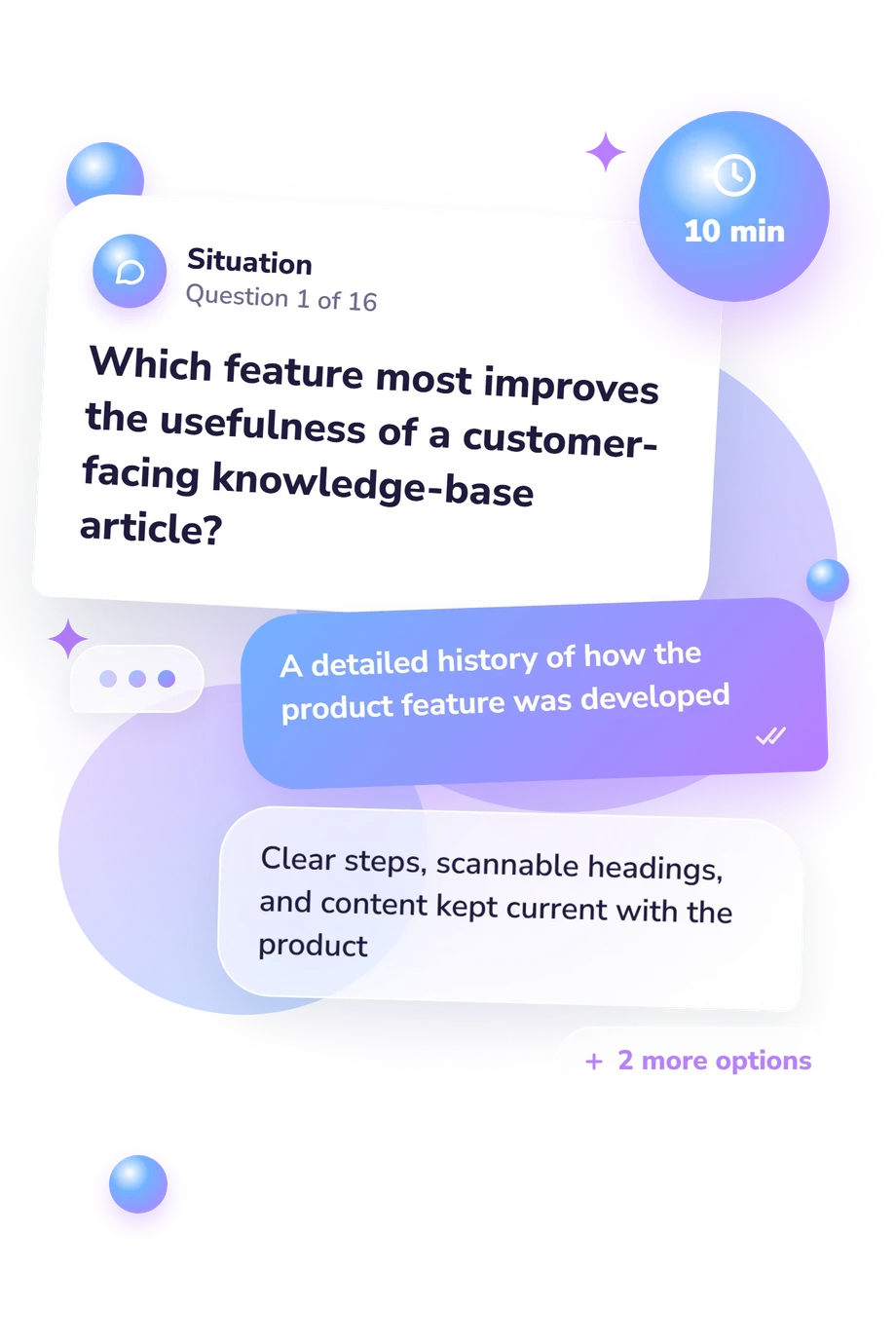
Example Questions From the Test
- Review the contact history, acknowledge the repetition, take ownership, and pursue a lasting resolution
- Provide the same workaround because consistency across contacts builds trust
- Wait for the customer to request escalation before involving anyone else
- Ask the customer to explain everything again to ensure the new case contains complete information
- Customer Effort Score
- First Response Time
- Net Promoter Score
- Average Handle Time
- “I agree that our team handled this incorrectly.”
- “I am sorry you feel that our policy is unfair.”
- “I can understand why an unexpected charge would be frustrating.”
- “Unfortunately, billing issues sometimes happen.”
Customer Service Quiz - Description and methodology of the test
Designed for people who want to examine how they handle everyday client situations, this assessment turns practical service judgment into an educational snapshot. The customer service quiz focuses on choices that affect clarity, trust, safety, and follow-through rather than on memorizing company-specific procedures. A quiz for employees on customer service can give teams a common starting point for coaching, reflection, and more consistent decisions.
What This Test Measures
This assessment treats customer service as practical judgment in listening, ownership, privacy, metrics, and problem-solving. It suits people reviewing skills for support or other client-facing work.
The questions cover five connected areas:
- Communication shows how clearly you clarify concerns and confirm understanding.
- Ownership shows whether you coordinate next steps and close the service loop.
- Metrics test recognition of common service measures and commitments.
- Privacy examines whether you protect account details and follow verification rules.
- Empathy shows how you acknowledge impact and explain realistic options.
Results appear as Customer Service Knowledge: 0-16. Building Foundations (0-6) signals a need to reinforce core principles; Developing Knowledge (7-12) shows a useful grasp with room to sharpen unfamiliar decisions; Strong Knowledge (13-16) reflects consistent recognition of practical, customer-focused responses. Answers to the customer-service quiz highlight learning priorities rather than assigning a fixed personal label.
Methodology and Evidence Base
Each item presents a workplace situation with four response options. Choosing the strongest service response makes this a scenario-based knowledge check, not a personality inventory. The scoring combines performance across the scenarios and places the result in the catalogue’s interpretive categories; the answer wording does not justify inventing a separate point rule.
The method is conceptually consistent with the Corporate Social Style Inventory (Sanchez & Fraser, 1993), which treats customer-service skill as observable social style in interactions. This questionnaire is not an adaptation or digital administration of that instrument. Martin and Fraser (2002) and Brown et al. (2002) offer related evidence on customer orientation and service performance, but those studies do not validate this online version.
Interpret the result as a structured snapshot of current knowledge, not as evidence that this online version has the norms of a standardized instrument. Familiarity with service policies, reading of the scenarios, and the difference between knowing an ideal response and using it under pressure can affect performance. The customer-service quiz with answer choices can guide study or coaching, but it does not establish professional certification.
- Sanchez, Juan I., and Scott L. Fraser. Development and Validation of the Corporate Social Style Inventory: A Measure of Customer Service Skills. Marketing Science Institute Report No. 93-108, Marketing Science Institute, 1993.
- Martin, Leisa A., and Scott L. Fraser. Customer Service Orientation in Managerial and Non-Managerial Employees: An Exploratory Study. Journal of Business and Psychology, vol. 16, no. 3, 2002, pp. 477-484. 10.1023/A:1012885310251
- Brown, Tom J., John C. Mowen, D. Todd Donavan, and Jane W. Licata. The Customer Orientation of Service Workers: Personality Trait Effects on Self- and Supervisor Performance Ratings. Journal of Marketing Research, vol. 39, no. 1, 2002, pp. 110-119. 10.1509/jmkr.39.1.110.18928
Updated: