
Softball Quiz
How the Scales are Structured
Who Usually Takes This Test?
See How You Compare
Below is a preview of how scores are typically distributed across each scale.
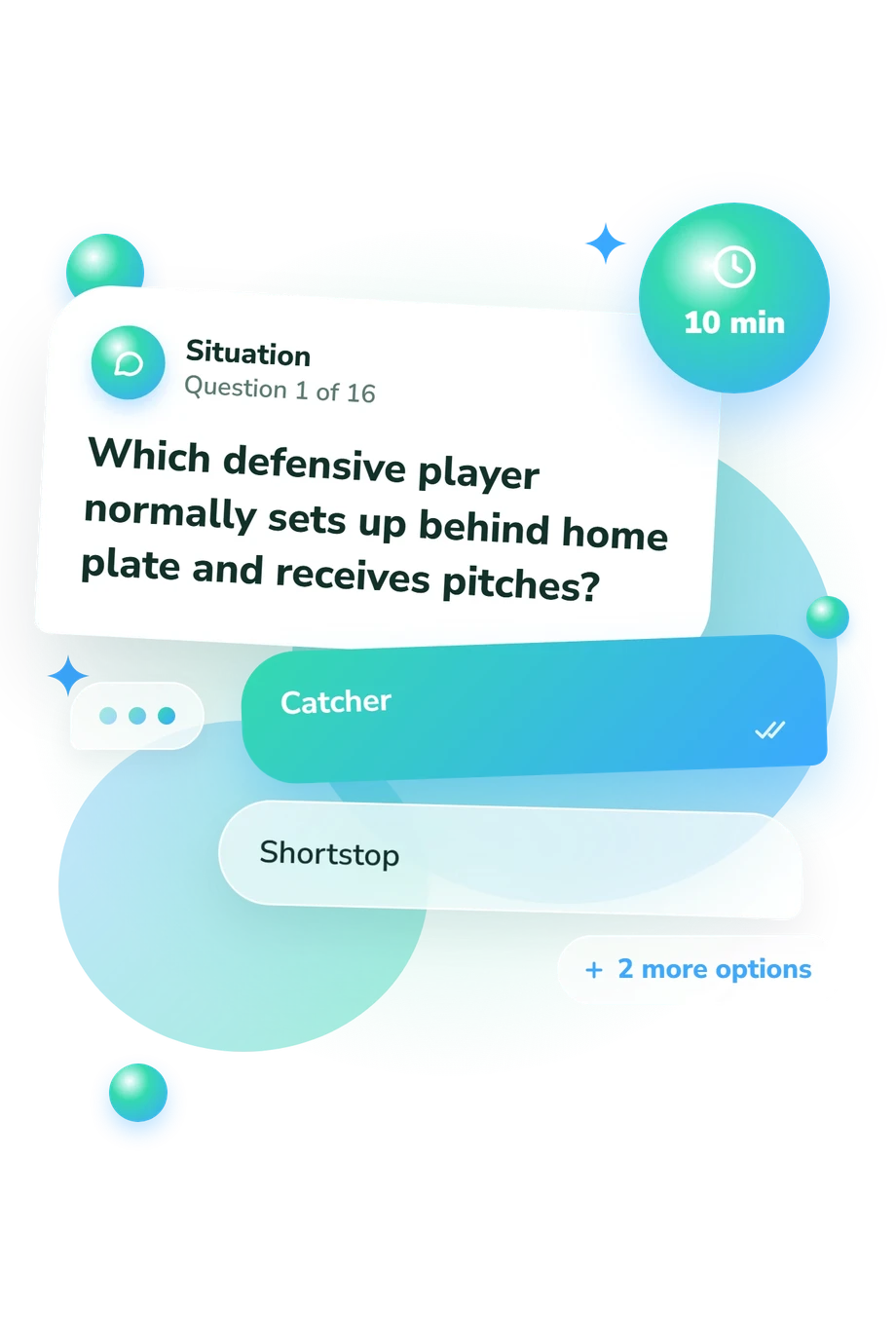
Example Questions From the Test
- Catcher
- Shortstop
- First baseman
- Center fielder
- The count resets to zero
- The batter remains at the plate for one more pitch
- The batter is awarded first base on a walk
- The batter is out for exceeding the count
- Nine
- Eight
- Ten
- Eleven
Softball Quiz - Description and methodology of the test
Players, coaches, students, and curious fans can use this softball quiz to check how well they recognize common fastpitch rules and game situations. The items test recognition of rules and tactics in presented examples, supporting review and discussion rather than demonstrating on-field judgment. Teammates can use these quiz questions about softball to compare interpretations. The result offers a starting point for reviewing familiar material and noticing where understanding may need attention.
What This Assessment Explores
Questions sample practical fastpitch knowledge: positions, legal advancement, outs, counts, pitching choices, scoring calls, and offensive tactics. In practice, this quiz for softball players tests whether rules are applied in context rather than recalled as isolated terms.
The questionnaire produces one Softball Knowledge score from 0-16. Its bands are Building the Fundamentals (0-6), Developing Diamond Knowledge (7-12), and Strong Softball Knowledge (13-16). These bands describe levels from foundational understanding to broad command; exact rules may vary by league or governing body.
The measured areas can be understood as follows:
- Rules and calls show whether legal play is recognized.
- Positions and responsibilities show whether defensive duties are understood.
- Baserunning and situations show how rules apply as plays change.
- Tactics and technique show recognition of bunting, changing speed, and slapping.
Methodology and Evidence Base
The questionnaire combines direct softball-knowledge questions with short rule, baserunning, and tactical scenarios. As a quiz about softball plays, it presents each item with four answer choices; the reader selects the option that best fits the rule or tactic. This is a structured knowledge check, not a measure of physical skill, batting ability, or coaching performance. Responses produce one overall result, so the outcome is a snapshot of answered knowledge rather than a complete playing profile.
The content is conceptually consistent with Waglow and Stephens (1955), the closest conceptual source for its focus on softball knowledge, but the online questionnaire is not a direct reproduction or normed adaptation of that instrument. USA Softball’s 2026 rulebook is an external reference for common rules, not evidence that this questionnaire was built from that edition.
No population norms or reliability estimate are stated, so results suit practical review rather than broad comparisons. Teammates can use the result for discussion, but answers may reflect memory, league rules, and current experience. Checking a relevant rulebook or discussing observed plays can add context.
- Waglow, I. F., and Foy Stephens. A softball knowledge test. Research Quarterly of the American Association for Health, Physical Education and Recreation 26, no. 2 (1955): 234-243.
- USA Softball. 2026 Official Rules of Softball. Oklahoma City, OK: USA Softball, 2026.
- Potter, Diane L., and Lynn V. Johnson. Softball: Steps to Success. 3rd ed. Champaign, IL: Human Kinetics, 2007. ISBN 978-0-7360-5953-4.
- Takamido, Ryota, Keiko Yokoyama, and Yuji Yamamoto. Task constraints and stepping movement of fast-pitch softball hitting. PLOS ONE 14, no. 2 (2019): e0212997. 10.1371/journal.pone.0212997.
Updated: