
Am I Dehydrated Quiz
How the Scales are Structured
Who Usually Takes This Test?
See How You Compare
Below is a preview of how scores are typically distributed across each scale.
Example Questions From the Test
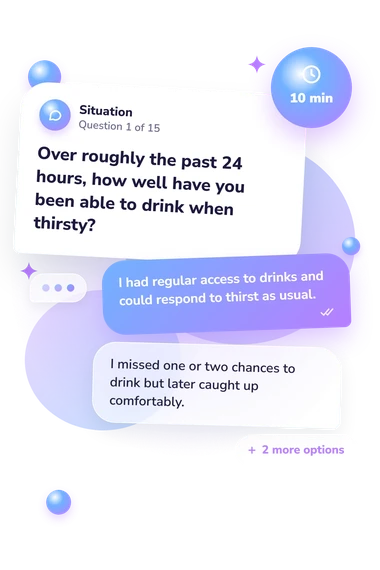
- I had regular access to drinks and could respond to thirst as usual.
- I missed one or two chances to drink but later caught up comfortably.
- Long gaps, a busy schedule, or limited access repeatedly kept me from drinking.
- I have had almost no fluid despite thirst, illness, or ongoing losses.
- I am urinating at roughly my usual frequency.
- I have gone somewhat less often than usual.
- I have passed only small amounts over many hours.
- I have passed almost no urine for most of the day while ill or feeling unwell.
- I know of no condition, medicine, or instruction that changes my usual fluid plan.
- I am unsure whether a medicine or health condition affects my fluid balance.
- I have a condition or medicine that affects fluid balance, but I have guidance I can follow.
- I have a fluid restriction or fluid-sensitive condition and now have symptoms or cannot follow my plan.
Am I Dehydrated Quiz - Description and methodology of the test
People who have noticed unusual thirst, fluid loss, darker urine, dizziness, or difficulty drinking may use the Am I Dehydrated Quiz to organize what is happening now. This dehydration quiz is designed for self-checking during everyday illness, heat, exercise, vomiting, diarrhea, or restricted access to drinks. It highlights patterns that may merit monitoring, prompt clinical advice, or urgent help.
What This Assessment Explores
The questionnaire examines current experiences, not a fixed trait. It covers reported dehydration symptoms such as thirst, dry mouth, urine changes, fatigue, concentration, cramps, headache, lightheadedness, altered heartbeat or breathing, alertness, vomiting, and diarrhea. These experiences are not specific to dehydration.
It also considers fluid-balance pressures from heat, illness, medicines, fluid restrictions, limited access, and fluid loss.
The three result dimensions are:
- Common Hydration-Related Changes (0-15) records selected physical or cognitive changes; bands: No change selected (0), Notice and reassess (1-2), Take action (3-15).
- Fluid Balance Pressures (0-15) records recent intake or fluid-loss pressures, including heat, illness, medicines, fluid restrictions, or access barriers; bands: No pressure selected (0), Review circumstances (1-2), Take action (3-15).
- Urgent Warning Signs (0-15) records serious experiences; bands: No warning signs selected (0-0), Check promptly (1-2), Seek timely help (3-15).
Methodology and Evidence Base
Each item offers four ordered responses, moving from usual conditions toward greater difficulty or risk. The questions combine recent experiences with intake gaps, fluid losses, heat, illness, and other circumstances. Responses are organized into the three displayed totals; the bands guide attention but are unvalidated, not diagnostic or severity cutoffs. A single concerning warning sign matters independently of the total.
Conceptually, the symptom coverage is closest to Burge’s study; this online quiz is conceptually consistent with that work but is not its adaptation. A separate acute-diarrhea severity model by Barry, together with work by Hooper and Lacey, supports interpreting symptoms alongside clinical context rather than relying on one sign.
The result is a structured snapshot of endorsed changes, fluid pressures, and warning signs, interpreted as a pattern of reported experiences rather than a measure of hydration status. Recall, self-awareness, medicines, illness, and fluid restrictions can change what a response means. Fainting, confusion, inability to keep fluids down, little or no urination, chest pain, or severe breathing trouble require urgent medical help regardless of the total score.
- Burge FI. Dehydration symptoms of palliative care cancer patients. Journal of Pain and Symptom Management. 1993;8(7):454-464. 10.1016/0885-3924(93)90188-2
- Barry MA, Qu K, Gainey M, Schmid CH, Garbern SC, Nasrin S, et al. Derivation and Internal Validation of a Score to Predict Dehydration Severity in Patients over 5 Years with Acute Diarrhea. The American Journal of Tropical Medicine and Hygiene. 2021;105(5):1368-1375. 10.4269/ajtmh.21-0143
- Hooper L, Abdelhamid A, Attreed NJ, Campbell WW, Channell AM, Chassagne P, et al. Clinical symptoms, signs and tests for identification of impending and current water-loss dehydration in older people. Cochrane Database of Systematic Reviews. 2015;4:CD009647. 10.1002/14651858.CD009647.pub2
- Lacey J, Corbett J, Forni L, Hooper L, Hughes F, Minto G, et al. A multidisciplinary consensus on dehydration: definitions, diagnostic methods and clinical implications. Annals of Medicine. 2019;51(3-4):232-251. 10.1080/07853890.2019.1628352