
EKG Strip Quiz
How the Scales are Structured
Who Usually Takes This Test?
See How You Compare
Below is a preview of how scores are typically distributed across each scale.
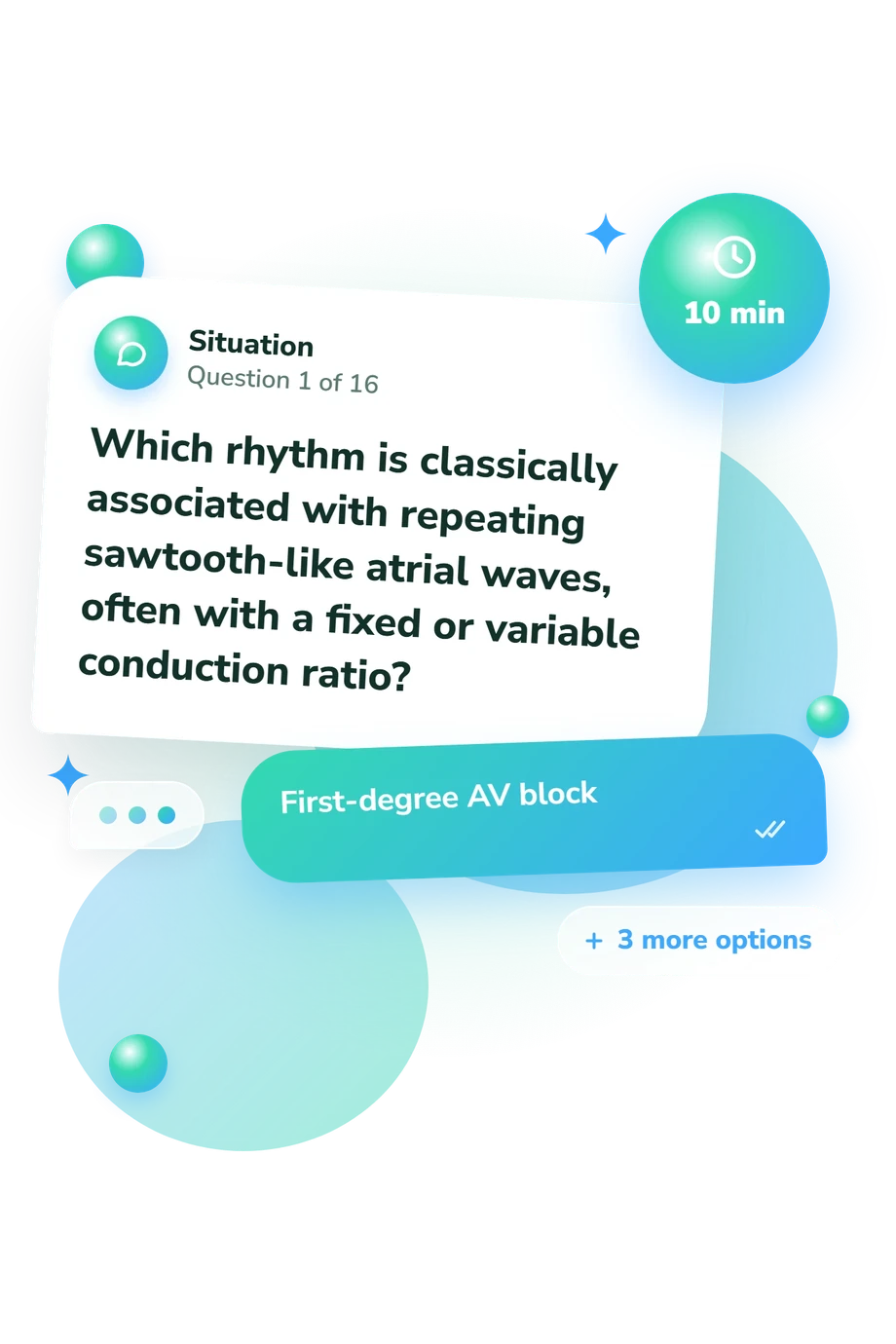
Example Questions From the Test
- First-degree AV block
- Ventricular fibrillation
- Sinus arrhythmia
- Atrial flutter
- Second-degree AV block type II
- First-degree AV block
- Third-degree AV block
- Atrial fibrillation
- 22-0.30 seconds
- 06-0.10 seconds
- 12-0.20 seconds
- Less than 0.06 seconds
EKG Strip Quiz - Description and methodology of the test
Designed for learners who want to check their ability to read basic electrocardiographic findings, this assessment turns common rhythm-recognition tasks into a focused study checkpoint. The EKG Strip Quiz is useful for students, trainees, and practitioners reviewing foundational concepts before more advanced interpretation. As a rhythm quiz, it can show which areas feel secure and which deserve targeted review.
What This Assessment Explores
It examines normal and abnormal rhythms, atrioventricular conduction, ventricular rate calculation, interval knowledge, and clinically important waveform findings. The items ask readers to distinguish atrial fibrillation, atrial flutter, supraventricular tachycardia, ventricular tachycardia, and different degrees of AV block, while also recognizing QT and ST-segment changes.
The rhythm-identification items use regularity, rate, P-wave relationships, QRS width, and interval behavior, so this ECG rhythm interpretation quiz tests applied pattern recognition rather than simple recall. It also asks them to respond appropriately when a monitor display conflicts with the patient’s clinical condition.
These are the result areas presented by the assessment:
- EKG Strip Knowledge, scored 0-16, reflects performance across rhythm recognition, conduction, rate, and tracing concepts; Foundation is 0-6, Developing is 7-12, and Strong is 13-16.
Methodology and Evidence Base
Each item presents a short clinical or tracing description followed by four answer choices, requiring one best interpretation. The set moves between pattern recognition, calculation using standard paper-speed conventions, and safe first-step reasoning when artifacts or urgent findings are possible. The displayed result combines performance across the items into one educational score.
Conceptually, the content aligns with ECG-KAT, one instrument in a published three-instrument toolkit, but this online questionnaire should not be described as that instrument or as a validated adaptation. Terminology for diagnostic statements, QT measurement, ST-segment changes, and acute ischemia is consistent with recommendations from Mason et al., Rautaharju et al., and Wagner et al.
Because the displayed score is an unvalidated educational measure, it indicates performance on these questions rather than clinical competence. Results can vary with recent study, test-taking strategy, and familiarity with the wording; real ECG interpretation depends on the full tracing, patient context, and qualified clinical review. For focused learning, the result from this heart rhythm practice quiz is best treated as a guide rather than a standalone diagnosis or treatment decision.
- José M. Hernández-Padilla, José Granero-Molina, Verónica V. Márquez-Hernández, Fiona Suthers, Olga M. López-Entrambasaguas, and Cayetano Fernández-Sola. "Design and validation of a three-instrument toolkit for the assessment of competence in electrocardiogram rhythm recognition." European Journal of Cardiovascular Nursing. 2017;16(5):425-434. 10.1177/1474515116687444
- Jay W. Mason, E. William Hancock, and Leonard S. Gettes. "Recommendations for the Standardization and Interpretation of the Electrocardiogram: Part II: Electrocardiography Diagnostic Statement List: A Scientific Statement From the American Heart Association Electrocardiography and Arrhythmias Committee, Council on Clinical Cardiology; the American College of Cardiology Foundation; and the Heart Rhythm Society: Endorsed by the International Society for Computerized Electrocardiology." Circulation. 2007;115(10):1325-1332. 10.1161/CIRCULATIONAHA.106.180201
- Pentti M. Rautaharju, Borys Surawicz, and Leonard S. Gettes. "AHA/ACCF/HRS Recommendations for the Standardization and Interpretation of the Electrocardiogram: Part IV: The ST Segment, T and U Waves, and the QT Interval: A Scientific Statement From the American Heart Association Electrocardiography and Arrhythmias Committee, Council on Clinical Cardiology; the American College of Cardiology Foundation; and the Heart Rhythm Society: Endorsed by the International Society for Computerized Electrocardiology." Circulation. 2009;119(10):e241-e250. 10.1161/CIRCULATIONAHA.108.191096
- Galen S. Wagner, Peter Macfarlane, Hein Wellens, Mark Josephson, Anton Gorgels, David M. Mirvis, Olle Pahlm, Borys Surawicz, Paul Kligfield, Rory Childers, and Leonard S. Gettes. "AHA/ACCF/HRS Recommendations for the Standardization and Interpretation of the Electrocardiogram: Part VI: Acute Ischemia/Infarction: A Scientific Statement From the American Heart Association Electrocardiography and Arrhythmias Committee, Council on Clinical Cardiology; the American College of Cardiology Foundation; and the Heart Rhythm Society: Endorsed by the International Society for Computerized Electrocardiology." Circulation. 2009;119(10):e262-e270. 10.1161/CIRCULATIONAHA.108.191098
Updated: