
Frank Ocean Quiz
How the Scales are Structured
Who Usually Takes This Test?
See How You Compare
Below is a preview of how scores are typically distributed across each scale.
Example Questions From the Test
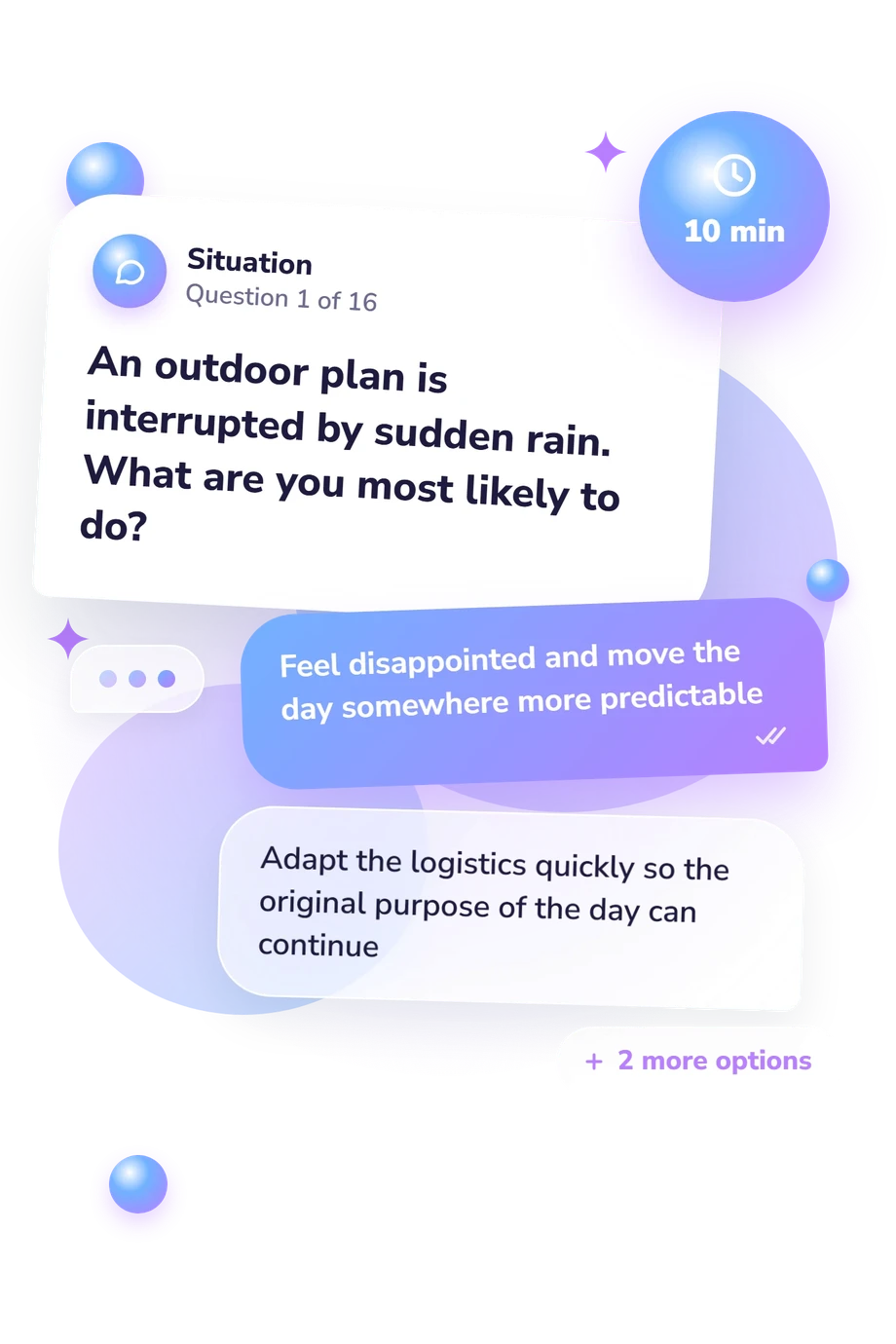
- Feel disappointed and move the day somewhere more predictable
- Adapt the logistics quickly so the original purpose of the day can continue
- Let the weather remind me of another meaningful day or person
- Pause to take in the changed light, air, and mood before deciding
- Give them room and wait until they choose to reach out
- Help identify one manageable action that could reduce the pressure
- Share a related experience so they know their reaction is understandable
- Stay present with them and make the moment gentler without forcing a solution
- How differently I understand that period now
- The visual details and atmosphere captured in the photo
- The feelings or conversations that never reached a clear ending
- The fact that it belongs to a chapter I no longer need to revisit
Frank Ocean Quiz - Description and methodology of the test
People who want to connect their reactions to emotionally charged situations with resonant Frank Ocean song perspectives may find the Frank Ocean Quiz a useful reflective exercise. It is intended for listeners curious about why particular songs feel personal, especially around memory, transition, longing, and self-expression. The result also works as a Frank Ocean song quiz, linking your choices to four song-specific affinities and their emotional themes.
What This Assessment Explores
Everyday situations-changed plans, difficult support, first love, late-night effort, unresolved encounters, and unfinished endings-show which emotional lens feels most familiar. The profile maps these situational reactions to four song-specific affinities, so this is a Frank Ocean song match quiz rather than a general personality assessment. Its four result dimensions are:
- Ivy Affinity (0-12) shows how memory and changing identity shape early-love reflection: Different wavelength (0-4), Nostalgic echo (5-8), or Strong Ivy match (9-12).
- Nights Affinity (0-12) shows how you experience late-hour energy and inner shifts: Different wavelength (0-4), Split-current resonance (5-8), or Strong Nights match (9-12).
- Pink + White Affinity (0-12) reflects sensory awareness and warmth amid change: Different wavelength (0-4), Gentle resonance (5-8), or Strong match (9-12).
- Self Control Affinity (0-12) captures private vulnerability and restrained longing: Different wavelength (0-4), Quiet undertow (5-8), or Strong match (9-12).
Methodology and Scientific Basis
Each prompt offers four response options describing different reactions, not right or wrong answers. The questionnaire produces four displayed scale scores that are compared to identify the strongest affinity, with scores within one point forming a blended result. The result describes resonance with a song perspective, not musical expertise.
The questionnaire is conceptually consistent with Music-evoked autobiographical memories (Janata et al., 2007), which links music with personal memory and significant life events. Barrett et al. (2010) adds evidence about nostalgia, mood, and autobiographical recall, while Lonsdale and North (2011) helps explain music’s roles in mood, identity, and social connection. These published studies offer conceptual parallels for the questionnaire’s themes; they did not create, validate, or standardize this online questionnaire, and they do not establish its scoring.
In this Frank Ocean music quiz, the bands are descriptive categories used to express relative song affinity. Self-report means current mood, accessible memories, relationship context, and willingness to disclose can influence the profile, so it works best as a structured reflection rather than a clinical diagnosis.
- Janata, Petr, Stefan T. Tomic, and Sonja K. Rakowski. "Characterisation of music-evoked autobiographical memories." Memory 15, no. 8 (2007): 845-860. 10.1080/09658210701734593
- Barrett, Frederick S., Kevin J. Grimm, Richard W. Robins, Tim Wildschut, Constantine Sedikides, and Petr Janata. "Music-Evoked Nostalgia: Affect, Memory, and Personality." Emotion 10, no. 3 (2010): 390-403. 10.1037/a0019006
- Lonsdale, Adam J., and Adrian C. North. "Why do we listen to music? A uses and gratifications analysis." British Journal of Psychology 102, no. 1 (2011): 108-134. 10.1348/000712610X506831
Updated: