
Should I Get Back with My Ex Quiz
How the Scales are Structured
Who Usually Takes This Test?
See How You Compare
Below is a preview of how scores are typically distributed across each scale.
Example Questions From the Test
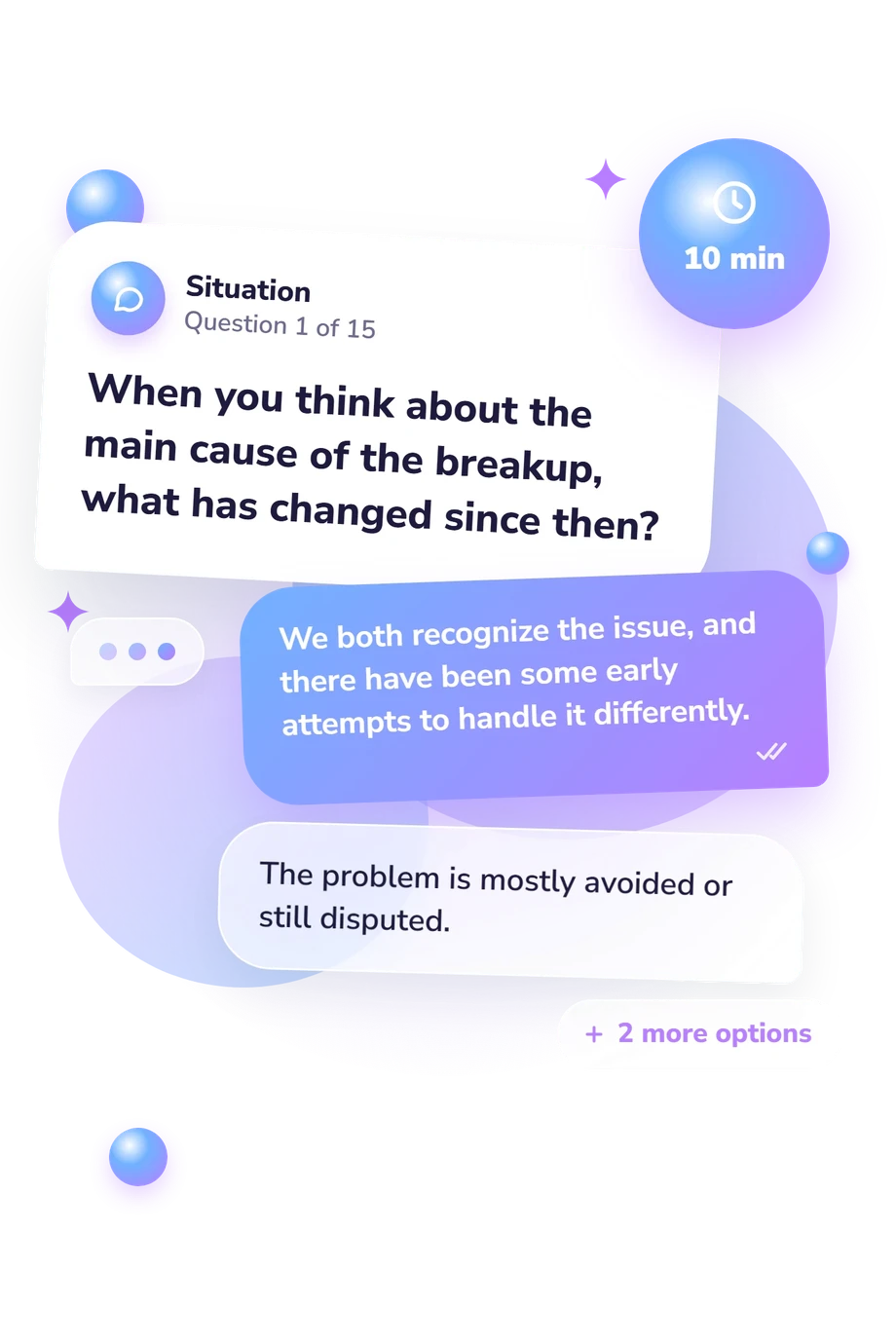
- We both recognize the issue, and there have been some early attempts to handle it differently.
- The problem is mostly avoided or still disputed.
- There are specific changes that have held up across time and difficult situations.
- We understand the problem better, but behavior has remained much the same.
- Each of us can name our part without erasing incompatibilities or excusing harmful behavior.
- We agree that mistakes happened, but discussions still become defensive.
- One person accepts most of the responsibility so that the conversation can move forward.
- Responsibility is largely denied, redirected, or used as leverage.
- I could keep living fully while noticing whatever feelings arise.
- I would function, but I would organize much of the month around hoping they contact me.
- I would struggle to focus on daily life without reassurance from them.
- I would have difficult moments but could still invest in my routines and relationships.
Should I Get Back with My Ex Quiz - Description and methodology of the test
People considering a renewed relationship may want more than a burst of hope or fear before contacting an ex. The Should I Get Back with My Ex Quiz organizes that reflection around emotional clarity, observable repair, and whether current goals and boundaries can coexist. It is a Should We Get Back Together Quiz that helps you assess whether to rely on present evidence rather than familiarity alone.
What This Assessment Explores
Breakup causes, responsibility, emotional triggers, apologies, change, boundaries, and future plans help separate longing from readiness. The test suits people considering renewed contact who want to assess a workable foundation. It helps you consider the Should I Reach Out to My Ex Quiz question: whether contact follows reflection or urgency.
The result uses three dimensions:
- Emotional Clarity (0-15) reflects whether loneliness, urgency, or unresolved pain is directing the decision: Emotion Is Steering (0-5), Mixed Clarity (6-10), or Grounded Clarity (11-15).
- Evidence of Repair (0-15) reflects whether breakup problems have been understood and addressed through observable, sustained change: Little Repair Evidence (0-5), Emerging Evidence (6-10), or Substantial Evidence (11-15).
- Future Fit and Boundaries (0-15) reflects whether current goals, non-negotiables, and relationship boundaries can coexist: Major Fit Gaps (0-5), Conditional Fit (6-10), or Stronger Fit Framework (11-15).
Together, these dimensions support reflection rather than predict a successful reunion.
Methodology and Evidence Base
Each item offers four options covering regulation, responsibility, change, pacing, boundaries, or alignment. Your closest response produces a profile rather than a yes-or-no verdict. It helps you consider whether talking to an ex reflects settled intention or immediate urgency.
The result reports three dimensions on 0-15 scales. Read each band within its dimension to identify areas needing reflection before contact. As self-report, answers can reflect loneliness, hope, defensiveness, memory, or a recent message; revisit the result as context changes. The profile also helps answer the Should I Talk to My Ex Quiz question by distinguishing settled intention from immediate urgency.
The themes are conceptually consistent with Dailey et al. (2020) on post-dissolution ambivalence, adjustment, and reconciliation, and with Dailey et al. (2011) on recurring on-again/off-again relationships. Responsibility, apology, and behavioral follow-through align with Wilder et al. (2024) on reconciliation efforts after conflict. These studies provide context; this questionnaire is a separate self-report assessment, and the studies do not establish its validity, norms, or scoring standardization.
- Dailey, René M., Lingzi Zhong, Rudy Pett, and Sarah Varga. (2020). Post-dissolution ambivalence, breakup adjustment, and relationship reconciliation. Journal of Social and Personal Relationships, 37(5), 1604-1625. 10.1177/0265407520906014
- Dailey, René M., Borae Jin, Abigail Pfiester, and Gary Beck. (2011). On-Again/Off-Again Dating Relationships: What Keeps Partners Coming Back? The Journal of Social Psychology, 151(4), 417-440. 10.1080/00224545.2010.503249
- Wilder, Siri, Karen J. Prager, and Srikar Garapati. (2024). But I said I'm sorry: Helpfulness of romantic couples' efforts to reconcile after conflict. Personal Relationships, 31(3), 836-854. 10.1111/pere.12565
Updated: