
Would I Be a Good Boyfriend Quiz
How the Scales are Structured
Who Usually Takes This Test?
See How You Compare
Below is a preview of how scores are typically distributed across each scale.
Example Questions From the Test
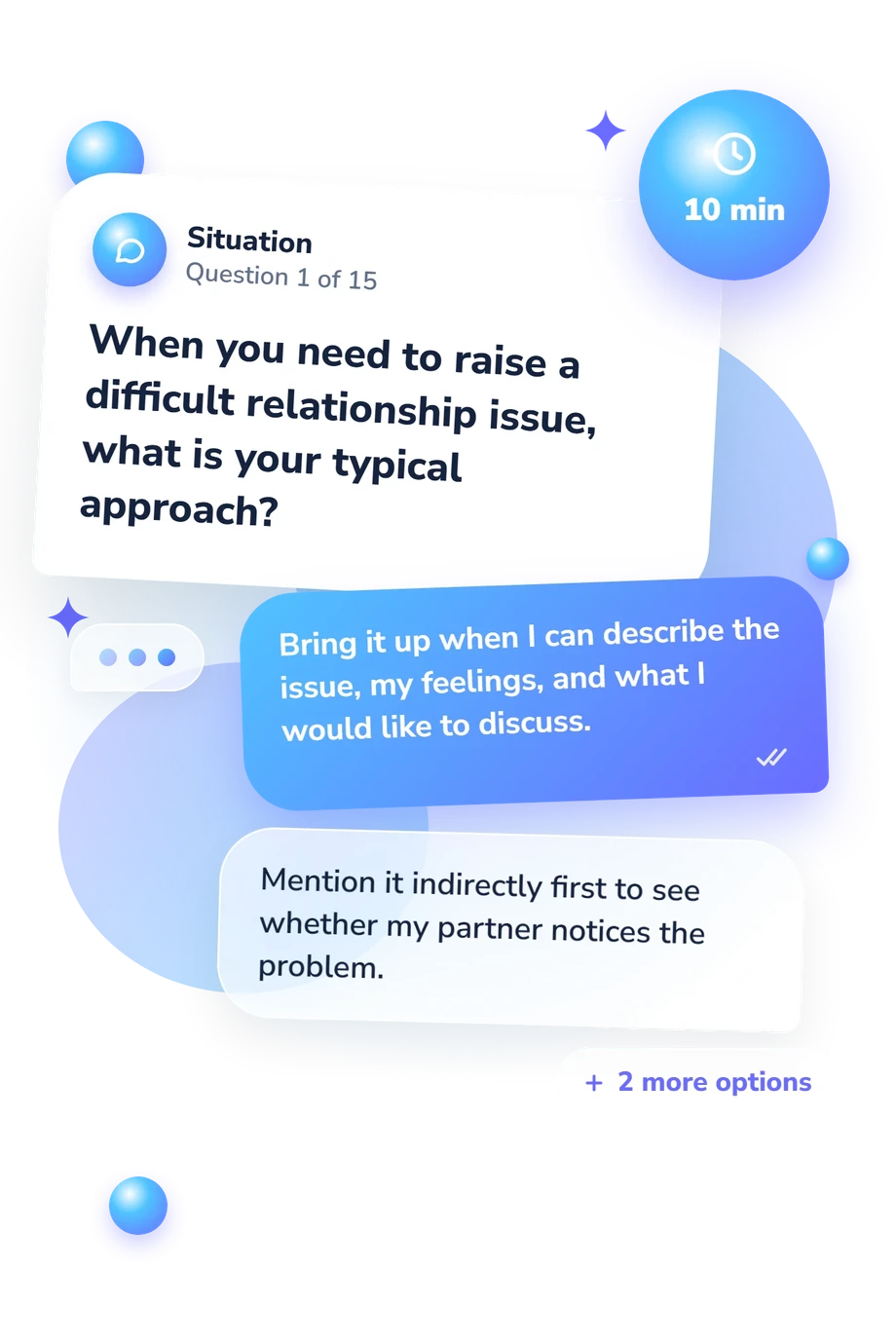
- Bring it up when I can describe the issue, my feelings, and what I would like to discuss.
- Mention it indirectly first to see whether my partner notices the problem.
- Wait until the issue becomes important enough that I cannot keep it in.
- Plan the main point and choose a reasonably calm time, even if I still feel awkward.
- Each person should handle what they notice or care about most, even if the split is uneven.
- Divide the visible tasks equally and assume that creates a fair arrangement.
- Compare the time and mental effort involved, then agree on a division both people can revisit.
- List the main responsibilities and divide them according to schedules and preferences.
- Stop immediately, check whether they want space or another kind of closeness, and avoid treating it as a debt.
- Stop, but become noticeably distant while I process feeling rejected.
- Stop and give them space, then wait for them to bring up the moment later.
- Stop, but ask them to explain right then because the sudden change would confuse me.
Would I Be a Good Boyfriend Quiz - Description and methodology of the test
For people reflecting on how they show up in a romantic relationship, the Would I Be a Good Boyfriend Quiz offers a structured look at everyday choices rather than a fixed identity. The assessment turns the question of whether you are a good boyfriend into concrete situations, making an Are You a Good Boyfriend Quiz result useful for noticing, discussing, and practicing relationship habits.
What This Assessment Explores
Questions cover difficult conversations, repair after hurt, emotional support, consent, and negotiations over time, chores, expectations, and personal space. An Is He a Good Boyfriend Quiz result describes tendencies, not character.
Instead, it examines choices when care, accountability, and individuality pull in different directions. Its dimensions help you reflect on communication, emotional presence, and partnership habits, showing which responses seem deliberate and which may need practice.
Three scales show areas a Do I Have a Good Boyfriend Quiz result can clarify:
- Communication and Repair (0-15) measures clarity, accountability, and collaborative resolution: Avoidant or Reactive (0-5), Developing Repair Skills (6-10), or Constructive Communicator (11-15).
- Emotional Presence (0-15) measures noticing feelings and adapting support: Still Finding Your Style (0-5), Growing Attunement (6-10), or Responsive Presence (11-15).
- Respectful Partnership (0-15) measures consent-aware cooperation, fairness, and separate needs: Needs More Deliberation (0-5), Emerging Mutuality (6-10), or Partnership-Minded (11-15).
Methodology and Evidence Base
Each scenario offers four response options for a relationship moment. The result presents three separate scale scores, each tied to a defined area of relationship behaviour. Rather than answering the question posed by an Is My Boyfriend a Good Boyfriend Quiz, it describes how your own responses address recurring relationship situations.
Methodologically, this is a structured self-report questionnaire with scenario-based choices. Faber's Inventory of Romantic Relationship Competence describes romantic competence through insight, mutuality, and emotion regulation. The questionnaire is conceptually consistent with that work and with research on partner responsiveness, romantic conflict, and respect, including studies by Crasta and colleagues, Zacchilli and colleagues, and Frei and Shaver. Conceptual consistency does not establish that this questionnaire is an adaptation of those instruments.
The profile cannot determine whether your boyfriend is a good boyfriend: it reflects only your answers and cannot establish another person's motives or conduct. Results may shift with current circumstances, self-awareness, and self-presentation, so read the profile as one snapshot of relationship habits.
- Faber, Anthony J., Eu Gene Chin, Victor R. Wilburn, and Shahrokh M. Shafaie. (2019). Measuring romantic competence in young adults: The Inventory of Romantic Relationship Competence. Interpersona: An International Journal on Personal Relationships, 13(1), 72-95. 10.5964/ijpr.v13i1.341
- Crasta, Dev, Ronald D. Rogge, Michael R. Maniaci, and Harry T. Reis. (2021). Toward an optimized measure of perceived partner responsiveness: Development and validation of the perceived responsiveness and insensitivity scale. Psychological Assessment, 33(4), 338-355. 10.1037/pas0000986
- Zacchilli, Tammy L., Clyde Hendrick, and Susan S. Hendrick. (2009). The romantic partner conflict scale: A new scale to measure relationship conflict. Journal of Social and Personal Relationships, 26(8), 1073-1096. 10.1177/0265407509347936
- Frei, Jennifer R., and Phillip R. Shaver. (2002). Respect in close relationships: Prototype definition, self-report assessment, and initial correlates. Personal Relationships, 9(2), 121-139. 10.1111/1475-6811.00008
Updated: