
Camera Quiz
How the Scales are Structured
Who Usually Takes This Test?
See How You Compare
Below is a preview of how scores are typically distributed across each scale.
Example Questions From the Test
- A compact tripod for deliberate framing or slower shutter speeds
- A polarizing or neutral-density filter compatible with my lens
- A small general-purpose accessory that adds little weight
- Equipment intended mainly for fast, distant subjects
- Maximum portability, so the camera is likely to be with me
- A compact kit with some room to change perspective
- More controls and lens choices, even if I carry it less often
- Purpose-built equipment selected for each planned subject
- Often; these are central situations for my photography
- Sometimes; I want reliable options when the occasion arises
- Rarely; I generally prefer people photos in brighter conditions
- Almost never; other subjects dominate my photography
Camera Quiz - Description and methodology of the test
People often know their subjects but not which compromises matter in a quiz about what camera I should buy. This camera quiz is for photographers who want to clarify priorities before choosing a body, lens, or accessory. It produces a preference profile, not a brand verdict. It turns the question behind a quiz asking which camera I should buy into a clearer account of subjects, weight, light, and readiness.
What This Assessment Explores
Rather than identify a superior model, the questionnaire connects situations with four equipment affinities. It considers weight, reach, people, dim light, landscapes, weather, and spontaneous versus planned shooting. The test clarifies which camera I should buy by showing which compromises fit the reader’s habits, not which brand is best.
These dimensions describe the profile behind a quiz about the best camera for me:
- Lightweight Everyday Kit shows affinity for a small ready-to-carry setup: 0-4 Specialist Leaning, 5-8 Compact Flexibility, and 9-12 Everyday Minimalist.
- Long-Reach Action & Wildlife Kit shows interest in distant subjects: 0-4 Close-Range Priority, 5-8 Occasional Reach, and 9-12 Long-Reach Tracker.
- People & Low-Light Kit shows the importance of portraits and dim settings: 0-4 Different Subject Priority, 5-8 Occasional People Shooter, and 9-12 People & Low-Light Focus.
- Wide-View Landscape & Travel Kit shows preference for scenic views: 0-4 Other Perspectives First, 5-8 Scenic Explorer, and 9-12 Wide-View Traveler.
Methodology and Evidence Base
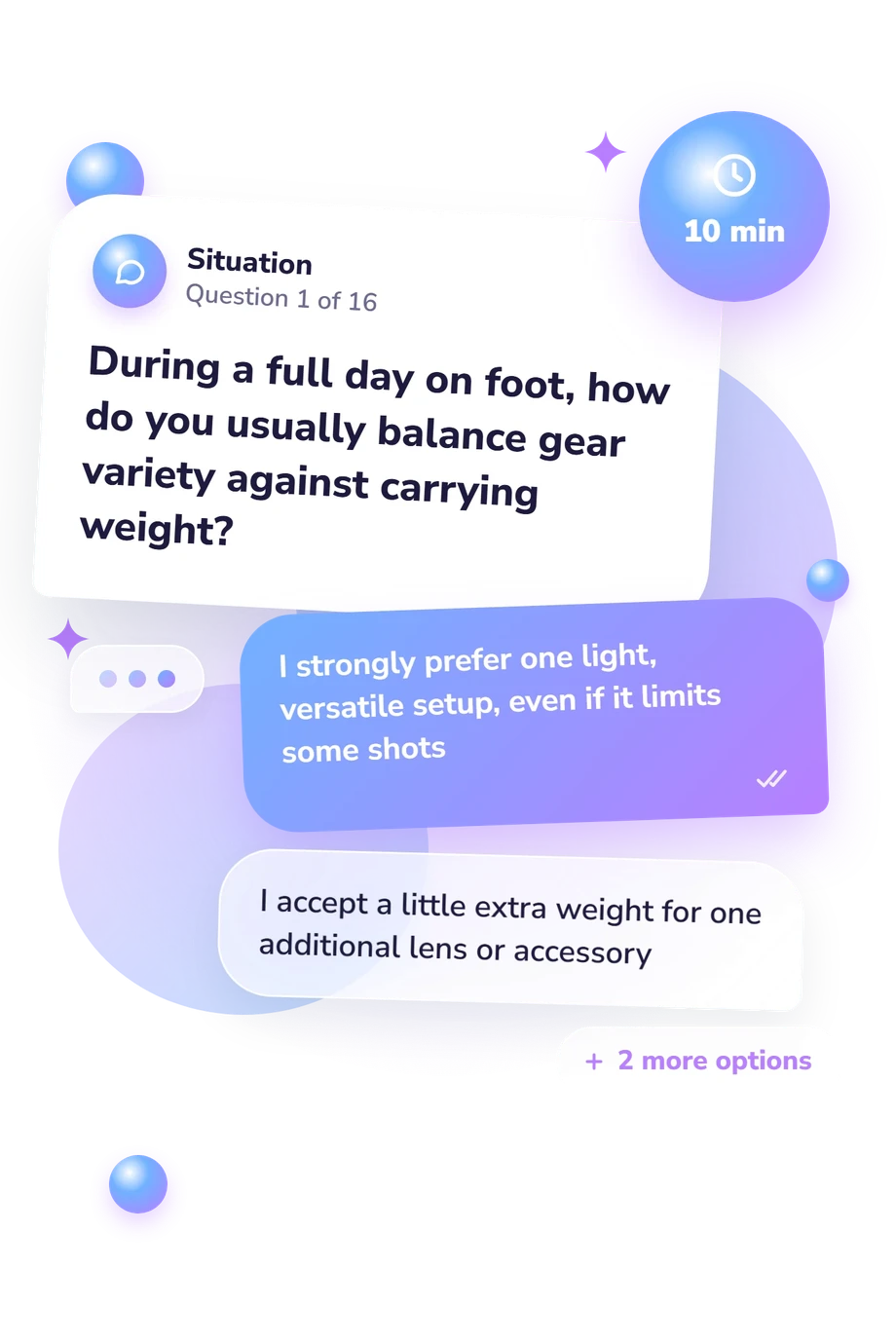
Each item presents a situation with four choices. Options frame trade-offs between lightness and specialization, quick readiness and deliberate setup, and close versus distant subjects. This self-report format captures preferences, not ability.
Answers contribute to four affinity scores: higher values signal stronger alignment with that priority, while the profile does not prescribe a body, lens, accessory, or brand. It helps answer the question behind a quiz about what camera to buy through preferences for portability, reach, people and low light, landscape and travel, readiness, and carrying tolerance.
Ploderer and Leong (2018) offer the closest conceptual reference, connecting amateur photography with tensions among manual engagement, automation, convenience, and control. This questionnaire is conceptually consistent with that work, not an adaptation of their study. Bilissi and Langford (2011) support attention to lenses, light, viewpoint, and accessories, while Van House (2011) places photography in social activity.
Rather than deciding what camera to buy, the result organizes shooting preferences into an affinity profile. Honest self-report, current plans, and self-awareness can influence answers; scores describe affinity with tested priorities, not photographic skill or a required equipment list.
- Ploderer, Bernd, and Tuck Wah Leong. “Manual Engagement and Automation in Amateur Photography.” Media International Australia 166, no. 1 (2018): 44-56. 10.1177/1329878X17738829
- Bilissi, Efthimia, and Michael Langford. Langford’s Advanced Photography: The Guide for Aspiring Photographers. 8th ed. Focal Press, 2011. ISBN: 9780240521916
- Van House, Nancy A. “Personal Photography, Digital Technologies and the Uses of the Visual.” Visual Studies 26, no. 2 (2011): 125-134. 10.1080/1472586X.2011.571888
Updated: