
Which BTS Member Are You Quiz
How the Scales are Structured
Who Usually Takes This Test?
See How You Compare
Below is a preview of how scores are typically distributed across each scale.
Example Questions From the Test
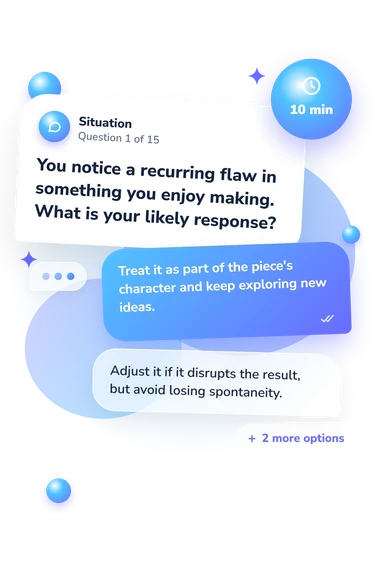
- Treat it as part of the piece's character and keep exploring new ideas.
- Adjust it if it disrupts the result, but avoid losing spontaneity.
- Study what causes it and practice a targeted correction.
- Break the problem into small parts and repeat them until the flaw is reliably resolved.
- I preserve freshness by preparing lightly and trusting my instincts in the moment.
- I outline the essentials, then leave room to respond naturally.
- I rehearse the difficult sections until I know I can recover from mistakes.
- I repeat the full performance and refine small details until the execution feels precise.
- It is useful or fun enough that I will enjoy it often.
- It captures one vivid activity from the trip.
- Its look or texture recreates the place's atmosphere.
- It represents a story or realization that gave the trip meaning.
Which BTS Member Are You Quiz - Description and methodology of the test
For fans seeking a structured comparison, the Which BTS Member Are You Quiz is designed for readers interested in how everyday choices form a three-part profile. It separates approaches to effort, social connection, and instinctive versus interpretive thinking, showing how several tendencies combine rather than reducing the result to one name. This BTS member quiz highlights how those dimensions combine rather than assigning a single label.
What This Assessment Explores
Rather than matching you from a favorite song or image, the questionnaire uses scenarios about challenge, relationships, creative choices, and interpretation to examine three tendencies. Framed as a What BTS Member Are You Quiz, it turns the question of what BTS member you are into a comparison of overlapping patterns across them. Creative choices provide context, not a separate creativity score.
These are the three dimensions reported:
- Mastery and Challenge Drive (0-15) shows whether novelty, flexible practice, or repetition drives you: Exploration-led (0-5), Adaptive builder (6-10), or Mastery-driven (11-15).
- Relational Expression (0-15) shows whether you connect through space, adaptable warmth, or visible encouragement: Selective presence (0-5), Responsive connector (6-10), or Visible encourager (11-15).
- Thoughtful Meaning-Making (0-15) shows whether instinct, reflection, or symbolism guides you: Instinct-first (0-5), Flexible interpreter (6-10), or Meaning-led (11-15).
Together, the dimensions explain why more than one member may resonate with one profile.
Methodology and Evidence Base
Each scenario offers four answer choices. Some contrast spontaneity with deliberate practice; others distinguish private support from visible energy or immediate experience from deeper interpretation. Answer according to your usual behavior so your responses describe the tendencies addressed by the scenarios rather than an imagined ideal.
The questionnaire presents a profile through the three displayed scales and their result bands. It provides no norm-referenced ranking; the result compares your tendencies internally.
The item themes are conceptually consistent with achievement-goal work by Elliot and McGregor (2001), interpersonal work by Wiggins (1979), and life-story work by McAdams (2001). BTS and Kang (2023) provide context for the members’ public-facing narratives, not a test manual. The questionnaire is not an adaptation of these published works.
Framed as a Which BTS Member Am I Quiz, the familiar question of which BTS member I am is therefore a prompt for comparison, not a definitive identity claim. As an online self-report instrument, it has no reported population norms, reliability estimates, or validation evidence; responses may also shift with self-perception, current mood, and the imagined situation.
- BTS and Myeongseok Kang. (2023). Beyond the Story: 10-Year Record of BTS. Translated by Anton Hur, Slin Jung, and Clare Richards. New York: Flatiron Books.
- Elliot, Andrew J., and Holly A. McGregor. (2001). A 2 × 2 Achievement Goal Framework. Journal of Personality and Social Psychology, 80(3), 501-519. 10.1037/0022-3514.80.3.501
- Wiggins, Jerry S. (1979). A Psychological Taxonomy of Trait-Descriptive Terms: The Interpersonal Domain. Journal of Personality and Social Psychology, 37(3), 395-412. 10.1037/0022-3514.37.3.395
- McAdams, Dan P. (2001). The Psychology of Life Stories. Review of General Psychology, 5(2), 100-122. 10.1037/1089-2680.5.2.100