
What Game Should I Play Quiz
How the Scales are Structured
Who Usually Takes This Test?
See How You Compare
Below is a preview of how scores are typically distributed across each scale.
Example Questions From the Test
- Decorating a space, tending a garden, or gathering useful items
- Winning a high-energy match that demands full attention
- Completing a few gentle tasks with a clear progression goal
- Solving a tightly designed tactical challenge
- Lose interest unless the game introduces a firm mission quickly
- Create my own project and enjoy shaping it over several sessions
- Experiment briefly, then look for a checklist or milestone
- Build something functional before moving to a harder challenge
- As a drawback; I want to play whenever I choose
- As worthwhile when the resulting group experience is memorable
- As manageable for occasional planned sessions
- As acceptable only if I can also make meaningful solo progress
What Game Should I Play Quiz - Description and methodology of the test
Choosing a game is easier when the decision starts with the experience you want, not only with a title or genre. The What Game Should I Play Quiz is for players unsure what to start next who want a profile of preferred pace, challenge, social setting, and goals. It can help answer what video game should I play by turning those preferences into a practical starting point.
What This Assessment Explores
The questionnaire links gaming preferences with five broad ways of enjoying play. It suits someone comparing genres, choosing a new title, or checking whether a session fits their current mood. A game recommendations quiz like this describes affinity, not skill or taste.
The result is organized through these dimensions:
- Competitive Action (0-12) reflects fast decisions and direct competition: Alternative Challenge (0-4), Selective Competitor (5-8), Match-Ready (9-12).
- Cozy Creative Play (0-12) reflects customization and self-chosen goals: More Structure Wanted (0-4), Comfort in Moderation (5-8), Creative Unwinder (9-12).
- Social Co-op & Party (0-12) reflects teamwork and shared moments: Independent Player (0-4), Group-Dependent (5-8), Co-op Connector (9-12).
- Story-Rich Adventure (0-12) reflects characters, exploration, dialogue, and choices: Different Direction (0-4), Story-Curious (5-8), Narrative Explorer (9-12).
- Strategy & Management (0-12) reflects planning and interconnected systems: Lighter Systems (0-4), Tactical Interest (5-8), Systems Architect (9-12).
Methodology and Evidence Base
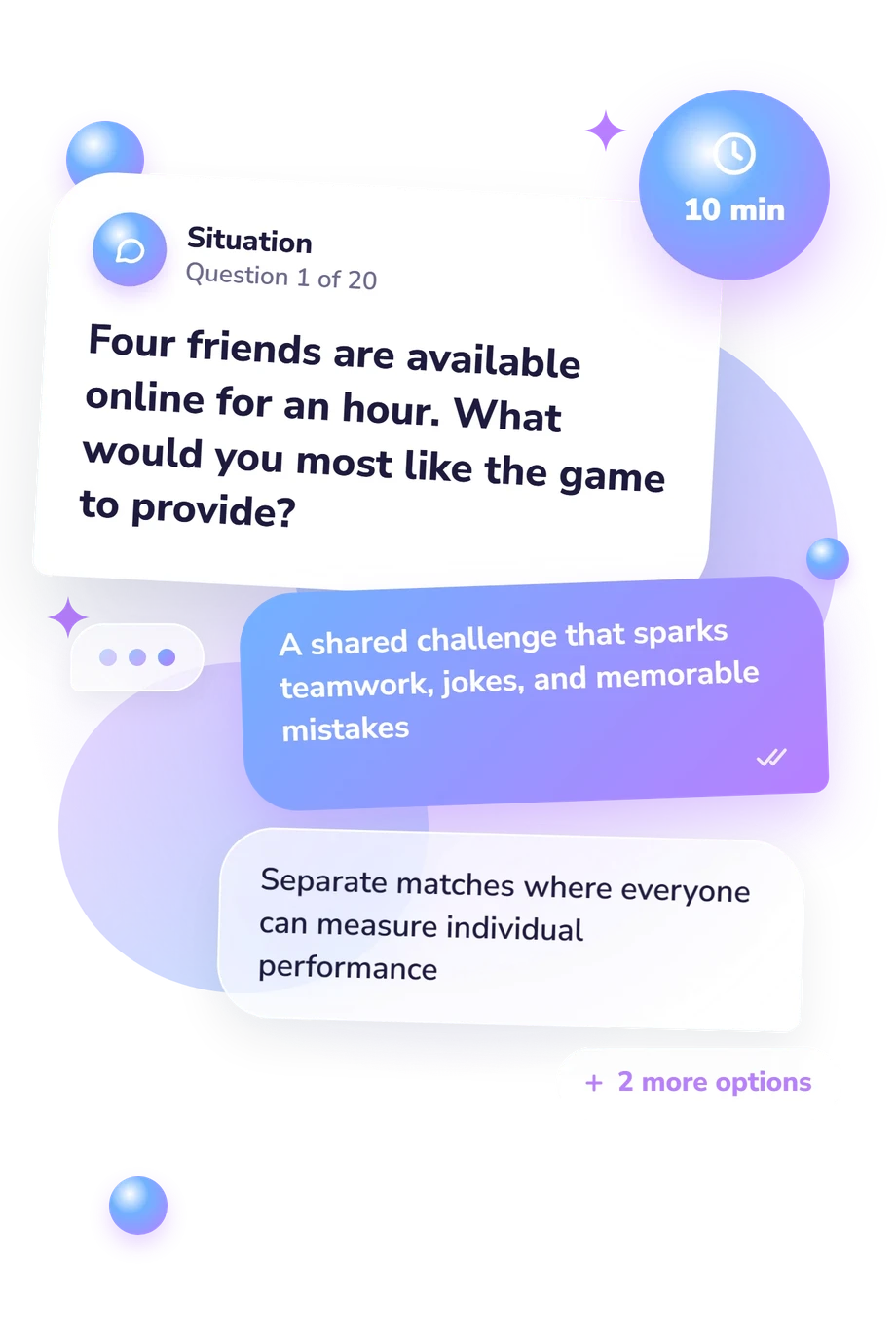
Each item presents a gaming situation with several responses, asking you to choose what you would enjoy. The scenarios cover social play, competition, creative freedom, narrative engagement, and planning. When deciding what PC game should I play, the structure keeps attention on the experience rather than platform.
Scoring compares responses across five affinity dimensions. The highest score marks the strongest current fit; results within one point indicate a blended preference. The bands turn the profile into practical directions without claiming one label fits every session. The same logic can clarify what Xbox game should I play when a library feels broad.
The method is conceptually consistent with the Game Preferences Questionnaire (GPQ) associated with Manero, Torrente, Freire, and Fernández-Manjón (2016). Zammitto’s 2009 work and Scharkow et al.’s 2015 study support viewing gaming preference as multidimensional. The result is a preference profile with interpretive bands rather than a clinical classification; mood, recent play, social availability, and genre familiarity can shift self-reported answers, so use it as a flexible guide rather than a fixed identity.
- Borja Manero, Javier Torrente, Manuel Freire, and Baltasar Fernández-Manjón. 2016. An instrument to build a gamer clustering framework according to gaming preferences and habits. Computers in Human Behavior, 62, 353-363. 10.1016/j.chb.2016.03.085
- Veronica Zammitto. 2009. Game research, measuring gaming preferences. In Proceedings of the 2009 Conference on Future Play on @ GDC Canada, 15-16. ACM. 10.1145/1639601.1639611
- Michael Scharkow, Ruth Festl, Jens Vogelgesang, and Thorsten Quandt. 2015. Beyond the “core-gamer”: Genre preferences and gratifications in computer games. Computers in Human Behavior, 44, 293-298. 10.1016/j.chb.2014.11.020
Updated: