
Naruto Quiz
How the Scales are Structured
Who Usually Takes This Test?
See How You Compare
Below is a preview of how scores are typically distributed across each scale.
Example Questions From the Test
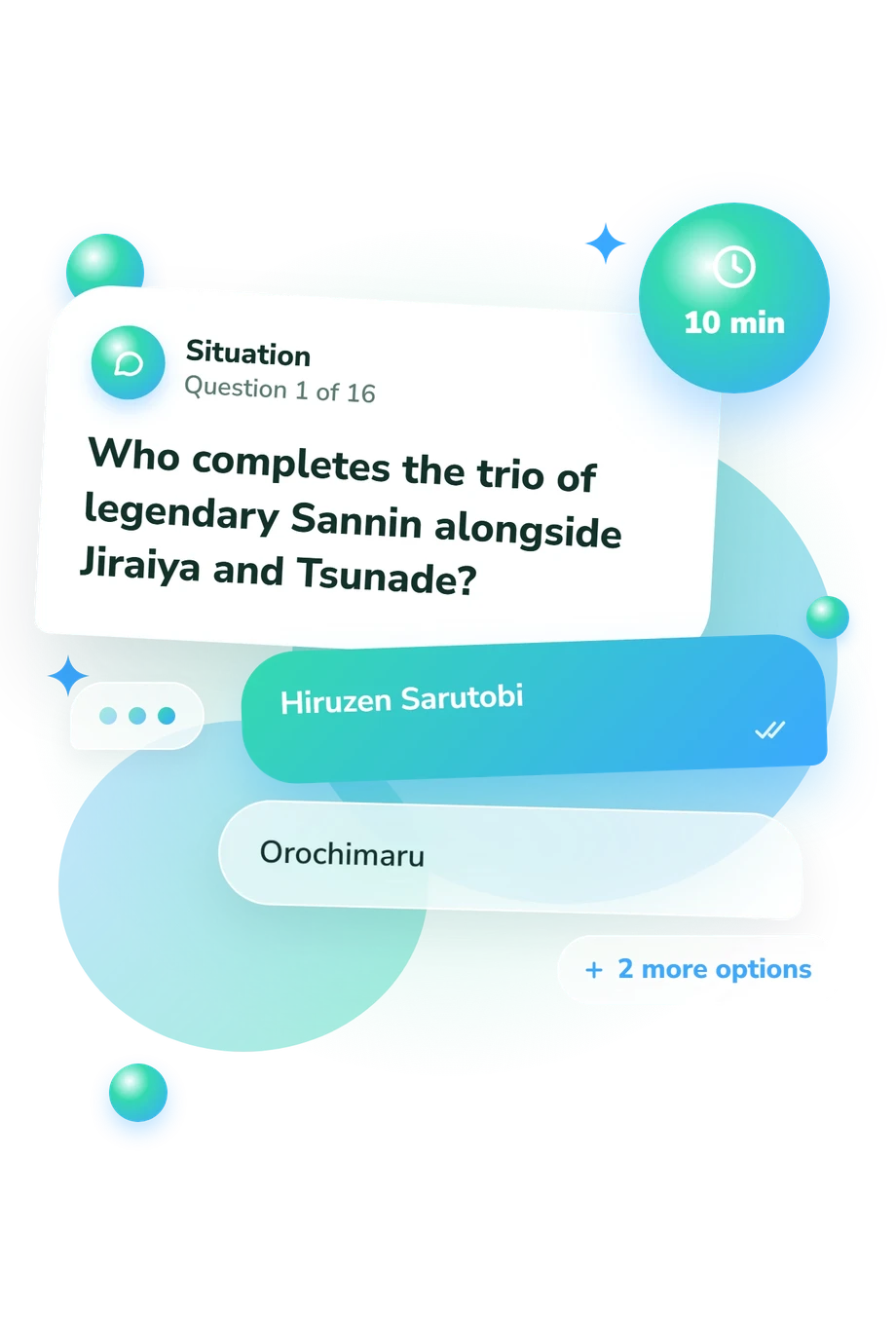
- Hiruzen Sarutobi
- Orochimaru
- Danzō Shimura
- Sakumo Hatake
- Shukaku
- Gyūki
- Kurama
- Matatabi
- The legendary weapons of the Seven Ninja Swordsmen
- The kekkei genkai of every major shinobi clan
- Forbidden scrolls belonging to each hidden village
- The tailed beasts sealed within their jinchūriki
Naruto Quiz - Description and methodology of the test
Fans who want to check their command of the shinobi world can use this Naruto Quiz as a focused recall exercise; its 16-question format differs from the 100-question format suggested by naruto quiz 100 questions. The Naruto knowledge test covers story facts, abilities, relationships, and turning points, showing which parts of the series feel secure and which details may be worth revisiting. It suits casual viewers and dedicated readers alike.
What This Assessment Explores
This questionnaire measures recall of Naruto characters, clans, techniques, chakra rules, alliances, battles, and major plot developments. It suits readers checking how well they connect identities with actions and abilities with outcomes.
Across the Naruto trivia questions, the focus is canon recognition and simple reasoning, not personality or opinion. The result identifies familiar details to revisit, rather than measuring intelligence or fandom.
One displayed scale, Naruto Knowledge (0-16), awards one point for each correct answer and uses three bands: Academy Starter (0-6), Chūnin-Level Recall (7-12), and Hokage-Level Knowledge (13-16). These are unofficial entertainment labels.
The themes fall into three groups:
- Character and relationship recall shows recognition of identities, family links, mentors, and teams.
- Techniques and chakra knowledge shows whether abilities and elemental advantages are matched correctly.
- Organizations and story events show recall of goals, battles, revelations, and turning points.
Methodology and Evidence Base
The response format is single-choice: each item presents four alternatives, with one intended answer. Questions move between direct identification and short scenario-based inferences, so success depends on memory and understanding of the fictional systems. Naruto quiz answers are counted as correct or incorrect and combined into the displayed result; no extra weighting is stated.
The questions cover facts from Masashi Kishimoto’s Naruto canon and official reference books, including character identities, clan affiliations, techniques, chakra relationships, and major events. These references supply the fictional details being recalled, while the displayed result is an unofficial entertainment score, not a franchise-endorsed rating.
Interpret the outcome as a snapshot of recalled canon at completion. Familiarity with particular arcs, time since reading, spoilers, and differences in translated terminology can affect recall, so the score does not establish population norms or formal expertise.
A high band reflects strong performance on this set of questions, while missed items offer useful prompts for revisiting characters, techniques, organizations, and turning points.
- Kishimoto, Masashi. Naruto: The Official Fanbook. San Francisco: VIZ Media, 2008. ISBN 978-1-4215-1844-2.
- Kishimoto, Masashi. Naruto: The Official Character Data Book. San Francisco: VIZ Media, 2012. ISBN 978-1-4215-4125-9.
- Kishimoto, Masashi. Naruto, Vol. 72. San Francisco: VIZ Media, 2015. ISBN 978-1-4215-8284-9.
- Huang, Cheng-Wen, and Arlene Archer. Fluidity of modes in the translation of manga: the case of Kishimoto’s Naruto. Visual Communication 13, no. 4 (2014): 471-486. DOI 10.1177/1470357214541746.
Updated: