
How Much Am I Worth Quiz
How the Scales are Structured
Who Usually Takes This Test?
See How You Compare
Below is a preview of how scores are typically distributed across each scale.
Example Questions From the Test
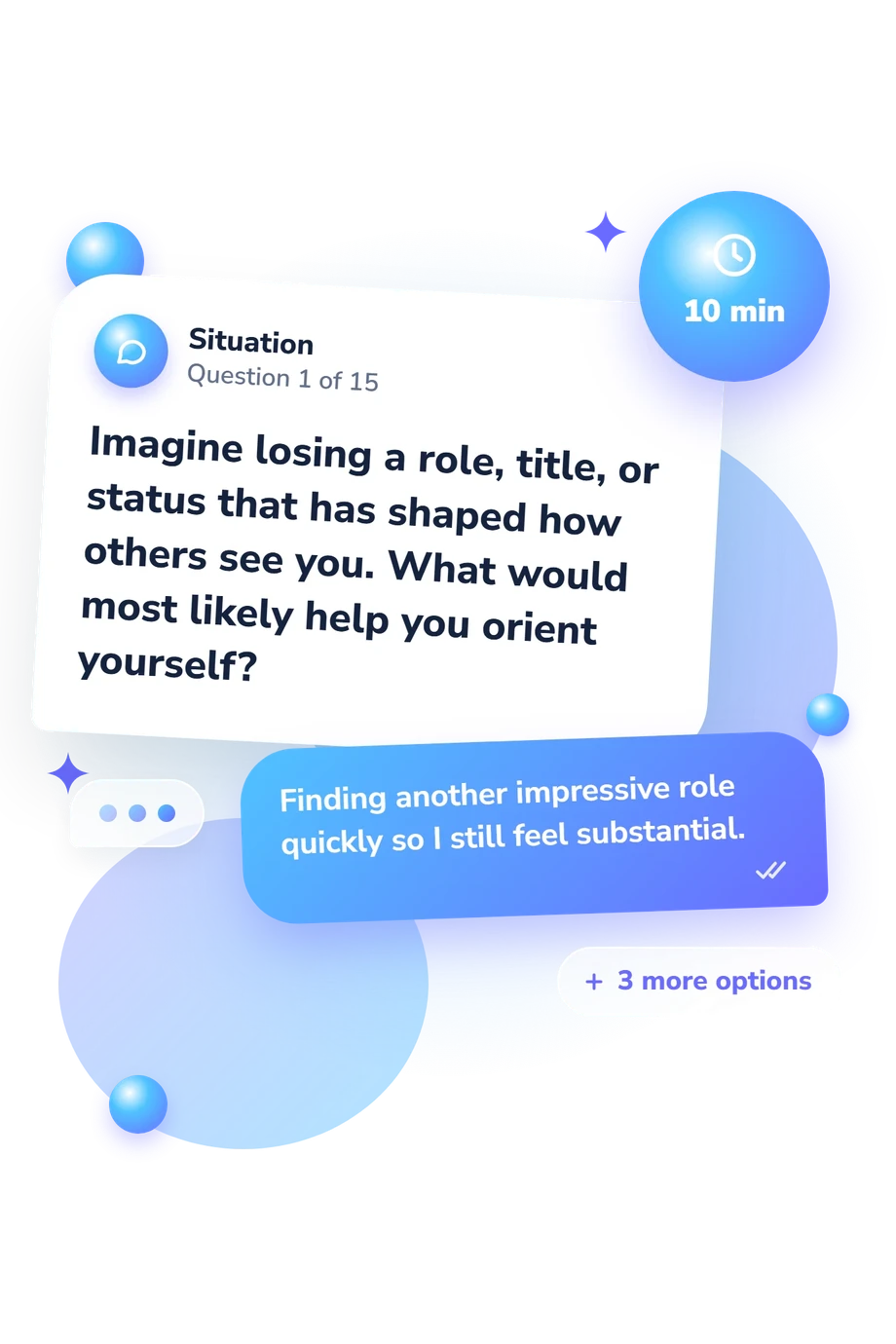
- Finding another impressive role quickly so I still feel substantial.
- Remembering that my qualities and relationships remain, even while I grieve the role.
- Listing past accomplishments until I feel I still measure up.
- Reconnecting with parts of myself the role expressed but did not create.
- I feel exposed and question whether my views deserve respect.
- I can revise my opinion without reducing my value as a person.
- I feel flawed at a deeper level, not merely incorrect about one thing.
- My confidence dips, but I can separate the error from my identity.
- It fades quickly, and I look for some sign that I matter.
- It is present, though a little reassurance would strengthen it.
- It remains steady without needing to be confirmed.
- It depends heavily on my mood and recent interactions.
How Much Am I Worth Quiz - Description and methodology of the test
People who question whether approval, achievement, or other people’s reactions shape their value can use the How Much Am I Worth Quiz to examine those patterns. This self-worth assessment is intended for personal reflection when self-respect feels inconsistent across relationships, setbacks, or comparison. It helps organize everyday experiences into a profile of what steadies value and what makes it harder to access.
What This Assessment Explores
Rather than assigning value, this self-worth questionnaire examines how readily a sense of value remains available without praise, certainty, comparison, or visible success. Its scenarios cover criticism, mistakes, exclusion, comparison, boundaries, support, rest, productivity, and achievement. The result describes tendencies in how you relate to yourself and others, not your worth or your relationships.
The profile contains three dimensions:
- Inner Worth Stability (0-15) shows how readily value remains accessible without reassurance: Approval-sensitive (0-5), Context-dependent (6-10), or Internally anchored (11-15).
- Relational Respect and Belonging (0-15) shows how consistently you experience yourself as deserving of respect, reciprocity, and boundaries with other people: Easily displaced (0-5), Uneven footing (6-10), or Mutual belonging (11-15).
- Worth Beyond Achievement (0-15) shows how well you separate human value from productivity and status: Performance-bound (0-5), Partly separated (6-10), or More than outcomes (11-15).
These bands help identify where self-respect feels conditional, uneven, or enduring.
Methodology and Evidence Base
The questions present situations with four response options. Choices differ in how a person interprets an event and protects or abandons a sense of value; they are not factual items. Scenarios sample comparison, closeness, criticism, boundaries, rest, and achievement, so the profile reflects response patterns rather than one isolated mood.
Each dimension receives its own score, but the questionnaire does not publish a rule showing how many points each answer contributes. The displayed bands are reflective descriptions, not clinical cutoffs. This is an online self-reflection questionnaire whose scoring has not been standardized. A worth assessment is most useful when compared with concrete examples from your life.
Its closest reference is the Contingencies of Self-Worth Scale (Crocker et al., 2003): this questionnaire is conceptually consistent with that work, not an adaptation of that scale. It also connects with self-esteem stability research by Altmann and Roth, respect in close relationships by Frei and Shaver, and sociometer theory from Leary and Baumeister.
Mood, self-awareness, memory, and response bias can shape self-report. Recurring patterns matter more than one uncomfortable score.
- Crocker, Jennifer, Riia K. Luhtanen, M. Lynne Cooper, and Alexandra Bouvrette. Contingencies of self-worth in college students: Theory and measurement. Journal of Personality and Social Psychology, 85(5), 894-908, 2003. 10.1037/0022-3514.85.5.894
- Altmann, Tobias, and Marcus Roth. The Self-esteem Stability Scale (SESS) for Cross-Sectional Direct Assessment of Self-esteem Stability. Frontiers in Psychology, 9, Article 91, 2018. 10.3389/fpsyg.2018.00091
- Frei, Jennifer R., and Phillip R. Shaver. Respect in close relationships: Prototype definition, self-report assessment, and initial correlates. Personal Relationships, 9(2), 121-139, 2002. 10.1111/1475-6811.00008
- Leary, Mark R., and Roy F. Baumeister. The nature and function of self-esteem: Sociometer theory. Advances in Experimental Social Psychology, 32, 1-62, 2000. 10.1016/S0065-2601(00)80003-9
Updated: