
Greek God Quiz
How the Scales are Structured
Who Usually Takes This Test?
See How You Compare
Below is a preview of how scores are typically distributed across each scale.
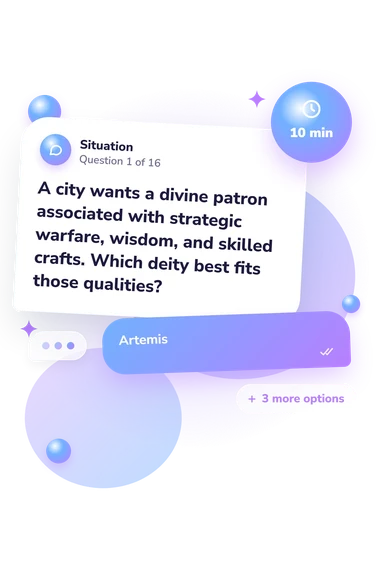
Example Questions From the Test
- Artemis
- Aphrodite
- Hera
- Athena
- Demeter
- Hestia
- Athena
- Artemis
- Hestia
- Aphrodite
- Hera
- Demeter
Greek God Quiz - Description and methodology of the test
Readers who enjoy ancient mythology and want to check what they genuinely remember can use the Greek God Quiz as a focused knowledge exercise. This recognition-based god quiz suits anyone who wants to test recall rather than receive a personality type. The result gives a concise picture of familiarity with major deities, their attributes, symbols, and stories, while pointing toward subjects worth revisiting.
What This Assessment Explores
The questionnaire checks factual knowledge of Greek gods and goddesses through domains, family roles, symbols, objects, and famous episodes. Items connect clues to figures such as Athena, Demeter, Hermes, and Dionysus, while distinguishing related powers over war, sea, and the underworld.
Taking this Greek deity quiz can help readers locate gaps in recall; it does not assess belief, literary interpretation, or resemblance to a deity.
The Greek God Knowledge scale has three bands:
- Mythology Starter (0-6) shows that reviewing domains, symbols, and family stories may strengthen foundational knowledge.
- Growing Mythologist (7-12) shows recognition of many major deities, with some mythic details still to refine.
- Olympus Expert (13-16) shows strong command of prominent gods, attributes, and classic episodes.
Methodology and Source Material
Each item presents a short mythological scenario, description, symbol, or narrative clue followed by four answer choices. The respondent selects the deity that best matches the information rather than rating feelings or behavior. Recognition-based responses are condensed into one total on the displayed knowledge scale, not a personality profile.
Content is conceptually consistent with the deity relationships, attributes, and stories discussed by Morford, Lenardon, and Sham. Hesiod’s mythic poems and the Homeric hymns supply primary literary contexts for gods, genealogies, domains, and cultic narratives. The questionnaire is an online educational self-assessment, while these works provide literary context rather than empirical validation of the questionnaire.
Performance on this Greek mythology quiz can identify remembered material, but performance depends on recognition, attention, and familiarity with the selected myths. Current concentration and choices between related figures may also affect the result. Treat the score as a starting point for reviewing sources and comparing variant myths.
The result is therefore a snapshot of recall, not a complete measure of mythological understanding.
- Morford, Mark P. O., Robert J. Lenardon, and Michael Sham. Classical Mythology. 9th ed. New York: Oxford University Press, 2011.
- Hesiod. Hesiod: Theogony, Works and Days, Shield. 3rd ed. Translated, with introduction and notes, by Apostolos N. Athanassakis. Baltimore: Johns Hopkins University Press, 2022. 10.56021/9781421443959.
- Homeric Hymns. Edited and translated by Susan C. Shelmerdine. Newburyport, MA: Focus, 2000.