
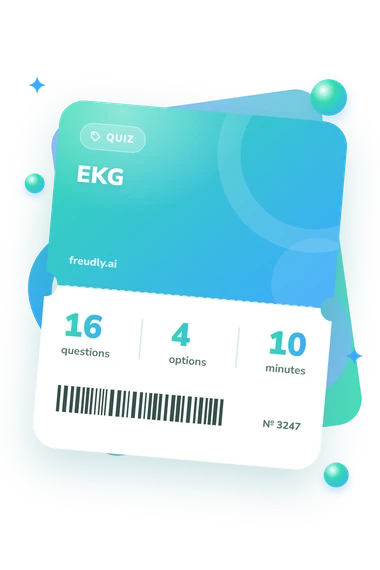
EKG Quiz
How the Scales are Structured
Who Usually Takes This Test?
See How You Compare
Below is a preview of how scores are typically distributed across each scale.
Example Questions From the Test
- Sinus arrhythmia
- Atrial flutter with fixed conduction
- Atrial fibrillation
- Monomorphic ventricular tachycardia
- Delayed conduction from the sinoatrial node to the atria
- An abnormally shortened period of ventricular repolarization
- Delayed or abnormal ventricular depolarization
- A normal variation in atrioventricular nodal conduction
- 20 second
- 10 second
- 04 second
- 40 second
EKG Quiz - Description and methodology of the test
For learners who want a focused check of electrocardiography fundamentals, this EKG Quiz connects rhythm recognition with interval, conduction, pacing, rate, ischemia, and electrolyte scenarios. This assessment functions as an ECG quiz for structured review, helping students and clinicians-in-training identify which concepts feel secure and which deserve deliberate practice before working with complete tracings and clinical context.
What This Assessment Explores
The assessment focuses on the skills tested in an ECG interpretation quiz: rhythm and conduction, interval and rate measurement, and the significance of ST elevation, ST depression, peaked T waves, and prolonged QT intervals.
The main themes are:
- Rhythm recognition asks you to distinguish sinus rhythm, atrial fibrillation, atrial flutter, ventricular ectopy, and AV block from waveform relationships.
- Intervals and conduction test what PR, QRS, and QT measurements imply about electrical activation.
- Rate and timing use paper speed and the 300 method.
- Pacing examines whether spikes are followed by ventricular capture.
- Ischemic and electrolyte patterns connect tracing changes with urgent possibilities.
Results appear under EKG Knowledge, with a 0-16 score range: Foundations to build (0-6), Developing interpretation (7-12), or Strong core knowledge (13-16). As an unvalidated educational score, these bands distinguish fundamentals needing review, developing recognition, and solid command of tested concepts; they do not establish clinical competence.
Methodology and Scientific Basis
Each item presents a vignette or measurement problem followed by four answer choices, so the task is selective recognition rather than free-form interpretation. Topics move from timing and interval knowledge to rhythm diagnosis, pacing, ischemic changes, and electrolyte-associated patterns. This questionnaire uses an ECG practice quiz format to support retrieval practice, but success depends on the concepts represented here. The responses are summarized as a total and grouped into the displayed educational bands.
The content is conceptually consistent with Hancock and colleagues’ 1987 standardized examination, which offers a precedent for assessing electrocardiogram interpretation, and with AHA/ACC/HRS recommendations on ECG technology, intraventricular conduction, ST-T changes, and QT assessment. This questionnaire is not presented as an adaptation or validation of that examination; its result helps direct review of the concepts represented here.
Interpretation depends on written scenarios, test familiarity, memory, and the absence of a complete tracing, patient history, and examination. Use the result to target review before applying ECG reasoning to full tracings and clinical context.
- E. William Hancock, John J. Norcini, George D. Webster. A standardized examination in the interpretation of electrocardiograms. Journal of the American College of Cardiology. 1987;10(4):882-886. 10.1016/S0735-1097(87)80284-X
- Paul Kligfield, Leonard S. Gettes, James J. Bailey, et al. Recommendations for the Standardization and Interpretation of the Electrocardiogram: Part I: The Electrocardiogram and Its Technology: A Scientific Statement From the American Heart Association Electrocardiography and Arrhythmias Committee, Council on Clinical Cardiology; the American College of Cardiology Foundation; and the Heart Rhythm Society, Endorsed by the International Society for Computerized Electrocardiology. Journal of the American College of Cardiology. 2007;49(10):1109-1127. 10.1016/j.jacc.2007.01.024
- Borys Surawicz, Rory Childers, Barbara J. Deal, et al. AHA/ACCF/HRS Recommendations for the Standardization and Interpretation of the Electrocardiogram: Part III: Intraventricular Conduction Disturbances: A Scientific Statement From the American Heart Association Electrocardiography and Arrhythmias Committee, Council on Clinical Cardiology; the American College of Cardiology Foundation; and the Heart Rhythm Society, Endorsed by the International Society for Computerized Electrocardiology. Journal of the American College of Cardiology. 2009;53(11):976-981. 10.1016/j.jacc.2008.12.013
- Pentti M. Rautaharju, Borys Surawicz, Leonard S. Gettes. AHA/ACCF/HRS Recommendations for the Standardization and Interpretation of the Electrocardiogram: Part IV: The ST Segment, T and U Waves, and the QT Interval: A Scientific Statement From the American Heart Association Electrocardiography and Arrhythmias Committee, Council on Clinical Cardiology; the American College of Cardiology Foundation; and the Heart Rhythm Society, Endorsed by the International Society for Computerized Electrocardiology. Journal of the American College of Cardiology. 2009;53(11):982-991. 10.1016/j.jacc.2008.12.014