
Data Science Quiz
How the Scales are Structured
Who Usually Takes This Test?
See How You Compare
Below is a preview of how scores are typically distributed across each scale.
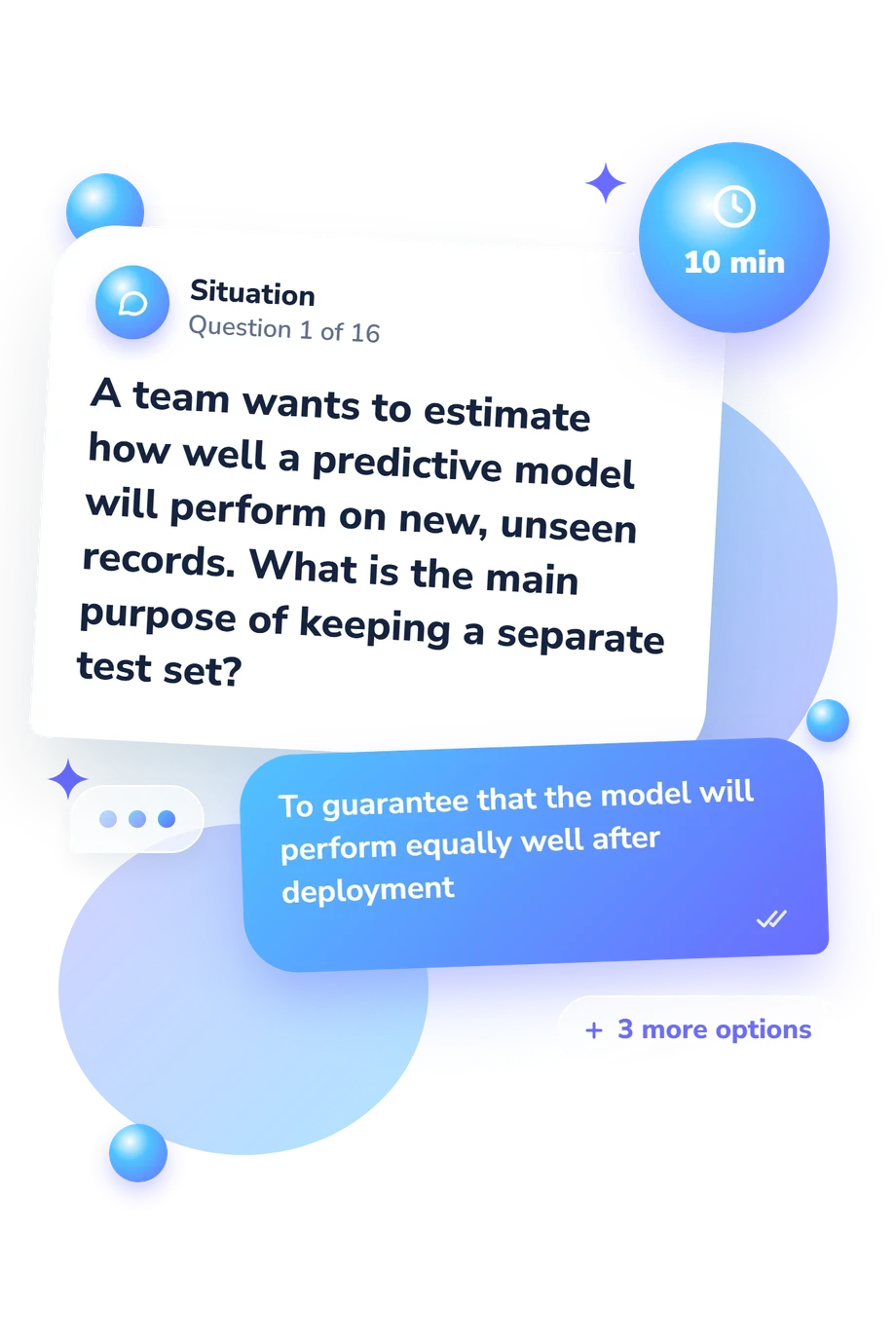
Example Questions From the Test
- Add more rows after each run
- Set and record the random seed used by the splitting procedure
- Sort the target values from highest to lowest before splitting
- Remove the target column before saving the dataset
- SELECT region, AVG(revenue) FROM sales GROUP BY revenue;
- SELECT region, AVG(revenue) FROM sales GROUP BY region;
- SELECT AVG(region), revenue FROM sales GROUP BY region;
- SELECT region, revenue FROM sales WHERE revenue = AVG(revenue);
- The model is overfitting patterns specific to the training data
- The model is underfitting because both scores are equally low
- The target variable must be continuous
- The test data have been used too many times during training
Data Science Quiz - Description and methodology of the test
People building foundational skills, reviewing coursework, or preparing for practical data work can use this data science assessment to check how they reason about common data problems. The data science quiz connects model evaluation, preprocessing, SQL, and machine learning with short applied scenarios. Before coursework or practical projects, learners can use the result to identify methods they may want to revisit.
What This Assessment Explores
This questionnaire measures understanding rather than personality or work history. It suits learners who want to choose methods, spot errors, and interpret results.
Topics include statistics, preparation, validation, learning, model maintenance, SQL, and categorical encoding. As a data science knowledge test, it shows whether methods match the problems they solve.
Data Science Knowledge runs 0-16: Foundations to build (0-6) means core ideas need review; Developing knowledge (7-12) means many essentials are understood with gaps; Strong knowledge (13-16) means foundational command. It is educational, not a professional certification or hiring recommendation.
The question themes are:
- Metrics and uncertainty show whether the respondent can choose suitable measures and interpret results.
- Preparation and validation show whether the respondent can prevent leakage and estimate performance on unseen data.
- Modeling and tools show whether the respondent can recognize overfitting, drift, clustering, SQL logic, and category encoding.
Methodology and Scientific Basis
Each item presents a data problem with four answer choices. The respondent selects the best answer, and the score gives one point for each correct response. This is an objective knowledge check rather than a self-report: it tests reasoning in context, such as choosing recall for missed positives or identifying leakage before a train-test split.
The content is conceptually consistent with De Veaux et al. (2017), whose curriculum guidance spans statistical thinking, computing, data management, modeling, and communication. It also aligns with Danyluk and Leidig (2021) and the professional capability areas described by Demchenko et al. (2016). These sources support the coverage and educational framing, but do not make this questionnaire an adaptation, normed form, or validated reproduction of one instrument.
Interpret the result as performance on selected concepts at completion. Prior coursework, terminology familiarity, guessing, and misunderstandings can affect it, while the short format cannot capture programming fluency, project execution, communication, domain expertise, or hiring performance. This assessment can point to the next topic in data science learning, but the bands are educational guideposts rather than universal standards.
- De Veaux, Richard D., Mahesh Agarwal, Maia Averett, Benjamin S. Baumer, Andrew Bray, Thomas C. Bressoud, et al. (2017). Curriculum Guidelines for Undergraduate Programs in Data Science. Annual Review of Statistics and Its Application, 4(1), 15-30. 10.1146/annurev-statistics-060116-053930
- Danyluk, Andrea, and Paul Leidig. (2021). Computing Competencies for Undergraduate Data Science Curricula: ACM Data Science Task Force. New York, NY: Association for Computing Machinery. 10.1145/3453538
- Demchenko, Yuri, Adam Belloum, Wouter Los, Tomasz Wiktorski, Andrea Manieri, Holger Brocks, Jana Becker, Dominic Heutelbeck, Matthias L. Hemmje, and Steve Brewer. (2016). EDISON Data Science Framework: A Foundation for Building Data Science Profession for Research and Industry. In 2016 IEEE International Conference on Cloud Computing Technology and Science (CloudCom), 620-626. 10.1109/CloudCom.2016.0107
Updated: