
Am I Yin or Yang Quiz
How the Scales are Structured
Who Usually Takes This Test?
See How You Compare
Below is a preview of how scores are typically distributed across each scale.
Example Questions From the Test
- I repeatedly move between listening, shaping, and taking action
- I explore first, then make a clear switch into execution
- I contribute mainly through careful analysis and refinement
- I focus mainly on decisions, assignments, and forward progress
- Introduce myself widely and start conversations
- Circulate when the energy feels inviting
- Respond warmly when others approach me
- Settle into one deeper conversation
- Spending it quietly with a book, music, or my thoughts
- Catching up with one person in a relaxed setting
- Using the time for a practical hobby or personal task
- Finding an active outing or lively gathering
Am I Yin or Yang Quiz - Description and methodology of the test
Readers who want to compare their responses across decisions, relationships, social settings, recovery, and pace can use the Am I Yin or Yang Quiz as a guided self-reflection exercise. By bringing those situations together, the yin or yang quiz helps reveal recurring preferences without forcing a permanent type. The result is most useful when used to notice where your responses stay consistent or change with circumstances.
What This Assessment Explores
Questions cover decisions, disagreement, unfamiliar settings, social contact, recovery, and changes in pace. The test suits readers who want to see whether they more often activate, receive, or combine these modes. The result shows what this yin and yang quiz makes visible about your preferences across situations, rather than assigning a permanent identity.
The three displayed dimensions are:
- Yang Energy (0-15) reflects initiative, expression, and momentum: Yang Less Central (0-5), Situational Yang (6-10), or Strong Yang Affinity (11-15).
- Yin Energy (0-15) reflects receptivity, contemplation, and quiet restoration: Yin less central (0-5), Situational Yin (6-10), or Strong Yin affinity (11-15).
- Yin-Yang Balance (0-15) reflects combining receptive and active modes: Distinct preference (0-5), Flexible bridge (6-10), or Integrated rhythm (11-15).
Together, the scores show whether one mode stands out or the profile suggests a blend.
Methodology and Scientific Basis
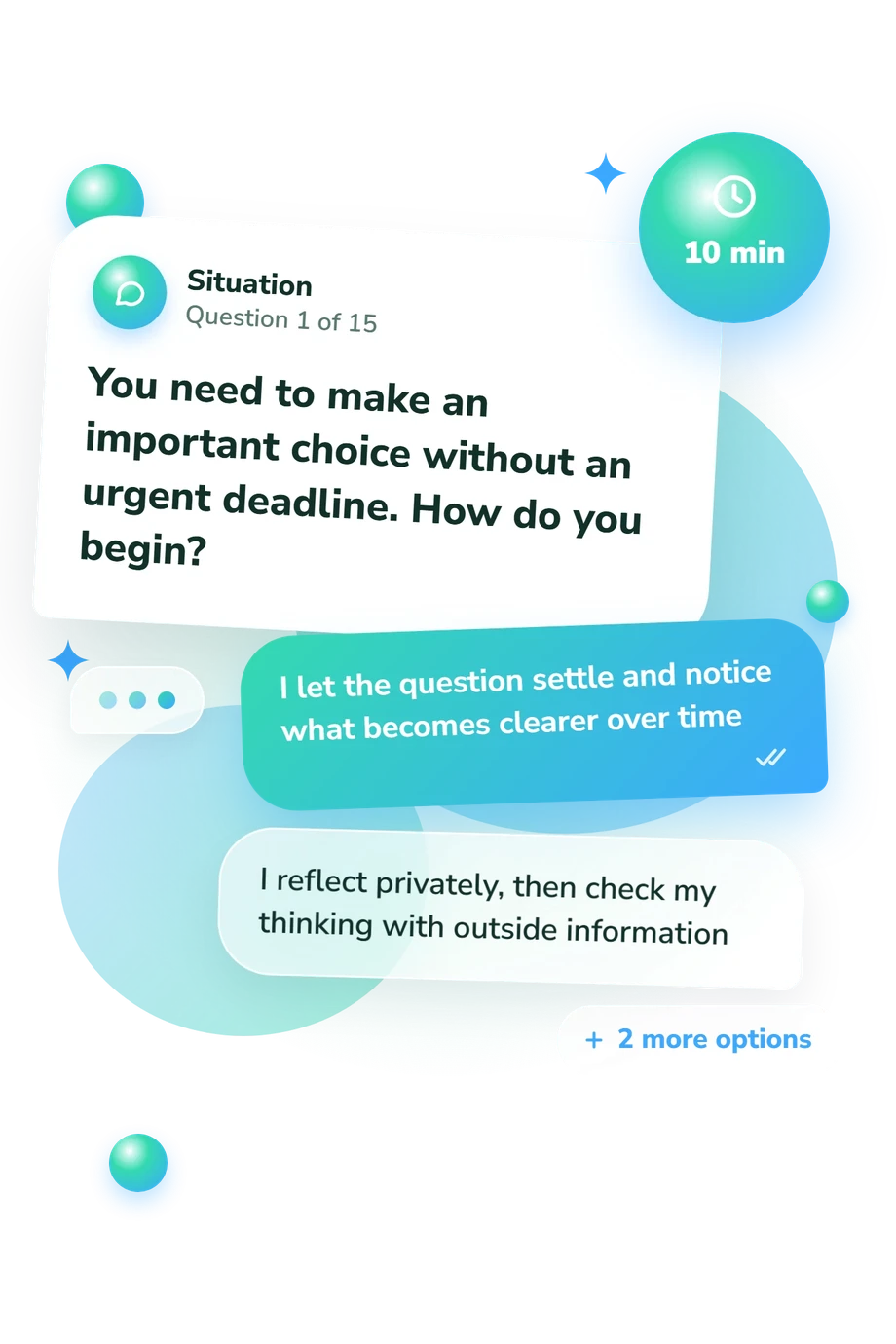
Each item presents a familiar situation and four response options. The choices span reflective, receptive, active, and integrative approaches, asking which feels most natural rather than testing right or wrong answers. Scenarios sample behavior, thought, emotion, social engagement, and personal rhythm.
Structurally, this questionnaire is conceptually consistent with the revised Sasang Personality Questionnaire, the 15-item instrument Chae and colleagues described in 2021, organized around behavior, cognition, and emotion. Its displayed scoring is specific to this assessment. Lee and colleagues’ 2016 study links Yin-Yang temperament to Cloninger’s model and BIS/BAS theory; that work offers conceptual context, not validation of this online questionnaire.
Scoring produces three displayed dimension scores, but their values do not show how many points each answer contributes. Compare the scores: the highest indicates the strongest affinity, and scores within one point indicate a blend.
Because this yin yang quiz relies on self-report, current context and self-perception can influence the result. Read the profile as a structured snapshot of stated preferences with the item situations showing how those preferences may appear in everyday decisions, relationships, and recovery.
- Chae H, Cho YI, Lee SJ. The Yin-Yang personality from biopsychological perspective using revised Sasang Personality Questionnaire. Integrative Medicine Research. 2021;10(1):100455. 10.1016/j.imr.2020.100455
- Lee SJ, Park SH, Chae H. Biopsychological structure of Yin-Yang using Cloninger’s Temperament model and Carver and White’s BIS/BAS scale. PeerJ. 2016;4:e2021. 10.7717/peerj.2021
- Chae H, Lee S, Park SH, Jang E, Lee SJ. Development and Validation of a Personality Assessment Instrument for Traditional Korean Medicine: Sasang Personality Questionnaire. Evidence-Based Complementary and Alternative Medicine. 2012;2012:657013. 10.1155/2012/657013
- Hwang BK, Yoon YJ, Han SY, Lee SJ, Chae H. Validity of Yin-Yang temperament in Sasang Personality Questionnaire. Integrative Medicine Research. 2018;7(1):77-84. 10.1016/j.imr.2018.01.001
Updated: