
Am I Poor Quiz
How the Scales are Structured
Who Usually Takes This Test?
See How You Compare
Below is a preview of how scores are typically distributed across each scale.
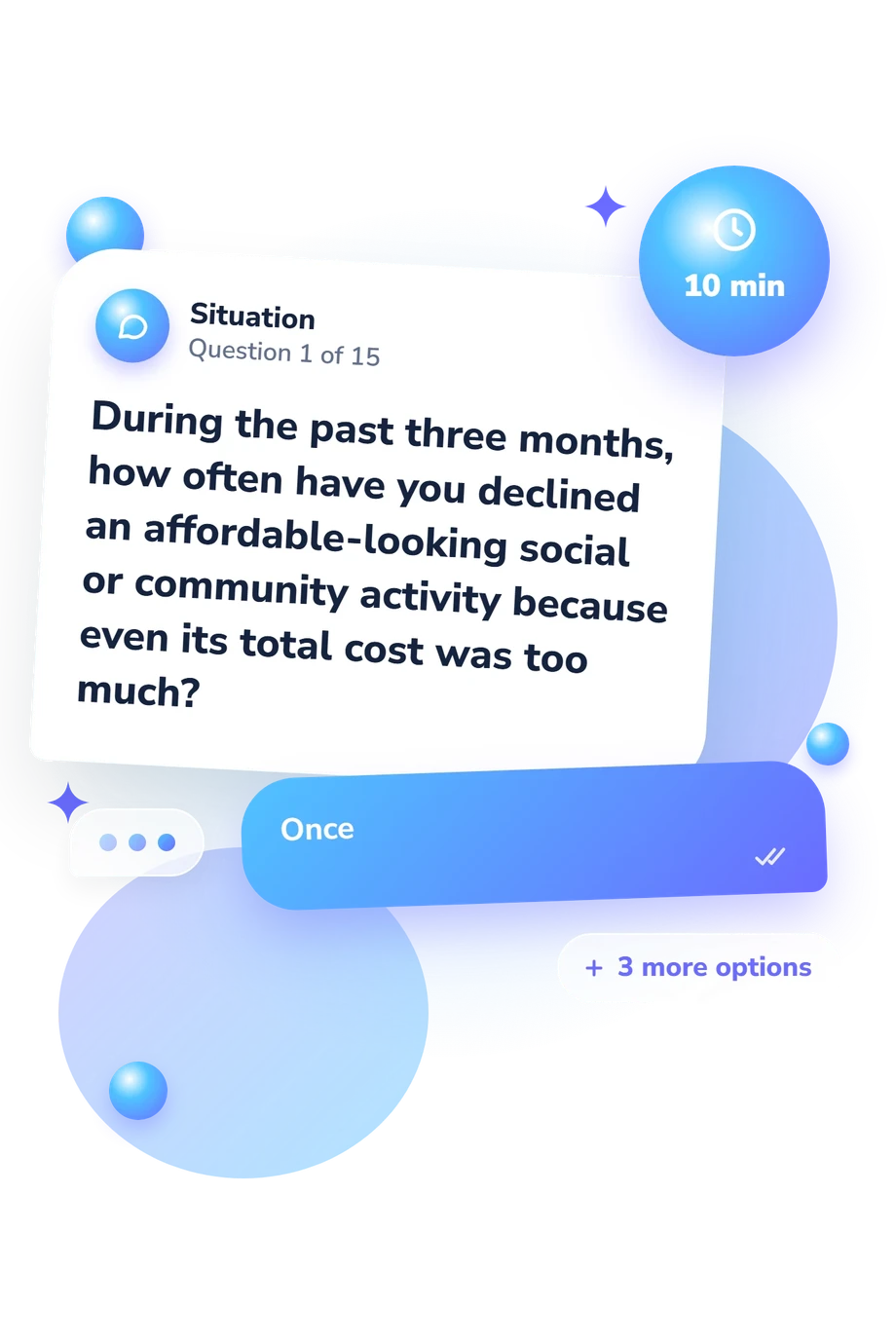
Example Questions From the Test
- Several times during the month
- Not during the past month
- Once or twice
- Most weeks or almost continuously
- Less than one month
- At least three months
- My available money already does not fully cover essentials
- One month but less than three months
- It varies, but I can usually plan around the changes
- Frequent gaps require credit, borrowing, or delayed payments
- It is predictable enough to plan regular expenses
- Repeated gaps leave essential expenses unpaid
Am I Poor Quiz - Description and methodology of the test
People trying to understand whether current financial pressures are manageable can use this financial strain questionnaire to organize experiences that are easy to blur together. The Am I Poor Quiz helps identify where present costs, interruptions, or trade-offs are creating difficulty. Its profile turns those experiences into practical areas for reflection and decisions about available support.
What This Assessment Explores
Questions focus on situations where money affects basic needs, financial buffer and debt pressure, and participation. They address food, housing, utilities, healthcare, necessary items, irregular income, debt pressure, limited reserves, shortfalls, emergencies, transport, digital access, relationships, and work or training. The profile offers a poverty assessment of where present strain is concentrated.
These are the three dimensions shown in the result:
- Essential Needs Security (0-15) reflects pressure on necessities: Fewer current pressures (0-5), Recurring trade-offs (6-10), or Essentials under strain (11-15).
- Financial Buffer and Debt Pressure (0-15) reflects room for costs and shocks: Some financial room (0-5), Thin buffer (6-10), or Persistent shortfalls (11-15).
- Participation and Opportunity Access (0-15) reflects affordability barriers: Broad access (0-5), Selective constraints (6-10), or Heavily restricted (11-15).
The questionnaire describes present financial conditions rather than predicting future wealth.
Methodology and Scientific Basis
Each item presents a self-report situation with four response choices about frequency, delay, borrowing, interruption, affordability, or meeting a need promptly. The choices describe different levels or forms of financial pressure, and the displayed method provides three separate summaries rather than a combined poverty score.
Read as a material hardship assessment, the questionnaire is conceptually consistent with the distinction between material hardship and income poverty discussed by Carle, Bauman, and Short (2009), Short (2005), and Iceland and Bauman (2007). Its multidimensional structure corresponds with Bourguignon and Chakravarty (2003). Those studies provide conceptual context for the dimensions; they do not validate this online questionnaire.
Interpret the displayed bands as summaries of current circumstances, not an official poverty classification. They help distinguish pressure involving essentials, financial interruptions, debt, reserves, and access to participation or opportunity. Results can shift with recent bills, memory, self-awareness, and willingness to disclose difficulty, so they are best used to identify pressure points and consider practical support or further assessment.
- Carle, Adam C., Kurt J. Bauman, and Kathleen S. Short. 2009. "Assessing the Measurement and Structure of Material Hardship in the United States." Social Indicators Research 92(1): 35-51. 10.1007/s11205-008-9287-7
- Short, Kathleen S. 2005. "Material and Financial Hardship and Income-Based Poverty Measures in the USA." Journal of Social Policy 34(1): 21-38. 10.1017/S0047279404008244
- Iceland, John, and Kurt J. Bauman. 2007. "Income Poverty and Material Hardship: How Strong Is the Association?" Journal of Socio-Economics 36(3): 376-396. 10.1016/j.socec.2006.12.003
- Bourguignon, François, and Satya R. Chakravarty. 2003. "The Measurement of Multidimensional Poverty." The Journal of Economic Inequality 1(1): 25-49. 10.1023/A:1023913831342
Updated: