
Am I Black Quiz
How the Scales are Structured
Who Usually Takes This Test?
See How You Compare
Below is a preview of how scores are typically distributed across each scale.
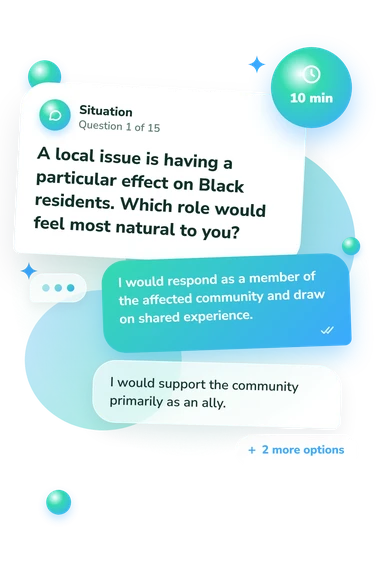
Example Questions From the Test
- I would respond as a member of the affected community and draw on shared experience.
- I would support the community primarily as an ally.
- I would first learn more while working out how my own background relates.
- I would feel partly connected because the issue affects communities or experiences I share.
- It has felt relevant in some situations but less so in others.
- It has not felt like part of my identity.
- It has felt like a stable part of who I am.
- I have been questioning or tentatively exploring it.
- They are a recurring and personally meaningful part of my life.
- They are central to how I understand myself and my communities.
- I am curious about them but mainly engage as a learner.
- They have little connection to how I understand my own identity.
Am I Black Quiz - Description and methodology of the test
People considering how culture, family history, community context, and self-description fit together can use the Am I Black Quiz as a structured reflection rather than a forced yes-or-no judgment. It is suited to someone exploring a mixed, emerging, uncertain, or established connection. As a racial identity questionnaire, it returns a profile showing which parts of that connection feel most settled.
What This Assessment Explores
The questionnaire examines Black identity through cultural connection and shared experiences, known family and community roots, and personal self-identification. It suits established, mixed, emerging, or uncertain backgrounds. This Black identity assessment describes a current profile rather than a single verdict.
The dimensions are:
- Cultural and Lived Connection (0-15) reads cultural spaces, histories, voices, and racialized experiences as Mainly outside connection (0-5), Developing or mixed connection (6-10), or Strong lived connection (11-15); participation alone cannot determine race.
- Family and Community Roots (0-15) summarizes known Black family histories and community ties, not blood quantum: Little known connection (0-5), Partial or emerging roots (6-10), or Established roots (11-15).
- Personal Self-Identification (0-15) reflects how consistently you currently claim Black as part of your identity: Not a current self-label (0-5), Exploring or contextual (6-10), or Established self-identification (11-15); no band proves or disproves your race.
Methodology and Scientific Basis
Each item uses a brief everyday scenario or self-description prompt followed by four response choices. The four response choices distinguish degrees of cultural connection, family-root knowledge, uncertainty, and self-identification.
Results are displayed across three separate scales and interpreted through the bands shown for each scale. Because answers are self-reported, current circumstances, family knowledge, social treatment, and willingness to disclose can influence the pattern.
The questionnaire is conceptually consistent with the Multidimensional Inventory of Black Identity (Sellers et al., 1997) and Davis et al.'s (2010) Black Identity Classification Scale, but is not an adaptation or direct validation of either instrument. The Sellers et al. (1998) model further emphasizes that identity can involve meaning, centrality, and regard rather than a single categorical label.
Read the result from this Black identity test as a way to organize self-understanding when cultural connection, family knowledge, and self-description do not line up neatly.
- Sellers, R. M., Rowley, S. A. J., Chavous, T. M., Shelton, J. N., & Smith, M. A. (1997). Multidimensional inventory of Black identity: A preliminary investigation of reliability and construct validity. Journal of Personality and Social Psychology, 73(4), 805-815. 10.1037/0022-3514.73.4.805
- Sellers, R. M., Smith, M. A., Shelton, J. N., Rowley, S. A. J., & Chavous, T. M. (1998). Multidimensional model of racial identity: A reconceptualization of African American racial identity. Personality and Social Psychology Review, 2(1), 18-39. 10.1207/s15327957pspr0201_2
- Davis, R. E., Alexander, G., Calvi, J., Wiese, C., Greene, S. M., Nowak, M., Cross, W. E., & Resnicow, K. (2010). A new audience segmentation tool for African Americans: The Black Identity Classification Scale. Journal of Health Communication, 15(5), 532-554. 10.1080/10810730.2010.492563