
Why Do I Feel Empty Inside Quiz
How the Scales are Structured
Who Usually Takes This Test?
See How You Compare
Below is a preview of how scores are typically distributed across each scale.
Example Questions From the Test
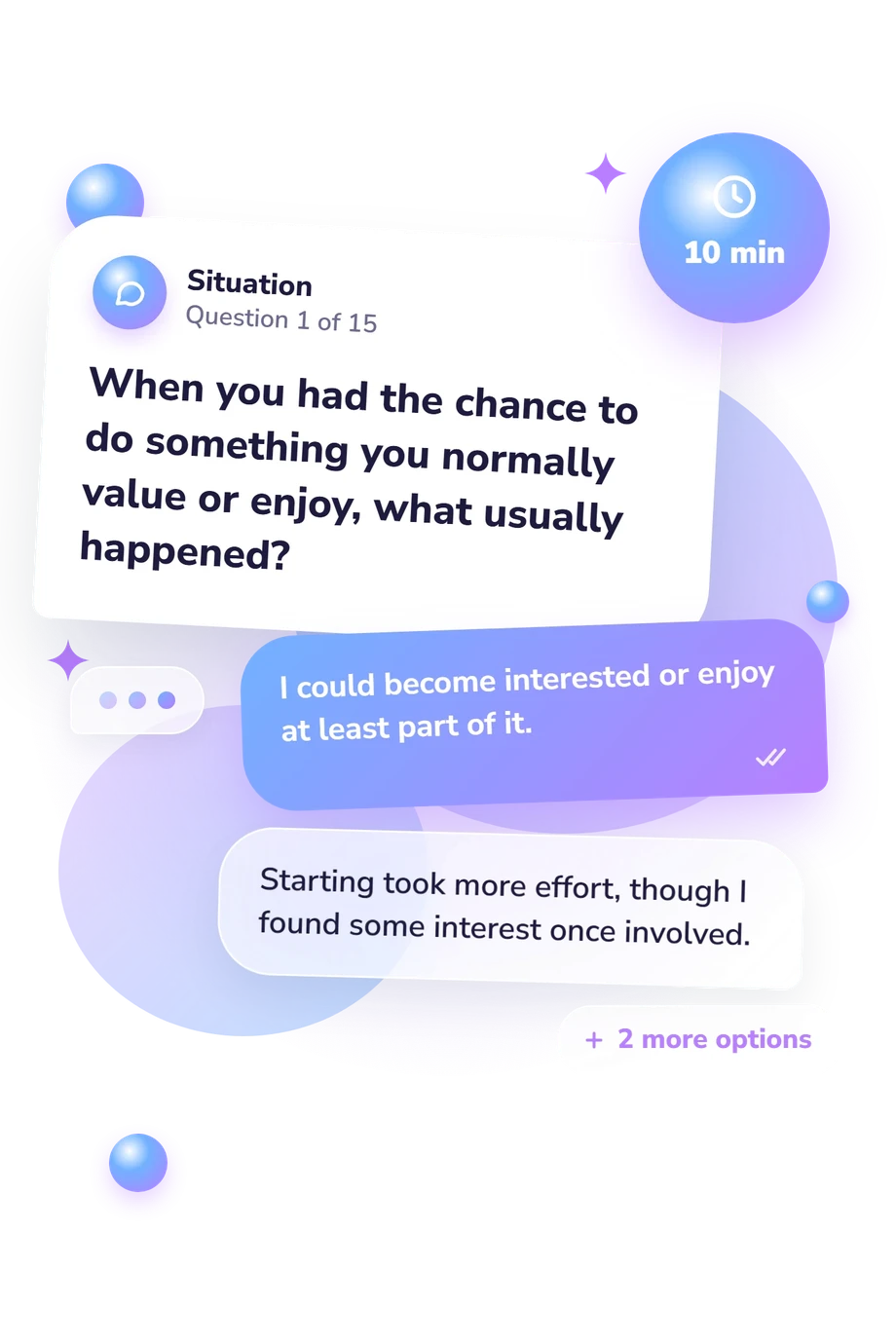
- I could become interested or enjoy at least part of it.
- Starting took more effort, though I found some interest once involved.
- I usually felt little interest and often stopped or avoided the activity.
- Nothing felt rewarding, and that loss felt deeply distressing or hopeless.
- I have not thought about or intentionally hurt myself.
- The idea crossed my mind, but I did not feel an urge to do it.
- I have felt urges to hurt myself, though I have not acted on them recently.
- I have hurt myself recently, taken steps toward it, or believe I may do so soon.
- I have not had an urge to put myself in danger or cause injury.
- I noticed a brief impulse but did not move toward acting on it.
- I have had repeated urges or taken minor risks that concern me.
- I have taken a dangerous or injurious action, begun preparing for one, or may act soon.
Why Do I Feel Empty Inside Quiz - Description and methodology of the test
People seeking clarity about current emptiness may use the Why Do I Feel Empty Inside Quiz to examine how disconnection affects feelings, routines, relationships, and safety. For some readers, naming the reasons for feeling empty can organize experiences that feel vague or difficult to explain. The profile highlights which areas deserve attention and whether reaching toward personal or professional support may be sensible.
What This Assessment Explores
Emptiness is examined as a recent experience involving reduced pleasure, muted emotions, lost meaning, difficulty connecting, low motivation, and disruption to responsibilities. As a why do I feel empty quiz, it supports reflection on hard-to-manage patterns.
By separating inner disconnection from functioning and safety or support concerns, the questionnaire helps a person ask why they feel empty without reducing the result to one label. The result is a profile rather than a single label. Its dimensions are:
- Daily Functioning Strain (0-15) measures disruption in routines, relationships, concentration, and self-care: No indicator 0; Worth monitoring 1-2; Support warranted 3-15.
- Emotional Disconnection (0-15) measures numbness, distance, reduced meaning, and muted feelings: No indicator endorsed 0; Worth noticing 1-2; Support warranted 3-15.
- Safety and Support Needs (0-15) measures danger-related experiences and barriers to help: No indicator endorsed 0; Reach toward support 1-2; Act now 3-15.
Methodology and Scientific Basis
Each item presents four ordered response descriptions, moving from little or no difficulty toward greater disruption, danger, or inability to meet basic needs. The wording asks about recent experience, so the result reflects current perspective rather than a fixed trait. Scores are grouped across the three dimensions; the questionnaire's point weighting is not documented.
Conceptually, the questionnaire is consistent with Miller et al. (2021), whose findings connect chronic emptiness with disconnection, painful inner experience, lost meaning, and effects on everyday life. Herron et al. (2024) offer comparison through the Psychological Emptiness Scale, while Ermis-Demirtas et al. (2022) offer conceptual context for viewing emptiness as multidimensional rather than singular. These works provide comparison and conceptual context, not the questionnaire's provenance.
The displayed bands are unvalidated reflective guides rather than clinical cutoffs. The emptiness quiz can organize self-observation about emotional emptiness alongside stress, sleep, relationships, and functioning. Self-report is sensitive to mood, memory, self-awareness, and immediate context. Any concerning endorsed experience matters independently of its scale total, and a red-flag response overrides the total; inability to stay safe requires urgent help.
- Miller CE, Townsend ML, Grenyer BFS. Understanding chronic feelings of emptiness in borderline personality disorder: a qualitative study. Borderline Personality Disorder and Emotion Dysregulation. 2021;8(1):Article 24, 1-9. 10.1186/s40479-021-00164-8
- Herron SJ, Saunders R, Sani F, Feigenbaum J. The Psychological Emptiness Scale: a psychometric evaluation. BJPsych Open. 2024;10(2):e42, 1-10. 10.1192/bjo.2023.649
- Ermis-Demirtas H, Smith RL, Watson JC. Development and Initial Validation of the Multidimensional Sense of Emptiness Scale. The Counseling Psychologist. 2022;50(7):918-941. 10.1177/00110000221110847
Updated: