
What Kind of Physical Touch Do You Need Quiz
How the Scales are Structured
Who Usually Takes This Test?
See How You Compare
Below is a preview of how scores are typically distributed across each scale.
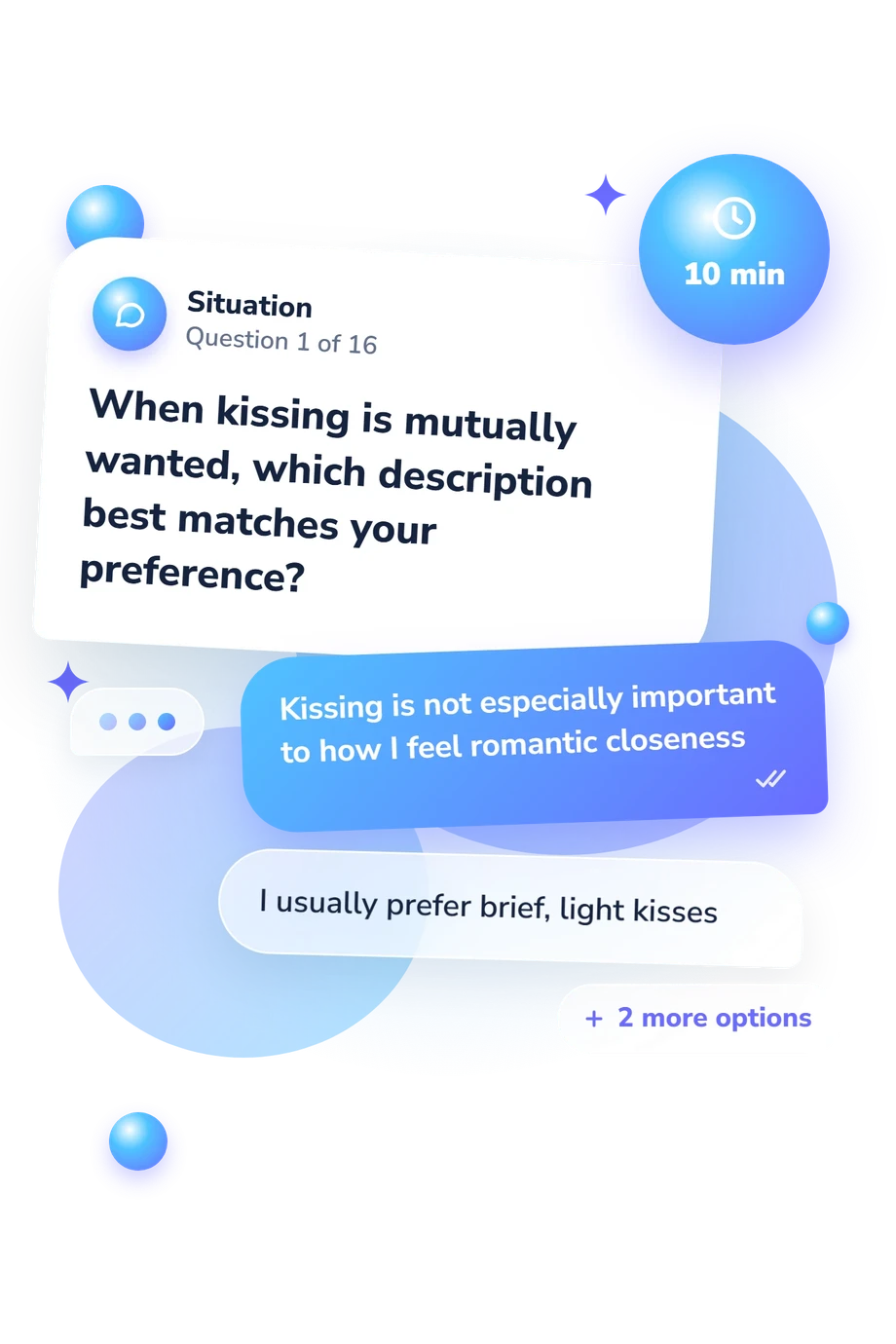
Example Questions From the Test
- Sharing a room while each person has their own space
- Sitting close enough for our feet or shoulders to touch
- Settling into an easy cuddle while we relax
- Sitting nearby without continuous contact
- A warm smile and an enthusiastic hello
- A full hug that lasts a few moments
- A quick side hug before we start talking
- A lingering embrace with another affectionate touch
- Focusing on conversation or a shared activity without much touch
- Sitting close with occasional contact
- Sharing a lingering embrace while we connect
- Spending unhurried time kissing or cuddling closely
What Kind of Physical Touch Do You Need Quiz - Description and methodology of the test
People who want to understand how touch fits into emotional and relational life can use this Personality Quiz What Kind of Physical Touch as a guided self-reflection exercise. It suits readers comparing preferences for comfort, everyday affection, play, or intimacy and seeking language for patterns that may be easy to notice but difficult to explain. The What Kind of Physical Touch Quiz groups these patterns into a profile of your touch preferences.
What This Assessment Explores
The questionnaire treats touch as several preferences rather than a single need. Situations cover reassurance during stress, familiar daily contact, lively gestures, and slower romantic closeness, so the quiz asks what physical touch feels most natural in different settings without equating preference with sociability or relationship quality.
These result dimensions are:
- Comforting & Grounding Touch (0-12) measures reassuring contact during stress; Not central (0-4), Situational comfort (5-8), or Strong grounding pull (9-12).
- Everyday Affection (0-12) measures warm touch in routines; Not central (0-4), Selective warmth (5-8), or Strong everyday pull (9-12).
- Playful & Energetic Touch (0-12) measures lively contact such as dancing or high-fives; Not central (0-4), Selectively playful (5-8), or Strong playful pull (9-12).
- Romantic & Sensual Closeness (0-12) measures unhurried touch linked to attraction; Not central (0-4), Context-dependent closeness (5-8), or Strong intimate pull (9-12).
Methodology and Evidence Base
Each item presents four self-report descriptions of a situation involving greeting, support, play, everyday contact, or romantic closeness. Options vary in the type, context, intensity, and duration of contact, so the respondent can choose the closest personal preference. The labels indicate the strength of preference or affinity rather than answer tendencies, required behavior, relationship quality, compatibility, or consent.
Each dimension receives an affinity score. The highest is the strongest preference; scores within one point form a blended result. As a physical touch personality quiz, it offers a profile and can support clearer conversations without deciding what anyone should want.
The structure is conceptually consistent with research by Jakubiak and colleagues on desire for touch, the TEAQ’s positive-touch measure, and work by Jakubiak and Feeney on touch during stress discussions. It is not presented as an adaptation or standardized administration of those instruments. The displayed bands are descriptive rather than normative cutoffs, and self-report may shift with mood, relationships, memory, and wording. Treat the profile as a snapshot of preference.
- Brett K. Jakubiak, Julian D. Fuentes, and Brooke C. Feeney (2021). Individual and relational differences in desire for touch in romantic relationships. Journal of Social and Personal Relationships, 38(7), 2029-2052. 10.1177/02654075211003331
- P. D. Trotter, F. McGlone, R. L. E. P. Reniers, and J. F. W. Deakin (2018). Construction and Validation of the Touch Experiences and Attitudes Questionnaire (TEAQ): A Self-report Measure to Determine Attitudes Toward and Experiences of Positive Touch. Journal of Nonverbal Behavior, 42(4), 379-416. 10.1007/s10919-018-0281-8
- Brett K. Jakubiak and Brooke C. Feeney (2019). Interpersonal touch as a resource to facilitate positive personal and relational outcomes during stress discussions. Journal of Social and Personal Relationships, 36(9), 2918-2936. 10.1177/0265407518804666
Updated: