
Vampire Power Quiz
How the Scales are Structured
Who Usually Takes This Test?
See How You Compare
Below is a preview of how scores are typically distributed across each scale.
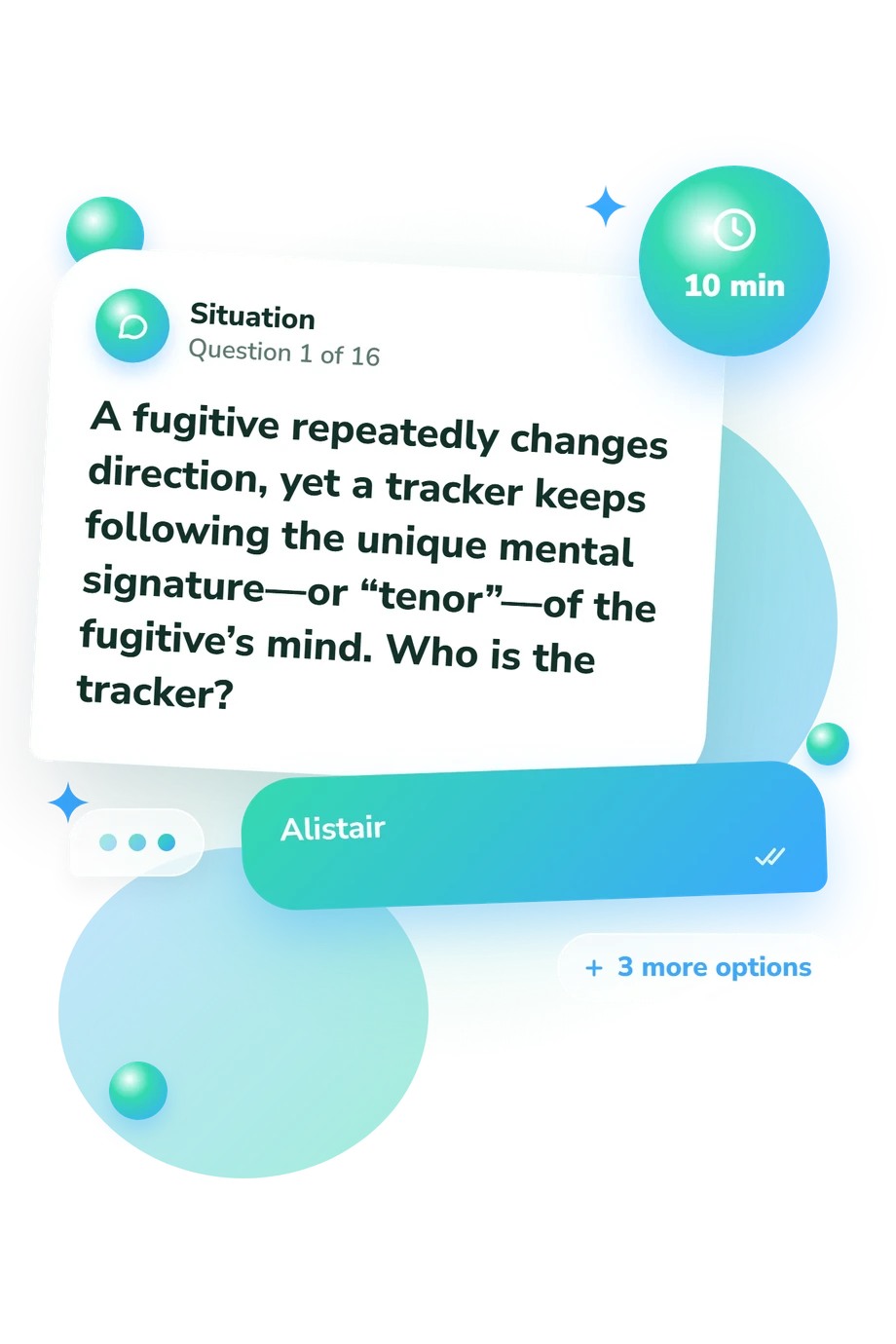
Example Questions From the Test
- Hearing unspoken thoughts from a distance
- Projecting thoughts and images through touch
- Influencing the person’s emotional loyalties
- Temporarily removing the person’s senses
- Benjamin
- Garrett
- Senna
- Stefan
- Sensing and influencing emotions
- Reading everyone’s private thoughts
- Creating visual illusions
- Changing the strength of personal bonds
Vampire Power Quiz - Description and methodology of the test
Readers who enjoy matching Twilight characters with their supernatural gifts can use this vampire power quiz to check canon recognition rather than personality or paranormal belief. This questionnaire directly tests recall of Twilight character powers, their effects, and limits for anyone reviewing the series’ lore. Results give a focused picture of familiarity and suggest which details deserve another look.
What This Assessment Explores
This assessment suits readers who match supernatural abilities to their owners. As a vampire ability quiz, it tests recall and the ability to infer a power from a scene, effect, or limit. The result reflects canon familiarity rather than personality or paranormal belief.
The tested knowledge falls into three areas:
- Character matching shows whether you connect a distinctive gift with its owner and affiliation.
- Gift mechanics show whether you understand projection, visions, shields, sensory effects, and emotional influence.
- Scene interpretation shows whether you identify a power from a change in perception, movement, or mood.
The displayed Vampire Power Knowledge scale runs from 0-16. Power Foundations covers 0-6, Developing Gift Knowledge covers 7-12, and Canon Fluent covers 13-16. These bands describe increasing command of gifts and owners. It is an unofficial fandom measure, not affiliated with the Twilight books or films.
Methodology and Evidence Base
Each item presents a canon situation with four answer choices. Prompts ask for a character, gift, or mechanism, so performance depends on connecting a remembered detail with its interpretation. The format measures recognition and applied recall rather than personality.
The questionnaire reports an informal 0-16 knowledge result through the catalogue’s three bands: Power Foundations, Developing Gift Knowledge, and Canon Fluent. The labels distinguish levels of familiarity with the represented gifts and owners. Familiarity with the novels, films, or both can affect performance.
The Official Illustrated Guide and Breaking Dawn serve as canon references for the characters and abilities represented in the questions. They support the subject matter, not the questionnaire’s scoring or status as a psychological instrument. The prompts ask about gifts, their effects, limits, and owners, so familiarity with terminology helps distinguish related choices. Question wording places abilities in scenes involving touch, perception, emotion, protection, and pursuit, so recall is tested in context rather than as isolated name matching.
This remains a canon knowledge quiz rather than a psychological scale. Current memory, interpretation, and guessing can influence the result.
- Meyer, Stephenie. The Twilight Saga: The Official Illustrated Guide. Little, Brown and Company, 2011. ISBN 978-0-316-04312-0.
- Meyer, Stephenie. Breaking Dawn. Little, Brown and Company, 2008. ISBN 978-0-316-06792-8.
- Day, Sara K. “Narrative Intimacy and the Question of Control in the ‘Twilight’ Saga.” In Genre, Reception, and Adaptation in the ‘Twilight’ Series, edited by Anne Morey, pp. 65-78. Ashgate, 2012.
- Jameson, Celia, and Julia Dane. “Bite Me! The Twilight Saga, a Fantasy Space of Self-Transformation as Self-Realization.” Journal of Communication Inquiry, vol. 38, no. 3, 2014, pp. 243-258. 10.1177/0196859914535953
Updated: