
Twin Test Quiz
How the Scales are Structured
Who Usually Takes This Test?
See How You Compare
Below is a preview of how scores are typically distributed across each scale.
Example Questions From the Test
- Comparing childhood photographs
- Checking whether their personalities match
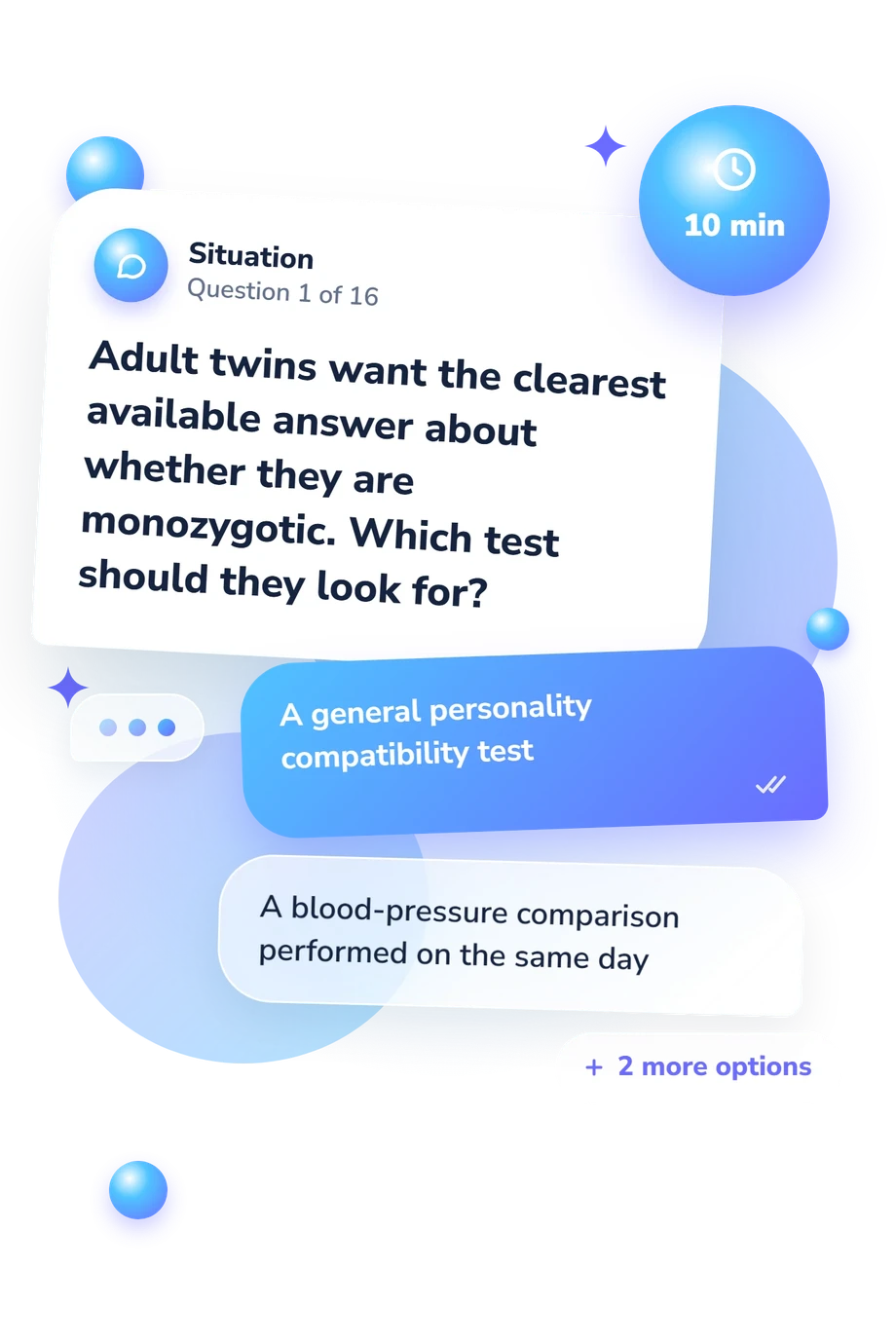
- Using a purpose-designed DNA zygosity test
- Asking whether twins were confused by teachers
- Two separate eggs are fertilized by two separate sperm cells.
- One fertilized egg splits at a late stage.
- One embryo develops two independent sets of organs.
- Two genetically identical embryos develop in separate placentas.
- Two eggs are fertilized and later fuse into one pregnancy.
- One fertilized egg divides into two embryos.
- One egg is fertilized by two sperm cells.
- Two embryos exchange enough DNA to become genetically alike.
Twin Test Quiz - Description and methodology of the test
People curious about how twins form and how zygosity is inferred can use the Twin Test Quiz to sort reliable clues from family stories, pregnancy records, and resemblance. It focuses on understanding twin zygosity and the reasoning behind monozygotic and dizygotic classifications rather than guessing from appearance. The result helps distinguish evidence that can support an inference from clues that cannot settle the question.
What This Assessment Explores
Readers seeking a practical introduction to twin biology can use this assessment to examine zygosity clues. It tests knowledge about zygosity and suits people interpreting family stories, pregnancy information, or resemblance. The result shows whether core concepts need review or are already clear.
It groups the subject into three areas:
- Twin development explains how monozygotic and dizygotic twins arise from one or two fertilized eggs.
- Pregnancy and biological evidence show why sex, blood type, placentas, fingerprints, and appearance vary in evidential value.
- Similarity and environment explain why twins may resemble or differ across life.
Twin Zygosity Knowledge (0-16) measures understanding of development, evidence, and testing limits. The Foundations to build band covers 0-6, Developing knowledge covers 7-12, and Strong knowledge covers 13-16. This knowledge questionnaire offers a practical guide to twin zygosity clues, showing which deserve confidence and which need caution in context.
Methodology and Evidence Base
Each item presents a short scenario or factual question with four answer choices. Choose the response that best matches twin biology, distinguishing strong evidence from a suggestive clue. The displayed result is a knowledge score; because no individual weighting rule is stated, point values should not be inferred from the score range.
Viewed as a twin zygosity quiz, the exercise uses concise educational reasoning. It is conceptually consistent with Gao et al. (2006), which examined questionnaires and physical features as zygosity clues while noting limits to appearance-based judgments. Hardiansyah et al. (2021) likewise support treating resemblance reports as informative but imperfect. This questionnaire is not an adaptation of either study.
Pregnancy evidence uses chorionicity and amnionicity, discussed by Jha et al. (2019). These findings can strengthen an interpretation without always settling zygosity. For same-sex twins, a purpose-designed DNA zygosity test generally offers a more definitive answer.
Interpret the result as a guide to review concepts. It tests how twin formation, resemblance, pregnancy findings, and DNA testing differ in evidential value when estimating zygosity. The displayed score is educational and does not determine a pair’s actual zygosity.
- Gao, W., Li, L., Cao, W., Zhan, S., Lv, J., Qin, Y., Pang, Z., Wang, S., Chen, W., Chen, R., & Hu, Y. (2006). Determination of Zygosity by Questionnaire and Physical Features Comparison in Chinese Adult Twins. Twin Research and Human Genetics, 9(2), 266-271. 10.1375/twin.9.2.266
- Hardiansyah, I., Hamrefors, L., Siqueiros, M., Falck-Ytter, T., & Tammimies, K. (2021). Determining Zygosity in Infant Twins - Revisiting the Questionnaire Approach. Twin Research and Human Genetics, 24(3), 168-175. 10.1017/thg.2021.24
- Jha, P., Morgan, T. A., & Kennedy, A. (2019). US Evaluation of Twin Pregnancies: Importance of Chorionicity and Amnionicity. RadioGraphics, 39(7), 2146-2166. 10.1148/rg.2019190042
Updated: