
The Red-Headed League Quiz
How the Scales are Structured
Who Usually Takes This Test?
See How You Compare
Below is a preview of how scores are typically distributed across each scale.
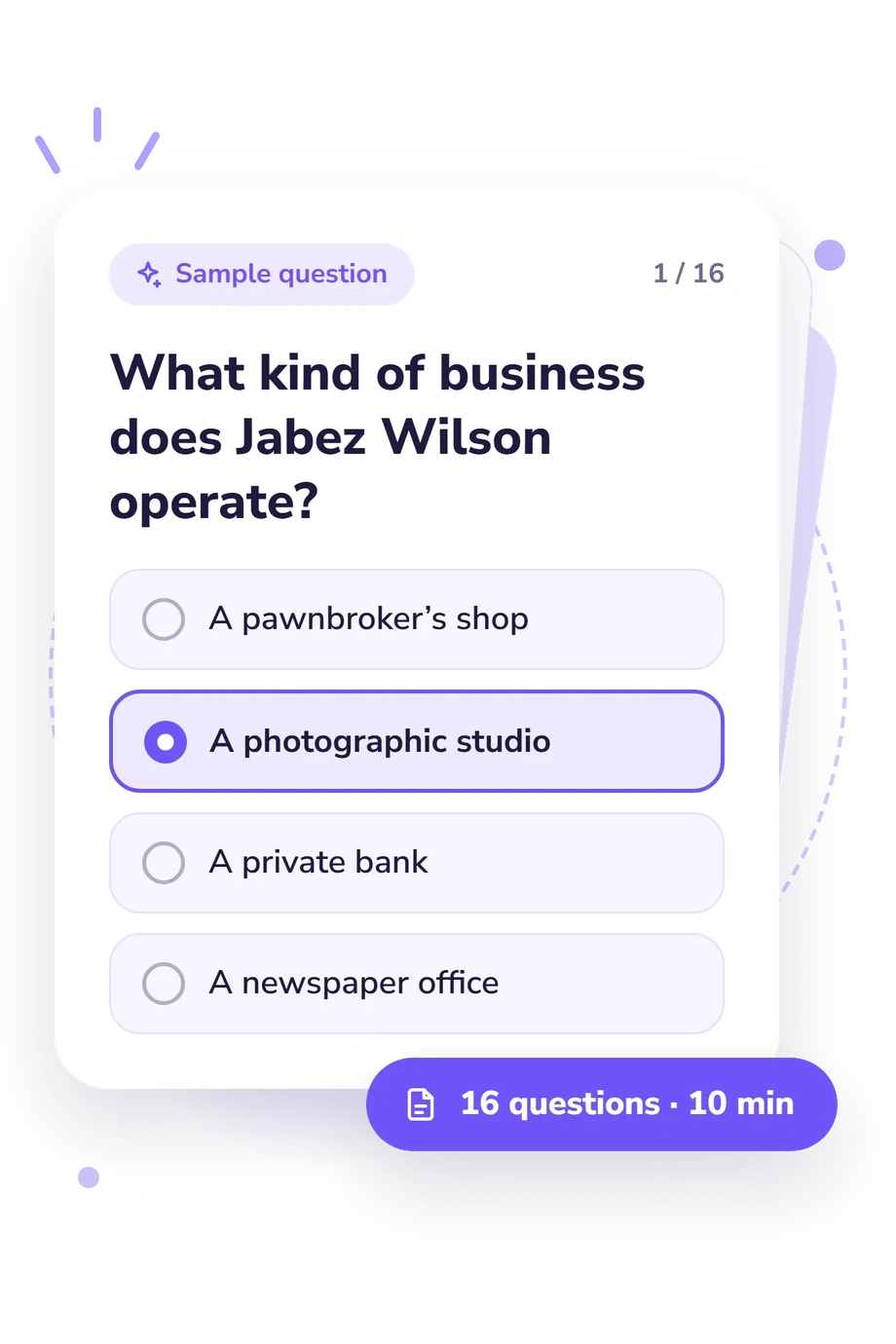
Example Questions From the Test
- A pawnbroker’s shop
- A photographic studio
- A private bank
- A newspaper office
- Fifty pounds
- One pound
- Ten pounds
- Four pounds
- A collection of royal jewels
- A shipment of French gold coins
- Bundles of government bonds
- A chest of rare manuscripts
The Red-Headed League Quiz - Description and methodology of the test
Readers deciding whether to revisit Arthur Conan Doyle’s mystery can use the Red Headed League Quiz to judge whether a short knowledge check suits their purpose. As a Sherlock Holmes story quiz, it suits book-club discussion, classroom review, or a quick check before returning to the text. The choice is especially useful for anyone interested in how a compact plot turns small clues into a final deduction.
What This Test Measures
The questionnaire tests knowledge of this fictional case, covering plot facts, character identities, setting, sequence, and the cause-and-effect linking its clues. Items focus on Wilson’s occupation, the League’s false offer, the tunnel plan, the bank target, and the ambush.
Reviewing the Red-Headed League quiz and answers afterward helps readers identify which story details they know securely and which clues or plot links deserve another look. It suits anyone checking recall after reading or discussing it.
The Red-Headed League Knowledge scale uses 0-16; its three result bands are:
- Case Beginner (0-6) means some elements are recognized, but key clues or plot links need review.
- Developing Detective (7-12) means the central mystery and many details are understood, with gaps remaining.
- Baker Street Expert (13-16) means strong knowledge of the scheme, deductions, and resolution, not literary ability in general.
Methodology and Evidence Base
Red-Headed League supplies the characters, setting, false employment scheme, tunnel strategy, bank robbery, and closing deduction tested here. The format is a self-administered online multiple-choice knowledge quiz: each item has a question stem and four answer choices, while the displayed outcome reports performance on the knowledge scale. Since no item weighting is stated, read the result as quiz performance rather than as a general measure of literary knowledge.
The cited studies by Atkinson, De Brie, and Green and Gibson provide context about reading, publication, and adaptation. The Red-Headed League questions follow Doyle’s clues and sequence; they are a story-specific knowledge check, not a published standardized instrument or an adaptation of those studies.
The displayed bands describe performance on this quiz, not population norms or general literary ability. A result can help identify which plot links, character roles, and deductions deserve closer review in the source story.
- Doyle, Arthur Conan. ‘The Red-Headed League.’ In The Adventures of Sherlock Holmes, pp. 29-55. London: George Newnes, 1892.
- Green, Richard Lancelyn, and John Michael Gibson. A Bibliography of A. Conan Doyle. Oxford: Clarendon Press, 1983.
- De Brie, Jo. ‘How Sherlock Holmes Can Change through Translation and Adaptation: A Case Study of The Red-Headed League.’ CLUES, vol. 42, no. 1, 2024, pp. 64-74.
- Atkinson, Michael. ‘The Red-Headed League’: Reading Holmes with a Holmesian Eye. In The Secret Marriage of Sherlock Holmes and Other Eccentric Readings, pp. 7-22. University of Michigan Press, 1996. 10.3998/mpub.15396
Updated: