
Shelving Library Books Quiz
How the Scales are Structured
Who Usually Takes This Test?
See How You Compare
Below is a preview of how scores are typically distributed across each scale.
Example Questions From the Test
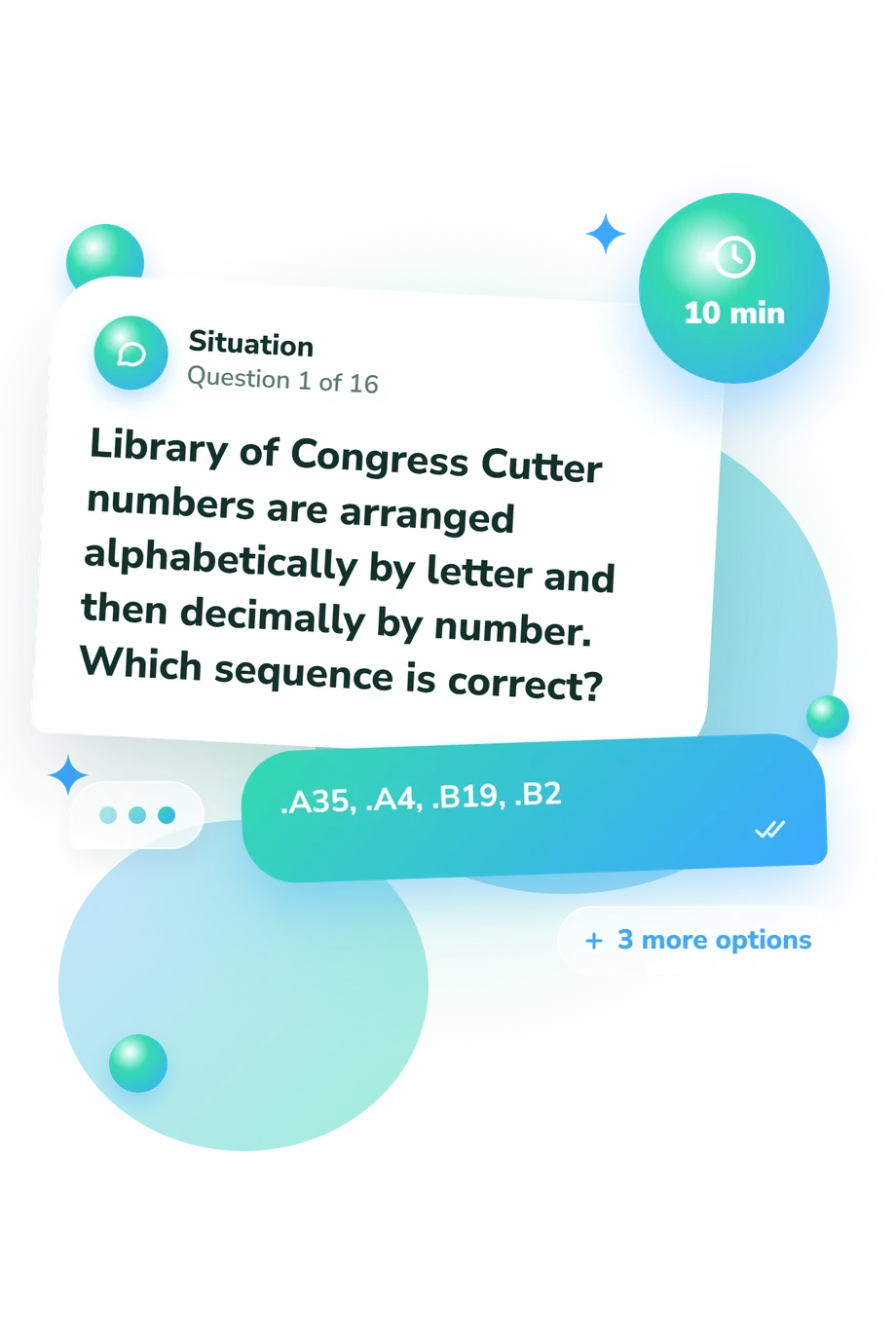
- .A35, .A4, .B19, .B2
- .A35, .B19, .A4, .B2
- .B19, .B2, .A35, .A4
- .A4, .A35, .B2, .B19
- 08, 590.81, 590.8, 590.9
- 08, 590.8, 590.81, 590.9
- 8, 590.08, 590.81, 590.9
- 9, 590.81, 590.8, 590.08
- 2017
- 2023
- 2020
- 2018
Shelving Library Books Quiz - Description and methodology of the test
People who shelve, reshelve, study, or prepare to work with library collections can use the Shelving Library Books Quiz to check whether their current shelving practice matches the conventions and local-procedure situations represented by the questions. Classification and placement choices give the library shelving test quiz a practical focus on ordinary collection decisions rather than general library ability. Its result concerns rule application.
What This Assessment Explores
Questions cover Library of Congress and Dewey Decimal order, Cutter and author marks, publication years, fiction titles, oversize locations, unreadable labels, and local-procedure decisions.
Questions ask respondents to decide where an item belongs and when local procedure should be checked rather than guessed, giving the book shelving quiz a practical focus on decisions rather than memorization.
The result, Shelving Library Books Knowledge (0-16), uses Foundation Needed (0-6), Developing Accuracy (7-12), and Strong Shelving Knowledge (13-16) to summarize application of common conventions; local procedures remain authoritative.
The themes are:
- Call-number sequencing shows whether letters, numbers, decimals, Cutters, and author marks are ordered correctly.
- Placement decisions show whether labels, oversize markings, and uncertain locations are handled safely.
- Shelf maintenance shows whether sequence and usable growth space are preserved during shifting.
- Fiction arrangement shows whether titles are alphabetized under the stated local rule.
Methodology and Evidence Base
Each item presents a short workplace-style situation with four answer choices. The result is presented as an educational score on the displayed scale, not as professional certification.
The library reshelving studies by Edwardy and Pontius and by Liu, Parker, and Sun treat mis-shelving and reshelving accuracy as observable library-operation problems. The Library of Congress manual supports Library of Congress call-number and location conventions, while Dewey Decimal Classification supports numerical ordering. This questionnaire is conceptually consistent with those sources, not an adaptation or validation study of them.
Because this is an online shelving skills test, it has no workplace observation component. Performance may reflect prior shelving experience, familiarity with local cataloguing practices, and attention to scenario wording. The overall result can indicate whether review of shelving conventions is warranted; then follow the procedures established by the library where the work is performed.
- Edwardy, Jeffrey M., and Jeffrey S. Pontius. "Monitoring Book Reshelving in Libraries Using Statistical Sampling and Control Charts." Library Resources & Technical Services 45, no. 2 (2001): 90-94. 10.5860/lrts.45n2.90
- Liu, Hongmei, Jay Parker, and Wei Sun. "Estimating Rates at Which Books Are Mis-Shelved." CHANCE 24, no. 1 (2011): 36-43. 10.1080/09332480.2011.10739850
- Library of Congress, Policy and Standards Division. Classification and Shelflisting Manual. Washington, DC: Library of Congress, 2013.
- Dewey, Melvil, Joan S. Mitchell, Julianne Beall, Rebecca Green, Giles Martin, and Michael Panzer. Dewey Decimal Classification and Relative Index. 23rd ed. Dublin, OH: OCLC Online Computer Library Center, 2011.
Updated: