
Random Math Quiz
How the Scales are Structured
Who Usually Takes This Test?
See How You Compare
Below is a preview of how scores are typically distributed across each scale.
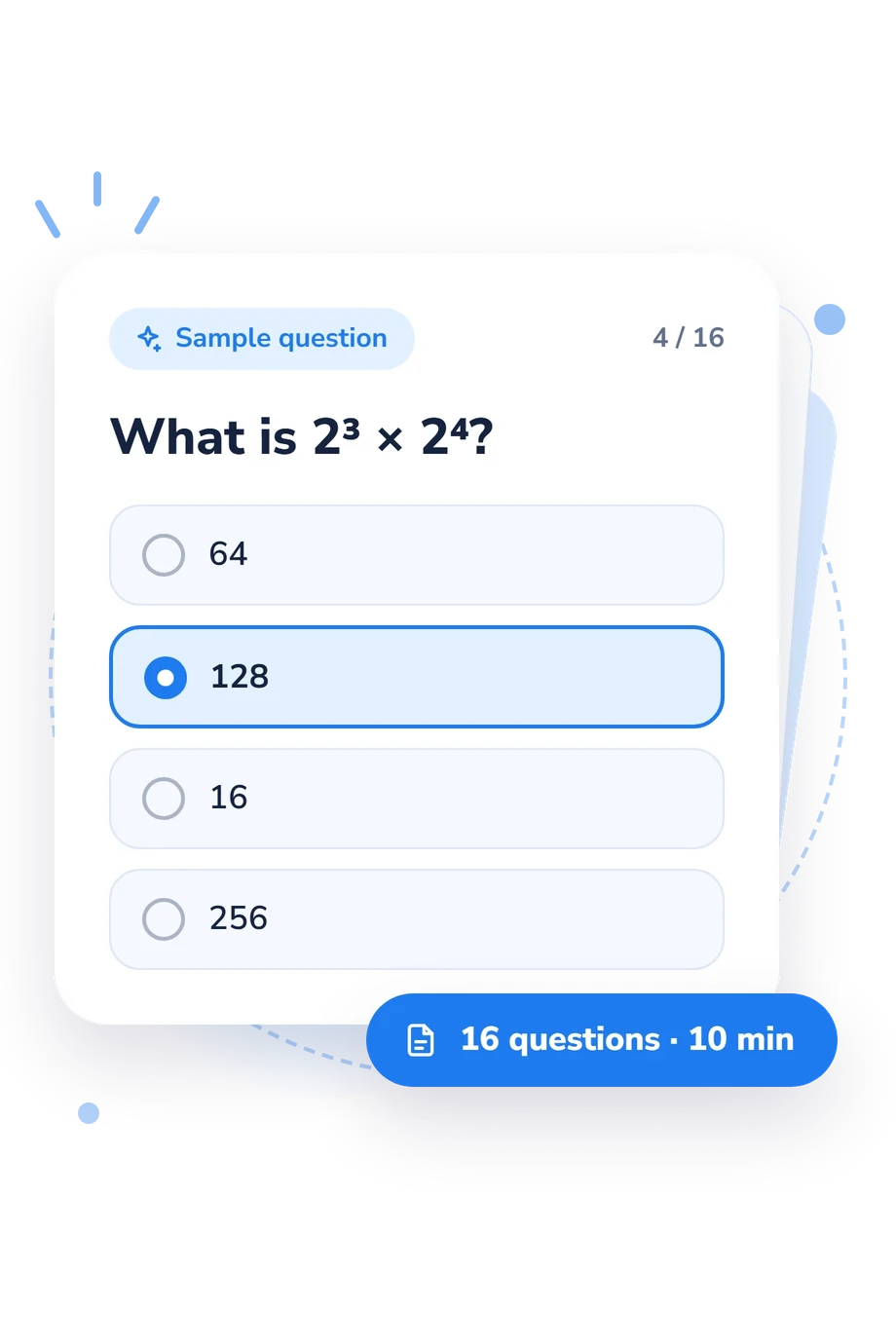
Example Questions From the Test
- 12
- 25
- 24
- 15
- 3/8 cup
- 1/4 cup
- 1/2 cup
- 3/2 cups
- 100
- 80
- 104
- 96
Random Math Quiz - Description and methodology of the test
Designed for learners and curious adults who want to decide where a broad review of mathematics might be useful, this random math quiz presents short problems across familiar academic and everyday contexts. A learner may incorporate a daily maths quiz into a regular revision routine when deciding whether to revisit fundamentals or continue with mixed practice. The result can help determine an appropriate next step.
What This Assessment Explores
Questions span ratios, fractions, percentage change, powers, order of operations, signed numbers, equations, averages, sequences, probability, area, perimeter, prices, fares, recipes, and measurement. This mix makes the test useful as a math skills assessment when someone wants to see how consistently different basics are handled.
It brings together direct calculations and short word problems, so the result reflects accuracy across varied contexts. One scale, Random Math Knowledge, is scored from 0-16. Its bands describe performance across this set rather than a complete picture of mathematical ability:
- Building Foundations (0-6) indicates that reviewing core operations, fractions, algebra, or measurement may support further mixed practice.
- Developing Range (7-12) suggests a useful foundation with less consistent accuracy.
- Strong Range (13-16) reflects broad, consistent command of the sampled mathematics.
Methodology and Evidence Base
Each item uses four answer choices, asking the respondent to select the option that solves a calculation or short problem. The content is mixed rather than divided into separately reported subscales, so the result summarizes the set. No point-per-answer rule should be inferred from the range; the catalogue presents the outcome through the named scale and bands.
Methodologically, the questionnaire is conceptually consistent with the KeyMath-3 Diagnostic Assessment, a published measure of mathematical achievement, but it is not presented as an adaptation or administration of that instrument. A 2025 confirmatory factor analysis of KeyMath-3 provides context for coherent mathematics domains, while the OECD PISA 2022 framework describes mathematical activity across varied applied situations. Together, they frame the questionnaire's mixed calculations and applied problems.
The questionnaire can serve as an online math practice test: lower results can prompt foundational review, middle results can support accuracy with less familiar material, and higher results can encourage continued mixed practice. It is not accompanied by norms or standardization; attention, guessing, prior instruction, and familiarity with a question type may shift results.
- Wray, Michael D., and Matthew R. Reynolds. (2025). Confirmatory Factor Analysis of the KeyMath-3 Diagnostic Assessment. Journal of Psychoeducational Assessment, 43(1), 18-35. 10.1177/07342829241298171
- Connolly, Austin J. (2007). KeyMath-3 Diagnostic Assessment: Manual Forms A and B. Minneapolis, MN: Pearson.
- OECD. (2023). PISA 2022 Assessment and Analytical Framework. PISA, OECD Publishing, Paris. 10.1787/dfe0bf9c-en
Updated: