
Micropipette Quiz
How the Scales are Structured
Who Usually Takes This Test?
See How You Compare
Below is a preview of how scores are typically distributed across each scale.
Example Questions From the Test
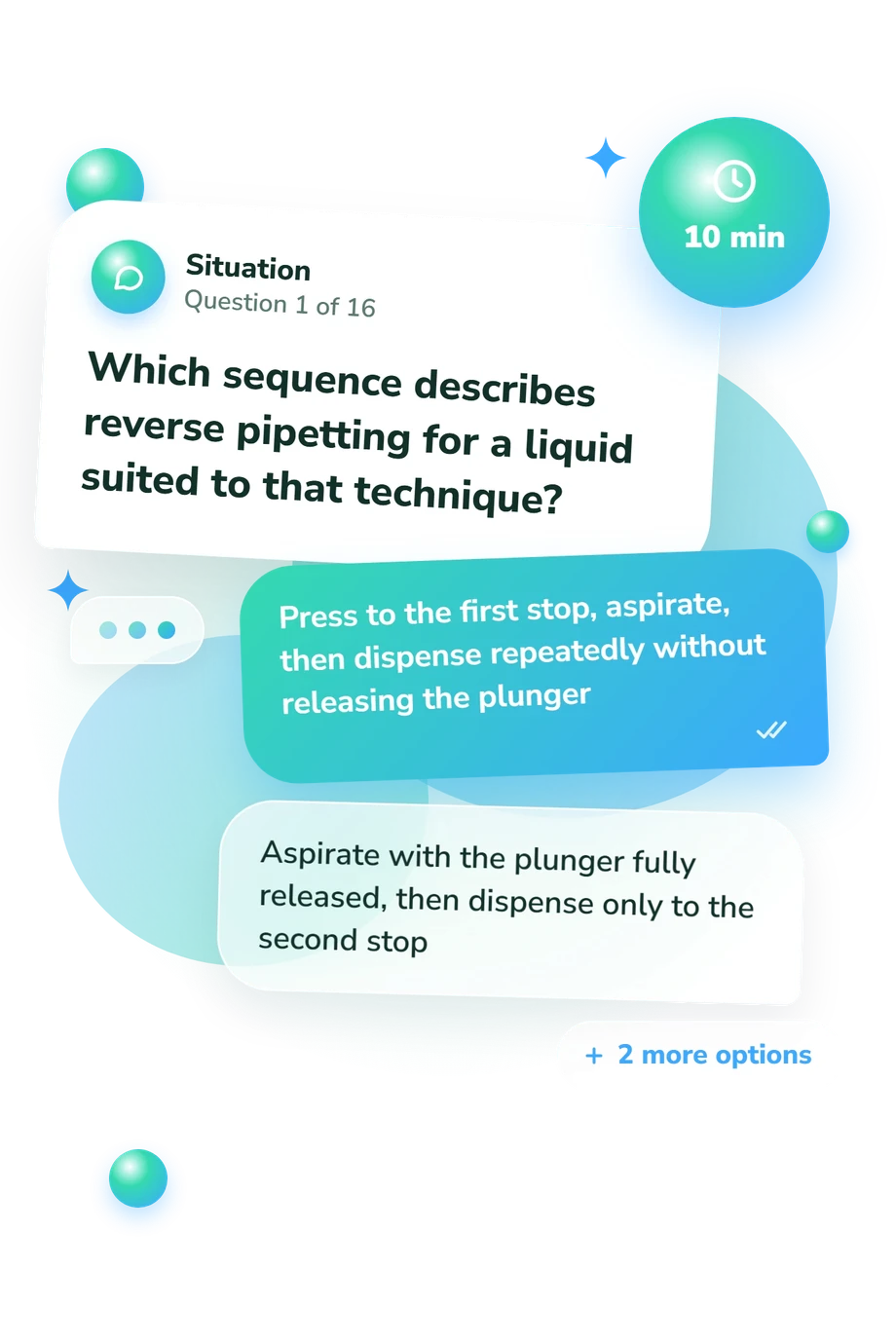
- Press to the first stop, aspirate, then dispense repeatedly without releasing the plunger
- Aspirate with the plunger fully released, then dispense only to the second stop
- Press to the second stop, aspirate, then dispense to the first stop and leave the residual liquid in the tip
- Press to the second stop, aspirate, then dispense through the second stop so no residue remains
- Calibration replaces the piston, while adjustment replaces the tip cone
- Calibration cleans the pipette, while adjustment sterilizes it
- Calibration applies only to fixed-volume pipettes, while adjustment applies only to variable-volume pipettes
- Calibration evaluates performance against a reference; adjustment changes the instrument to bring performance within requirements
- To blow out liquid remaining in the tip
- To aspirate an extra volume for the next transfer
- To reset the pipette's calibration electronically
- To release the disposable tip from the tip cone
Micropipette Quiz - Description and methodology of the test
People may take this micropipette quiz before supervised practice, during refresher learning, or when checking their confidence with routine laboratory decisions. It produces an overall educational result that summarizes knowledge across the questionnaire rather than identifying a particular practical weakness. Its purpose is to help readers decide whether a broader review of the covered concepts would be useful before hands-on work. The format emphasizes understanding procedures rather than speed, giving this micropipette knowledge assessment a clear focus.
What This Assessment Explores
The items examine decisions that make transfers reliable: pipette selection, plunger control, contamination prevention, storage, and recognizing when inspection is needed. They connect technique with accuracy, precision, and quality control, making the items useful for reviewing common technique problems during micropipette technique training.
The displayed Micropipette Knowledge scale spans 0-16. Foundation (0-6) suggests reviewing ranges, stop positions, and handling; Developing (7-12) shows essential understanding with room to strengthen technique, assessment, or troubleshooting; Strong (13-16) reflects broad knowledge of selection, operation, care, and quality control. These bands are educational, not certification of practical competence.
The result brings together these areas:
- Operation and volume control show understanding of aspiration, dispensing, stops, and range selection.
- Care and contamination control indicate sound storage, tip replacement, and sealing.
- Performance and troubleshooting show how you distinguish accuracy from precision and respond to uneven delivery.
Methodology and Evidence Base
Each item presents a laboratory situation with four answer choices. The questionnaire produces an educational result with the displayed bands, but the exact point-allocation method is not specified. This format tests recognition and judgment; it does not observe hand position, sealing, timing, or actual liquid delivery.
The educational questionnaire is conceptually consistent with Furukawa et al. (2018), which connects micropipette handling with dispensing accuracy, and Pushparaj (2020), which discusses technique in good laboratory practice. ISO 8655-2:2022 covers piston-operated pipettes, while ISO 8655-6:2022 specifies gravimetric reference measurement for volume determination. It is an educational online questionnaire, not an adaptation of those publications; no normative standardization or validation of this questionnaire is established.
As a micropipette knowledge test, it supports review before or alongside supervised practice. A strong result may indicate broad understanding, but responses still depend on equipment condition, liquid properties, technique, attention, and current familiarity with procedures. Interpret the result with manufacturer instructions, observed practice, and documented performance checks.
- Furukawa S, Kohguchi K, Okazaki K, Morinaga M, Ookubo M, Tsujioka T, Tohyama K. Effects of handling micropipettes on dispensing accuracy and results of a questionnaire survey of each institution. Japanese Journal of Medical Technology. 2018;67(1):44-51. 10.14932/jamt.17-80
- Pushparaj PN. Revisiting the Micropipetting Techniques in Biomedical Sciences: A Fundamental Prerequisite in Good Laboratory Practice. Bioinformation. 2020;16(1):8-12. 10.6026/97320630016008
- International Organization for Standardization. ISO 8655-2:2022. Piston-operated volumetric apparatus - Part 2: Pipettes. 2nd ed. Geneva: ISO; 2022.
- International Organization for Standardization. ISO 8655-6:2022. Piston-operated volumetric apparatus - Part 6: Gravimetric reference measurement procedure for the determination of volume. 2nd ed. Geneva: ISO; 2022.
Updated: