
How Bad Do You Have to Pee Quiz
How the Scales are Structured
Who Usually Takes This Test?
See How You Compare
Below is a preview of how scores are typically distributed across each scale.
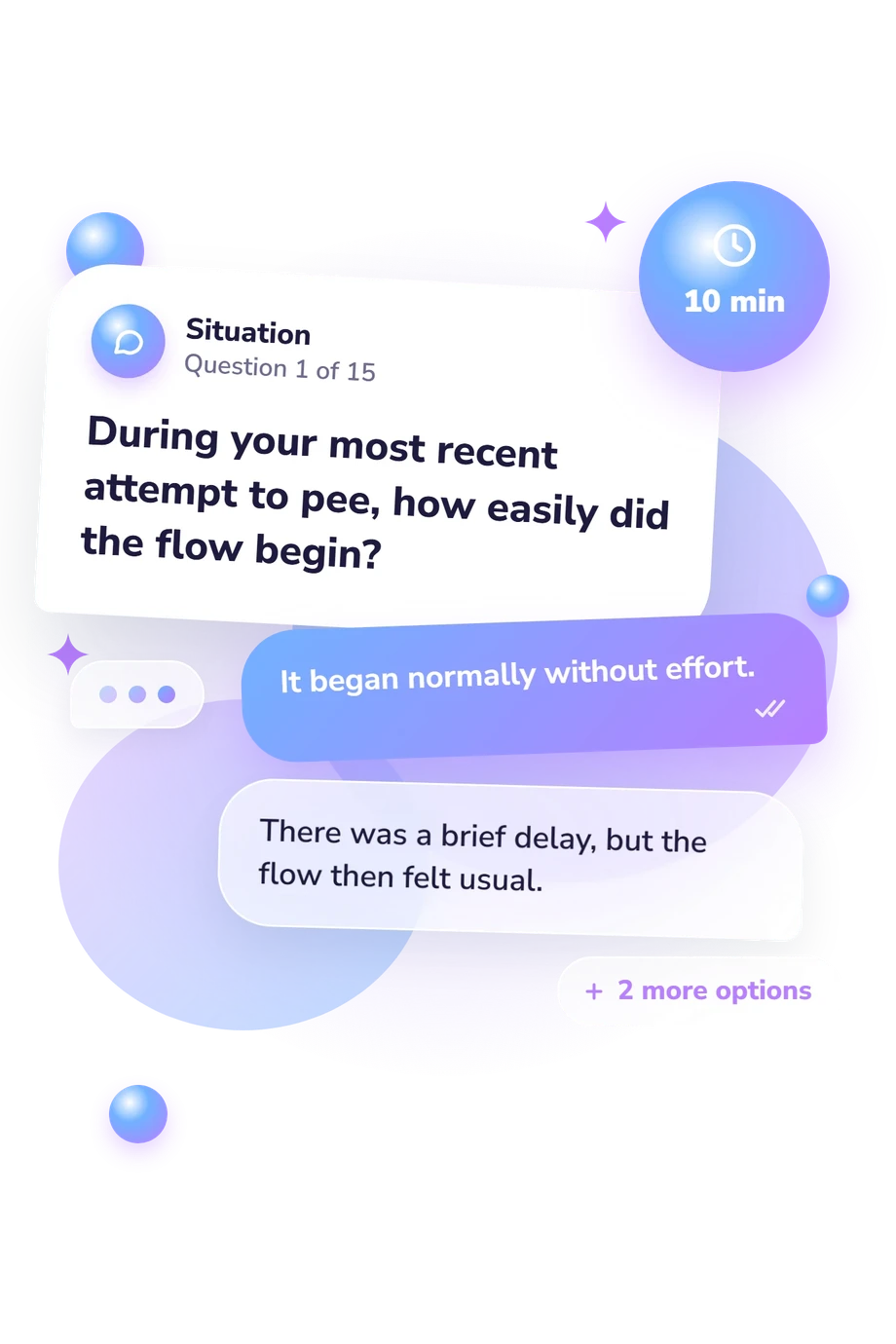
Example Questions From the Test
- It is not changing my activity.
- I am casually noting where a bathroom is.
- I am shortening or rearranging what I am doing to reach one soon.
- I have stopped, am rushing, or cannot continue until I find one.
- I do not currently notice an urge.
- I am aware of it, but I remain comfortable.
- The urge is strong enough to interrupt my attention.
- It feels overwhelming, or I may leak if I wait.
- Those movements do not bring on an urge.
- They cause a brief, mild increase.
- They create a strong surge that makes me pause or tense up.
- They trigger leakage or an immediate fear of losing control.
How Bad Do You Have to Pee Quiz - Description and methodology of the test
People unsure whether a strong or uncomfortable need to urinate merits attention can use this assessment to organize what they notice. The How Bad Do You Have to Pee Quiz suits someone reflecting on current urgency, control, bladder comfort, or warning signs. This assessment works as a how badly do you need to pee quiz, turning observations into a snapshot for deciding what to monitor and when to act.
What This Assessment Measures
Questions cover urge intensity, control, relief, flow, pressure, burning, urine appearance, feverish illness, neurological changes, and side/back pain. These displayed scales organize experiences recorded alongside urinary urgency.
Results appear in three displayed scales:
- Accompanying Warning Signs (0-15) captures fever, confusion, possible blood in urine, severe side/back pain, or neurological changes; bands: No warning signs selected 0, Change to follow up 1-2, Prompt support warranted 3-15.
- Bladder Comfort and Emptying (0-15) captures pain, pressure, difficult flow, poor relief, or little urine with strong urge; bands: No change selected 0, Notice and reassess 1-2, Respond promptly 3-15.
- Urgency and Control (0-15) captures strong urge, activity disruption, position-triggered surges, or leakage; bands: No current signal selected 0-0, Early signal 1-2, Act on the need 3-15.
The quiz also addresses the feeling that you gotta pee so bad, while keeping intensity in context.
Methodology and Evidence Base
Each item presents four ordered choices, from no change to greater interference. Plain language captures experience, making this a symptom snapshot rather than a complete history. Because items concern current experiences, this urinary urgency assessment varies with symptoms, timing, and self-observation.
Scores appear separately on displayed scales. The questionnaire states no universal point value for each answer, so its ranges should not be used to infer one. The bands are unvalidated reflective summaries, not diagnoses, severity ratings, or clinical cutoffs. A score-3 red-flag response overrides the total; any concerning experience matters independently.
The grouping is conceptually consistent with BFLUTS (Jackson et al., 1996) and OAB-q (Coyne et al., 2002), which address lower urinary tract symptoms, overactive-bladder symptoms, and daily impact. This questionnaire is not an adaptation or validated version of either instrument. Serlin et al. (2018) and the 2024 AUA/SUFU guideline provide clinical context for urinary retention and overactive-bladder evaluation; this questionnaire is neither an adaptation nor a validated version of them.
Persistent or recurrent changes merit medical advice; severe red-flag experiences may require urgent or emergency help.
- Jackson S, Donovan J, Brookes S, Eckford SD, Swithinbank L, Abrams P. The Bristol Female Lower Urinary Tract Symptoms questionnaire: development and psychometric testing. British Journal of Urology. 1996;77(6):805-812. 10.1046/j.1464-410X.1996.00186.x
- Coyne K, Revicki D, Hunt T, Corey R, Stewart W, Bentkover J, Kurth H, Abrams P. Psychometric validation of an overactive bladder symptom and health-related quality of life questionnaire: the OAB-q. Quality of Life Research. 2002;11(6):563-574. 10.1023/A:1016370925601
- Serlin DC, Heidelbaugh JJ, Stoffel JT. Urinary Retention in Adults: Evaluation and Initial Management. American Family Physician. 2018;98(8):496-503.
- Cameron AP, Chung DE, Dielubanza EJ, et al. The AUA/SUFU guideline on the diagnosis and treatment of idiopathic overactive bladder. Journal of Urology. 2024;212(1):11-20. 10.1097/JU.0000000000003985
Updated: