
Eragon Character Quiz
How the Scales are Structured
Who Usually Takes This Test?
See How You Compare
Below is a preview of how scores are typically distributed across each scale.
Example Questions From the Test
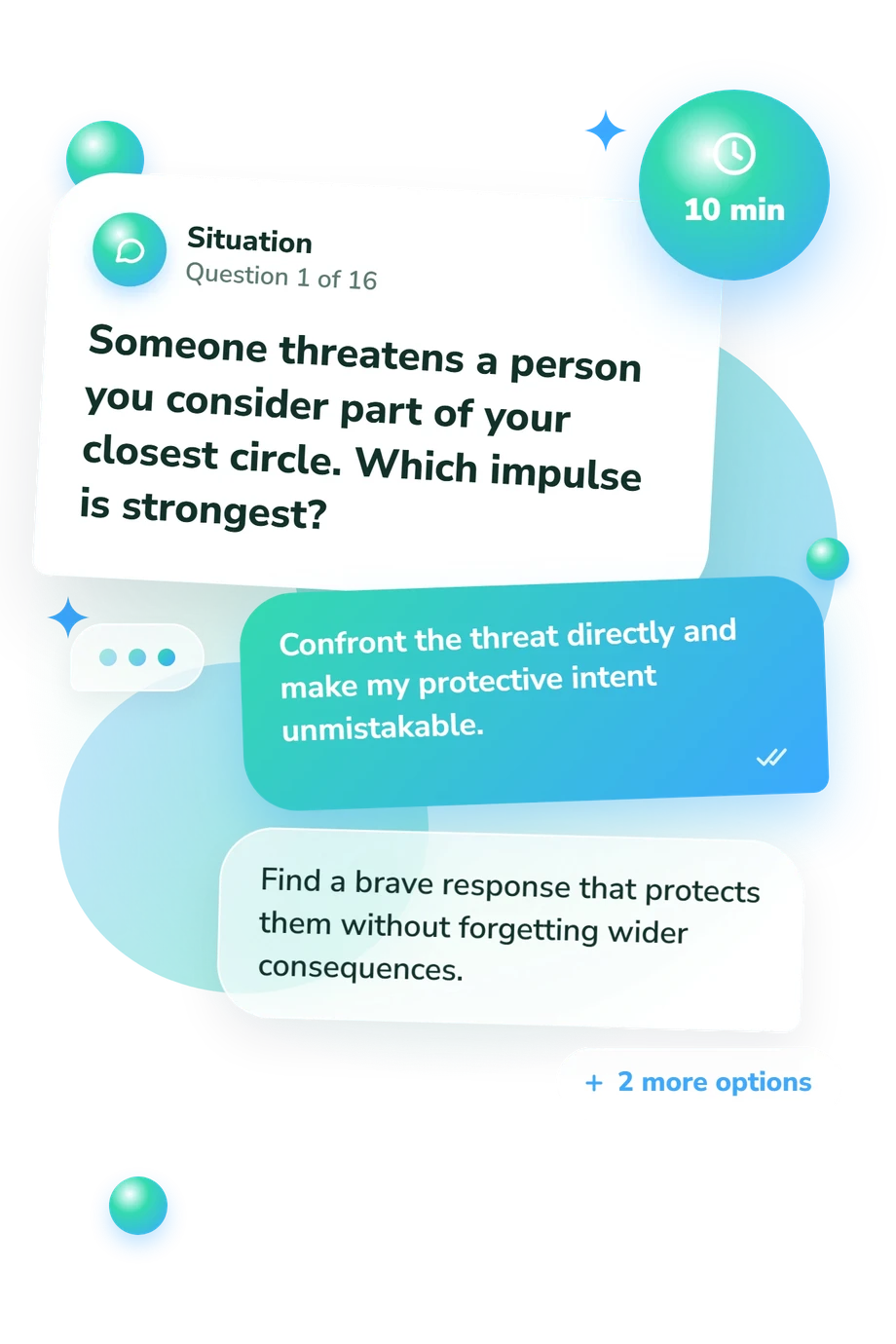
- Confront the threat directly and make my protective intent unmistakable.
- Find a brave response that protects them without forgetting wider consequences.
- Outmaneuver the threat through patience and precise timing.
- Help my person escape so neither of us becomes trapped by the conflict.
- Test whether I can keep my independence before committing to anything.
- Accept the role, then learn what I need as I go.
- Study the wider consequences before revealing my decision.
- Trust my instincts and act decisively for the people closest to me.
- With calm confidence—I see no reason to make myself smaller.
- With measured reserve while I study the room’s alliances.
- With openness, hoping to learn from whoever approaches.
- With guarded attention so no one gains leverage over me.
Eragon Character Quiz - Description and methodology of the test
Fans of Christopher Paolini’s world can use the Eragon Character Quiz to explore which character pattern best matches their own judgments, loyalties, and reactions to responsibility. It is intended for readers who enjoy fictional character comparisons and want a nuanced result rather than a single identity label. The resulting Eragon personality quiz profile shows why certain choices feel familiar and how a blended result can be interpreted.
What This Assessment Explores
Rather than measuring one trait, this quiz about which Eragon character you are maps protection, responsibility, loyalty, independence, trust, leadership, authority, and competing duties across profiles. Results align answers with character themes.
Displayed scales are:
- Arya (0-12) measures discipline, strategic restraint, independence, and commitment to a cause larger than yourself: Different Path (0-4), Purposeful Parallel (5-8), Envoy’s Focus (9-12).
- Eragon (0-12) measures developing courage, curiosity, adaptability, and willingness to accept responsibility: Different Path (0-4), Shared Spark (5-8), Rider’s Resolve (9-12).
- Murtagh (0-12) measures guarded loyalty, resistance to control, skepticism toward authority, and resilience under an unwanted legacy: Different Path (0-4), Defiant Streak (5-8), Unbound Will (9-12).
- Saphira (0-12) measures instinctive confidence, fierce protectiveness, direct judgment, and delight in strength and freedom: Different Path (0-4), Dragonhearted (5-8), Skyborne Spirit (9-12).
Highest score is the strongest affinity; scores within one point blend.
Methodology and Scientific Basis
Each item presents a social or moral situation with four reactions. Choices ask how you would respond to danger, authority, betrayal, responsibility, intimacy, or a difficult trade-off. Responses are compared across four profiles; the highest displayed score is the strongest affinity. Ranges describe result bands rather than a point-by-point rule.
Methodologically, it is conceptually consistent with Huang and Fung’s 2024 Identification scale, which measures identification with narrative characters, but this questionnaire is not an adaptation or validation of it. Rapp, Gerrig, and Prentice’s 2001 work supports trait-based character models, while Yu and colleagues’ 2023 research examines how readers understand fictional personalities. Paolini’s Eragon supplies the narrative context.
The Eragon character personality test connects the character-affinity result to the choices behind it, so blended outcomes can be read as overlapping profiles. Familiarity with the novel, current mood, self-perception, and the meaning assigned to an option can shift responses. The displayed bands are interpretive categories for thematic resemblance, so a close or blended outcome shows how closely your choices echo a character profile, not a fixed psychological type or diagnosis.
- Huang, Kate Y., and Helene H. Fung. 2024. "Measuring identification with narrative characters: the development and validation of a new scale." Current Psychology 43: 24835-24849. 10.1007/s12144-024-06191-2
- Paolini, Christopher. 2003. Eragon. New York: Alfred A. Knopf.
- Rapp, David N., Richard J. Gerrig, and Deborah A. Prentice. 2001. "Readers’ Trait-Based Models of Characters in Narrative Comprehension." Journal of Memory and Language 45(4): 737-750. 10.1006/jmla.2000.2789
- Yu, Mo, Jiangnan Li, Shunyu Yao, Wenjie Pang, Xiaochen Zhou, Zhou Xiao, Fandong Meng, and Jie Zhou. 2023. "Personality Understanding of Fictional Characters during Book Reading." In Proceedings of the 61st Annual Meeting of the Association for Computational Linguistics (Volume 1: Long Papers), 14784-14802. Association for Computational Linguistics. 10.18653/v1/2023.acl-long.826
Updated: