
Easy NBA Quiz
How the Scales are Structured
Who Usually Takes This Test?
See How You Compare
Below is a preview of how scores are typically distributed across each scale.
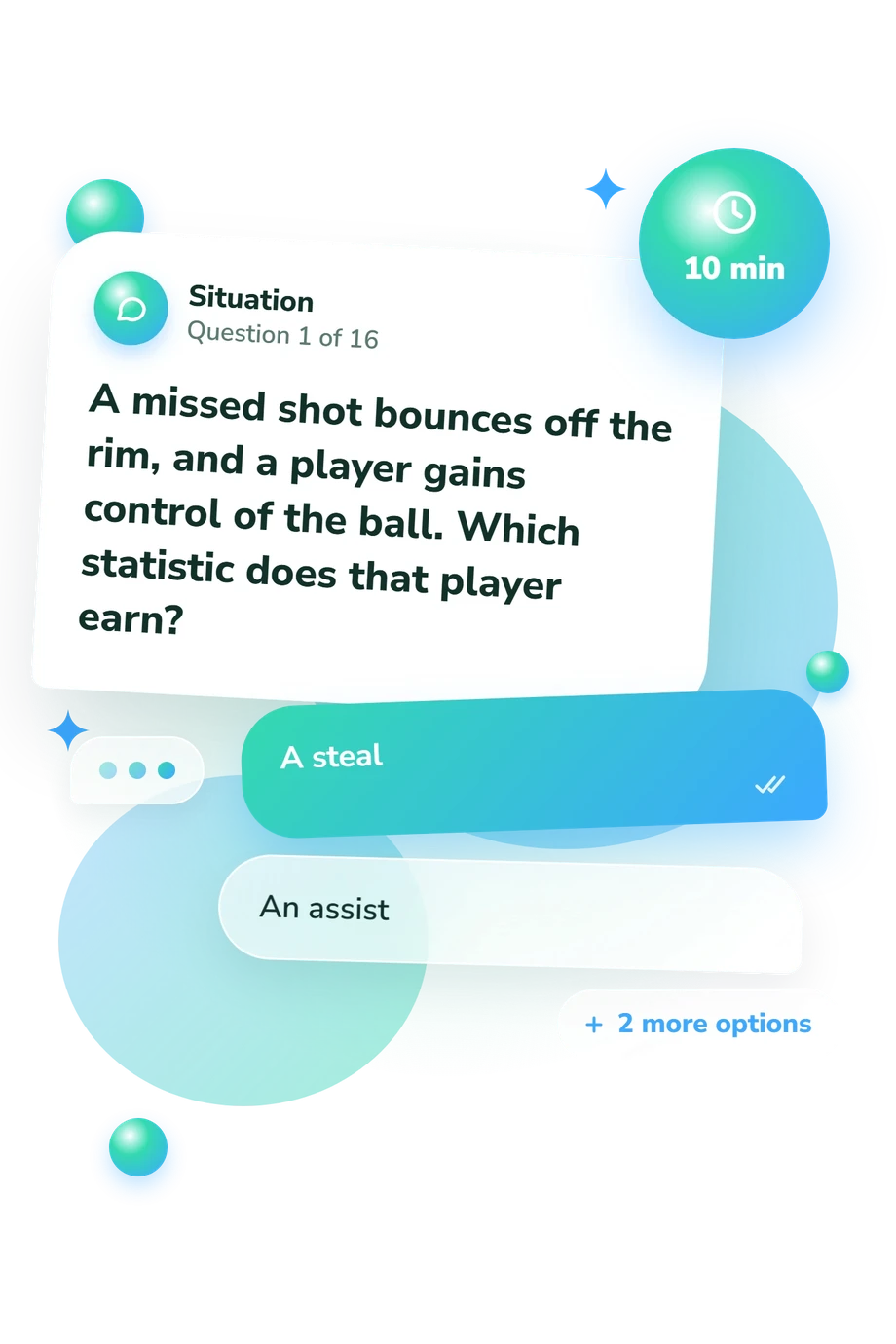
Example Questions From the Test
- A steal
- An assist
- A rebound
- A block
- The player must attempt a free throw
- The player is automatically suspended for the next game
- The player’s team loses a timeout
- The player fouls out and cannot return
- Three points
- Two points
- One point
- Zero points
Easy NBA Quiz - Description and methodology of the test
Readers who want a clear starting point for basketball facts can use the Easy NBA Quiz to check practical knowledge of the league without advanced statistics or specialist terminology. It suits curious newcomers, casual viewers, and fans who want to see which areas they understand best. Its NBA trivia quiz format keeps the result focused on recognizable facts and game decisions rather than broad claims about expertise.
What This Assessment Measures
The content centers on everyday NBA knowledge. Questions cover rebounds, fouls, goaltending, free throws, dribbling violations, shot clocks, overtime, and on-court player counts. Other items test conferences, championships, trophies, famous players, and franchises.
As an accessible starting point for newcomers, it covers fundamentals without claiming to be the easiest NBA quiz.
The questions form four thematic groups:
- Rules and violations show whether you identify outcomes after common infractions.
- Scoring and game structure show whether you understand points, possessions, player counts, and statistical achievements.
- League structure and franchise history show whether you recognize conferences, championships, and trophies.
- Player knowledge shows whether you connect names with franchises and achievements.
The single result scale is NBA Knowledge (0-16). Starter (0-6) indicates recognition; Developing Fan (7-12) reflects a useful grasp with gaps; Strong Knowledge (13-16) indicates understanding of essential facts and familiar rules.
Methodology and Evidence Base
Each item presents a basketball situation or factual prompt with four answer choices. Selecting the option that fits tests recognition and straightforward application rather than written explanation. One point is assigned for each correct answer, so the total counts correct responses.
Content is conceptually consistent with Van Hoye et al. (2016), which addresses basketball-rule knowledge, and Tsuda et al. (2023), which examines basketball common content knowledge. This questionnaire is not an adaptation of either instrument. The NBA's 2025-26 rulebook provides the rule framework, while Sachare's encyclopedia supports historical facts about teams, championships, and players. The questionnaire therefore checks practical understanding through established content areas, and its rules situations make this NBA rules quiz a focused review of fundamentals.
The online version has no stated population norms or independent validation statistics. Interpret the band as a descriptive snapshot: guessing, uneven familiarity with NBA history, and changing rules or terminology can influence performance. It is useful for identifying learning topics and reviewing fundamentals rather than measuring complete basketball expertise.
- Van Hoye, Martin, Marc Cloes, Lionel Dauby, and Gilles Dubru. (2016). Development and validation of a survey on the rules in basketball. In ARIS (Ed.), The intervention in sport and physical education in the face of societal transformations: Issues, challenges, responsibility of research, p. 142.
- Tsuda, Emi, Phillip Ward, James D. Ressler, James Wyant, Yaohui He, Insook Kim, and José A. Santiago. (2023). Basketball Common Content Knowledge Instrument Validation. International Journal of Kinesiology in Higher Education, 7(1), 35-47. DOI 10.1080/24711616.2021.2010624
- National Basketball Association. (2025). 2025-26 Official Rules.
- Sachare, Alex, editor. (1994). The Official NBA Basketball Encyclopedia. 2nd ed. Villard Books.
Updated: