
Costume Quiz
How the Scales are Structured
Who Usually Takes This Test?
See How You Compare
Below is a preview of how scores are typically distributed across each scale.
Example Questions From the Test
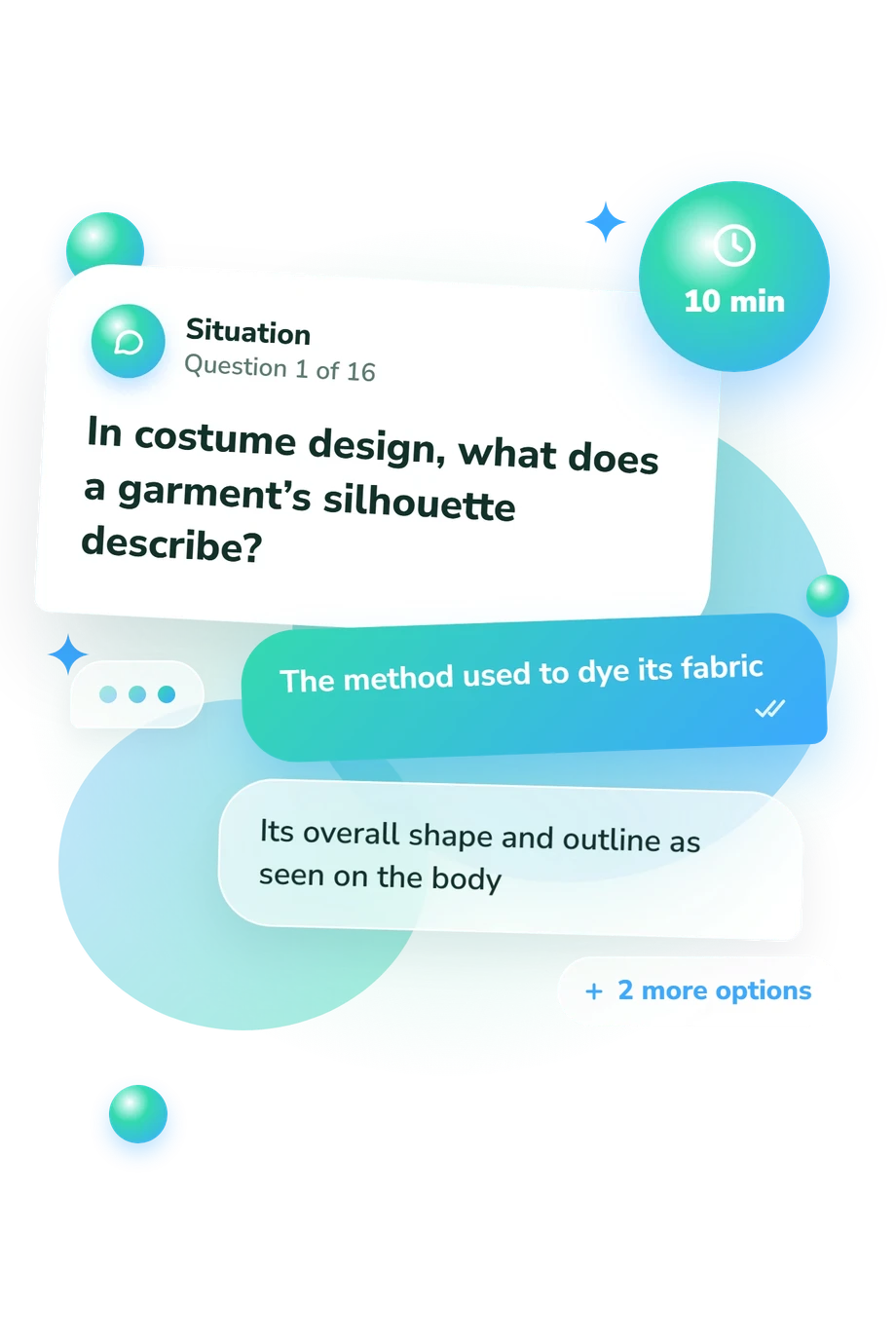
- The method used to dye its fabric
- Its overall shape and outline as seen on the body
- The list of notions needed to construct it
- The written history of who previously wore it
- A cast list with actors’ measurements
- A rack label naming the character and scene
- A costume rendering accompanied by a fabric swatch
- A sewing pattern without fabric samples
- To map the actors’ stage movements during dialogue
- To diagram the theatre’s lighting circuits
- To record only the retail price of every fabric
- To track which costumes each character wears in each scene
Costume Quiz - Description and methodology of the test
Readers who want to understand practical thinking behind theatrical and screen wardrobes can use this costume quiz as an introduction to costume work. It suits learners, performers, makers, and curious viewers interested in how design choices affect movement, continuity, care, period appearance, and backstage efficiency. Results point to topics worth revisiting. As a costume design quiz, it connects visual decisions with workable technical choices.
What This Assessment Explores
The questions treat costume knowledge as applied understanding, making this a practical costume construction quiz for learners and practitioners. They cover silhouette, rendering, fabric behavior, lighting, continuity, costume plots, millinery, quick changes, care, safety, and historical appearance.
The result brings those themes into one general-interest profile:
- Costume Knowledge (0-16) shows understanding of costume design and wardrobe practice: Foundation Building (0-6) means core ideas need development; Developing Knowledge (7-12) reflects a useful grasp with room to strengthen unfamiliar areas; Strong Knowledge (13-16) indicates broad, accurate understanding. The catalogue treats it as a general-interest knowledge score.
- Design language shows how you connect silhouette, color, texture, rendering, and period features with intended appearance.
- Construction and movement shows whether you recognize choices supporting fit, stretch, mobility, and safe use.
- Production practice shows how continuity, care, lighting, documents, and backstage planning work together.
Methodology and Scientific Basis
Each item uses four answer choices. Some test terminology; others present a production problem and ask for the best response. Responses are judged against keyed best answers, so the format emphasizes accuracy and applied judgment rather than personal preference.
As a costume knowledge test, the catalogue presents an online educational questionnaire with one general-interest result, not a standardized, norm-referenced, diagnostic, or professional-qualification measure.
Methodologically, its vocabulary is conceptually consistent with Ingham and Covey (2003) on fittings, care, quick changes, and production records; Cunningham (2020) on silhouette, fabric, color, and period; and La Motte (2010) on continuity and screen production. Isaac (2017) provides a compatible contextual perspective on historic theatre costume. These sources clarify the subject matter, but the online questionnaire is not an adaptation of any one published instrument.
Prior exposure, guessing, wording, attention, and self-report can affect performance, so the result is most useful for identifying learning priorities and supporting self-reflection.
- Ingham, Rosemary, and Liz Covey. The Costume Technician's Handbook. 3rd ed. Heinemann, 2003. ISBN 978-0-325-00477-8.
- Cunningham, Rebecca. The Magic Garment: Principles of Costume Design. 3rd ed. Waveland Press, 2020. ISBN 978-1-4786-3815-5.
- La Motte, Richard. Costume Design 101: The Business and Art of Creating Costumes for Film and Television. 2nd ed. Michael Wiese Productions, 2010. ISBN 978-1-932907-69-8.
- Isaac, Veronica. "Towards a New Methodology for Working with Historic Theatre Costume: A Biographical Approach Focussing on Ellen Terry's 'Beetlewing Dress'." Studies in Costume & Performance 2, no. 2 (2017): 115-135. 10.1386/scp.2.2.115_1.
Updated: