
Boy Quiz
How the Scales are Structured
Who Usually Takes This Test?
See How You Compare
Below is a preview of how scores are typically distributed across each scale.
Example Questions From the Test
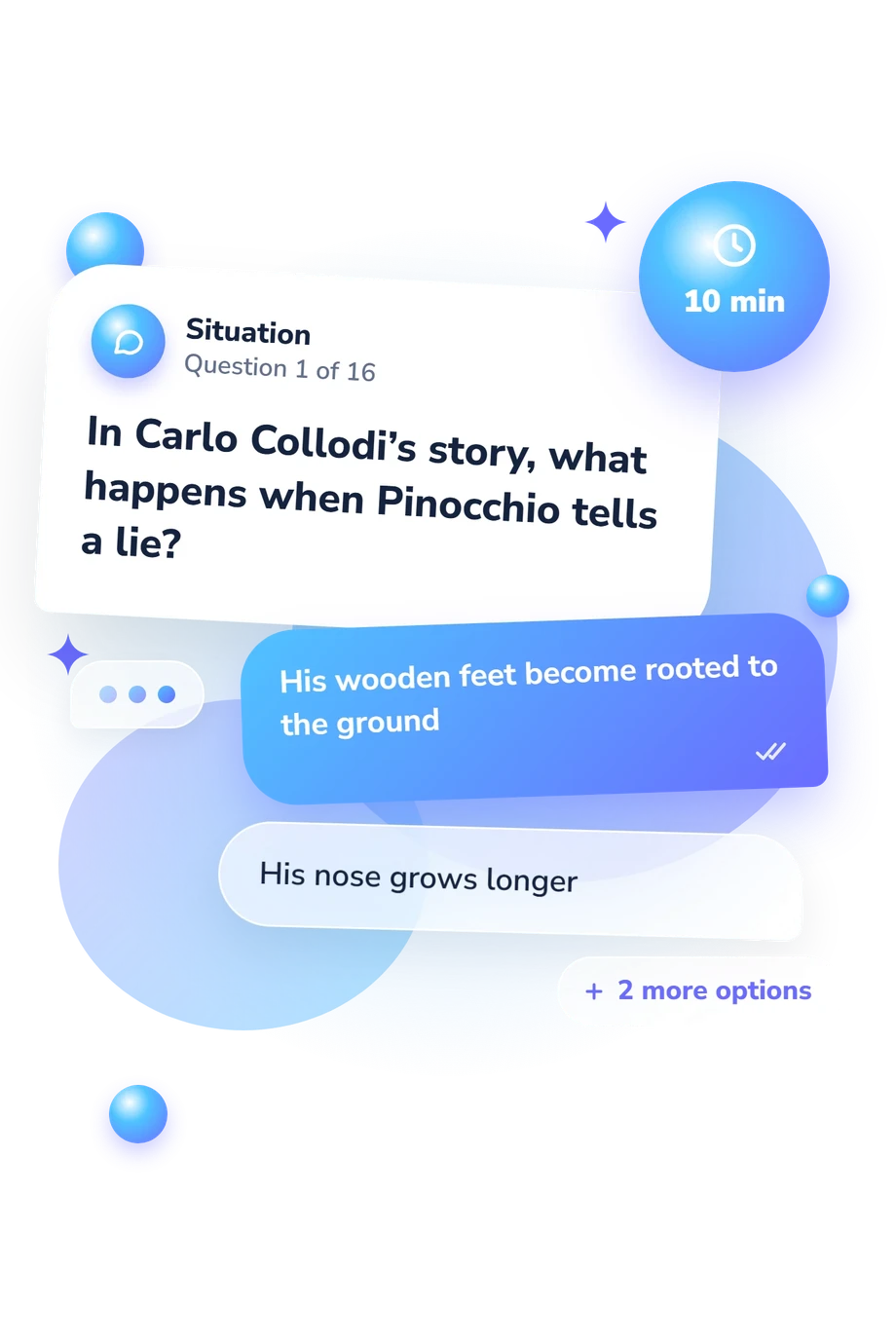
- His wooden feet become rooted to the ground
- His nose grows longer
- His voice changes into a donkey’s bray
- His painted smile disappears
- The Royal Air Force
- The FBI
- Scotland Yard
- MI6
- A rose
- A fox
- A sheep
- A baobab tree
Boy Quiz - Description and methodology of the test
Readers and families who enjoy children’s and young-adult fiction can use the boy quiz to check how well they remember central characters, story events, settings, and defining details. It suits casual readers, dedicated fans, and anyone who wants a fictional boy character quiz spanning literary and screen-linked worlds rather than personal traits. The result offers a playful profile of remembered fictional knowledge.
What This Assessment Explores
This assessment focuses on recognition: can you connect a memorable boy character with the right story, companion, setting, role, or plot detail? The items span classic children’s literature, middle-grade fiction, fantasy, adventure, and family films. The emphasis is recall rather than interpretation, so this fictional character quiz shows which narrative worlds remain most accessible to you.
Fictional Boy Knowledge (0-16) counts correct answers across the full quiz. It is an informal entertainment score, not a measure of intelligence or reading ability. Its bands are:
- Emerging Explorer (0-6) indicates recognition of some characters, with more fictional worlds still to discover.
- Developing Fan (7-12) shows broad familiarity and the ability to connect many characters with their stories.
- Fiction Expert (13-16) reflects strong, detailed knowledge across genres and eras.
Methodology and Evidence Base
Each question presents a brief prompt about a named work or character and four answer choices. Across the item groups, prompts ask about character roles, companions, turning points, settings, and distinctive objects or assignments. The displayed total comes from correct responses, so the outcome reflects recognition accuracy across the selected stories rather than a hidden personality trait.
This is an informal multiple-choice entertainment quiz rather than a standardized instrument or adaptation of a published scale: no external study establishes published norms, reliability, validity, or cutoffs for this questionnaire. Its questions sample factual recall of fictional characters, plots, settings, companions, and objects across selected stories, so the total describes performance on this selection rather than a general ability.
In practical terms, it functions as an entertainment quiz about fictional characters, with a result that is a snapshot of remembered reading and viewing experience. Familiarity with adaptations, school reading, cultural availability, and current recall can shape performance. The bands are descriptive, and the questionnaire does not support conclusions about intelligence, reading ability, or broader literary expertise.
- Sang, Y., Mou, X., Yu, M., Yao, S., Li, J., & Stanton, J. (2022). TVShowGuess: Character Comprehension in Stories as Speaker Guessing. In Proceedings of the 2022 Conference of the North American Chapter of the Association for Computational Linguistics: Human Language Technologies, 4267-4287. Association for Computational Linguistics. 10.18653/v1/2022.naacl-main.317
- Schroeder, S., Segbers, J., & Schröter, P. (2016). The Children Title Recognition Test (K-TRT): A test to assess children's print exposure in German. Diagnostica, 62(1), 16-30. 10.1026/0012-1924/a000131
- Stanovich, K. E., & West, R. F. (1989). Exposure to Print and Orthographic Processing. Reading Research Quarterly, 24(4), 402-433. 10.2307/747605
Updated: