
Bible Quiz Luke Chapter 1-10
How the Scales are Structured
Who Usually Takes This Test?
See How You Compare
Below is a preview of how scores are typically distributed across each scale.
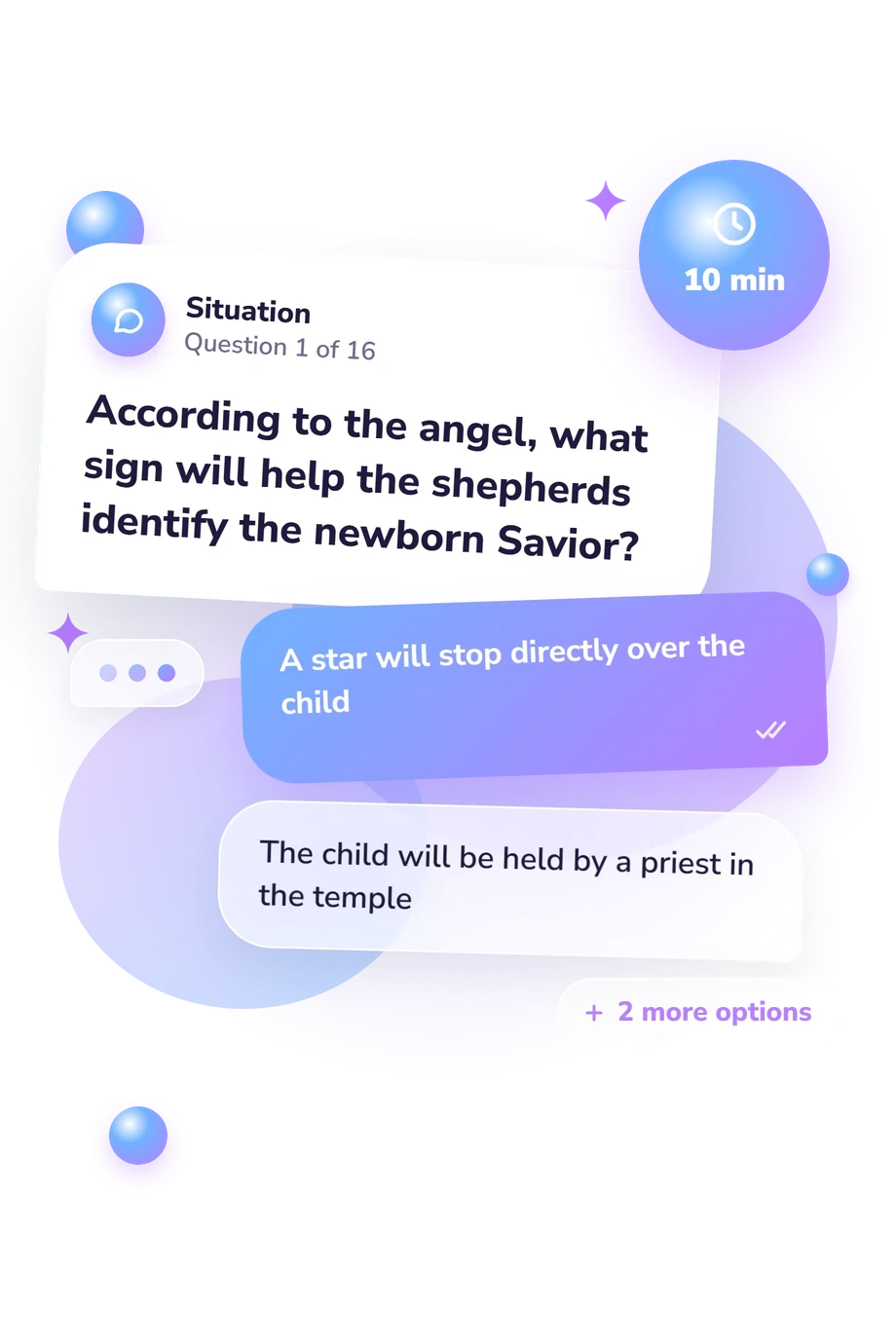
Example Questions From the Test
- A star will stop directly over the child
- The child will be held by a priest in the temple
- The baby will be wrapped in cloths and lying in a manger
- The child will be surrounded by visiting rulers
- The shepherds identify the child for him
- The Holy Spirit guides and reveals this to him
- He reads the child’s name in a Roman record
- Zechariah sends him a written message
- He declares that the man’s sins are forgiven
- He questions the man’s friends about the Sabbath
- He asks the man to make an offering
- He sends the scribes out of the house
Bible Quiz Luke Chapter 1-10 - Description and methodology of the test
Readers who want to revisit Luke 1-10 can use the Bible Quiz Luke Chapter 1 10 as a focused check before returning to the Gospel text. As a Luke 1-10 knowledge check, it offers an overall band that can guide personal study or group discussion, especially by pointing to passages needing another reading. It suits readers who want to refresh their understanding without requiring broader biblical knowledge.
What This Assessment Measures
This questionnaire checks comprehension of Luke 1-10 rather than general biblical knowledge. Items cover the birth narratives, John the Baptist, Jesus’ teachings, parables, miracles, discipleship, and encounters with outsiders. It tests the knowledge needed to answer Bible quiz questions from Luke 1-10, including themes such as mercy, faith, humility, and social reversal.
The displayed result summarizes familiarity with the selected material and indicates how firmly the reader understands these chapters, rather than measuring religious commitment.
The main content groups are:
- Birth and preparation narratives show recognition of promises, signs, and key figures.
- Teachings and parables show understanding of mercy, forgiveness, prayer, and neighborly action.
- Miracles and discipleship show how well events, faith, need, and response are connected.
Methodology and Evidence Base
Each item presents four answer options and asks the reader to select the answer that matches Luke 1-10. This format tests recall and comprehension of the Gospel text, including links among events, teachings, characters, and themes. It is a focused Bible quiz on Luke 1-10, not a measure of personality, spirituality, or religious identity.
The reported result is presented on the displayed Early Gospel of Luke Knowledge scale (0-16), with Foundation to Build (0-6), Developing Knowledge (7-12), and Strong Knowledge (13-16). These bands describe knowledge of Luke 1-10 rather than a comparison with population norms. Performance may also reflect prior study, translation, memory, and whether the reader focuses on detail or broad meaning.
Luke 1-10 is the content source. Fitzmyer’s commentaries (1981, 1985), Aland et al. (2014), Levine and Brettler (2017), and Wasiak (2024) serve as contextual references for sequence, wording, Jewish history, miracle, and praise themes; they do not establish a scoring method or standardization for this questionnaire. After completion, reviewing the Gospel of Luke quiz questions with the biblical text can clarify why each answer fits.
- Fitzmyer, Joseph A. The Gospel According to Luke: Introduction, Translation, and Notes. 2 vols. Anchor Bible 28, 28A. Garden City, NY: Doubleday, 1981, 1985.
- Aland, Barbara, Kurt Aland, Johannes Karavidopoulos, Carlo M. Martini, Bruce M. Metzger, and the Institute for New Testament Textual Research, eds. The Greek New Testament. 5th revised edition. Stuttgart: United Bible Societies, 2014.
- Levine, Amy-Jill, and Marc Zvi Brettler, eds. The Jewish Annotated New Testament: New Revised Standard Version Bible Translation. 2nd ed. New York: Oxford University Press, 2017.
- Wasiak, Wojciech. “Miracle Stories and Praise: Two Neglected Topics in Luke.” New Testament Studies 70 (2024): 452-469. 10.1017/S0028688524000122
Updated: