
Baby Due Date Predictor Quiz
How the Scales are Structured
Who Usually Takes This Test?
See How You Compare
Below is a preview of how scores are typically distributed across each scale.
Example Questions From the Test
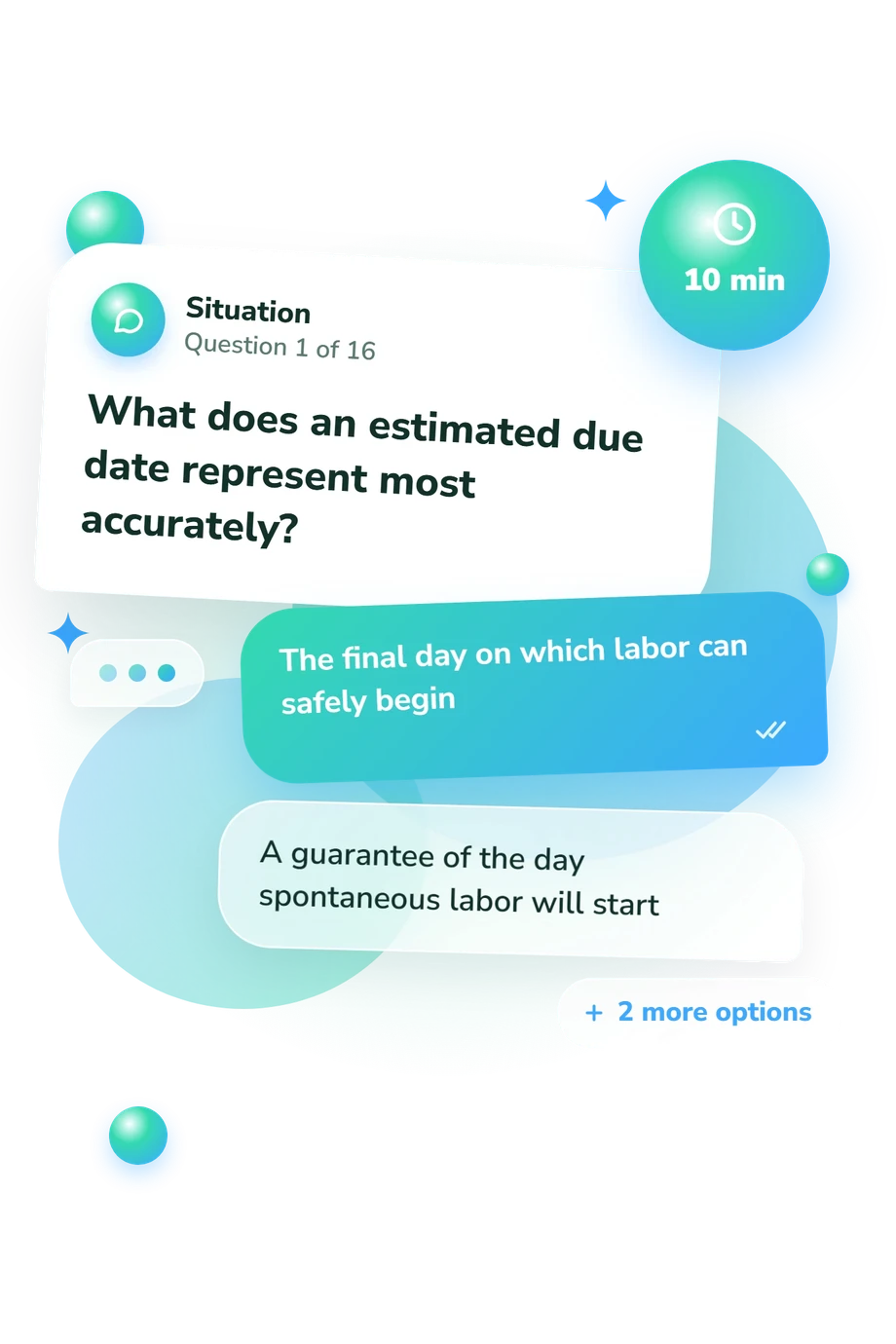
- The final day on which labor can safely begin
- A guarantee of the day spontaneous labor will start
- The exact date the baby reached full development
- A reference estimate around which birth may occur
- A 21-day cycle with ovulation near day 7
- A 28-day cycle with ovulation near day 14
- A 30-day cycle with ovulation near day 20
- A 35-day cycle with ovulation near day 28
- An ultrasound during the final month
- A fundal-height measurement
- A home pregnancy test taken after a missed period
- A first-trimester ultrasound measurement
Baby Due Date Predictor Quiz - Description and methodology of the test
People who want to understand how clinicians estimate pregnancy dates can use the Baby Due Date Predictor Quiz as a focused learning check. It is suited to readers reviewing menstrual dating, ultrasound evidence, conception timing, and common exceptions rather than seeking a personal calculation. Although this predict my due date quiz does not calculate a personal date, its questions clarify the principles behind estimates.
What This Assessment Explores
The questionnaire asks whether a reader can distinguish an estimated due date from a guaranteed delivery day. It covers gestational age, the conventional 40-week framework, and why the last menstrual period is used even though conception usually occurs later.
This baby due date quiz groups its questions around dating knowledge:
- Questions about menstrual dating test cycle assumptions and irregular-cycle limits.
- Questions about ultrasound dating test why early scans carry more weight than later size alone.
- Special situations test IVF timing, twins, uncertain dates, and reaching the estimate without labor.
- Baby Due Date Prediction Knowledge runs 0-16: Foundations to build (0-6) signals concepts need review; Developing knowledge (7-12) shows many core principles; Strong knowledge (13-16) reflects well-rounded understanding.
Together, these areas show what the respondent understands about estimating dates, not what date a particular pregnancy should have.
Methodology and Scientific Basis
Each item presents a pregnancy-dating scenario with four answer choices. Selecting the best answer earns one point when it matches the educational key, so the total counts correct responses. The format checks knowledge rather than calculating a date. Items also test the 40-week convention, calendar calculation, and caution about changing dates after later scans.
ACOG due-date guidance (2017) supplies the framework for menstrual dating, early ultrasound, later scans, and established dates. Mongelli, Wilcox, and Gardosi (1996) support the comparison of menstrual dates with ultrasound biometry, while Tunón and colleagues (2000) address IVF conception. The questionnaire is conceptually consistent with these sources, not an adaptation or validation of one published instrument.
For interpretation, this due date quiz gives educational feedback: more correct answers indicate stronger command of the tested principles, not greater certainty about one pregnancy. Its bands identify topics to review, not medical risk or fetal status.
Performance can vary with prior knowledge, interpretation of the wording, and guessing. The educational score is not a validated medical assessment and cannot establish an individual due date.
- Committee on Obstetric Practice, American Institute of Ultrasound in Medicine, and Society for Maternal-Fetal Medicine; Christian M. Pettker, James D. Goldberg, Yasser Y. El-Sayed, and Joshua A. Copel. Committee Opinion No. 700: Methods for Estimating the Due Date. Obstetrics & Gynecology. 2017;129(5):e150-e154. 10.1097/AOG.0000000000002046
- Mongelli M, Wilcox M, Gardosi J. Estimating the date of confinement: ultrasonographic biometry versus certain menstrual dates. American Journal of Obstetrics and Gynecology. 1996;174(1 Pt 1):278-281. 10.1016/S0002-9378(96)70408-8
- Tunón K, Eik-Nes SH, Grøttum P, Von Düring V, Kahn JA. Gestational age in pregnancies conceived after in vitro fertilization: a comparison between age assessed from oocyte retrieval, crown-rump length and biparietal diameter. Ultrasound in Obstetrics & Gynecology. 2000;15:41-46. 10.1046/j.1469-0705.2000.00004.x
Updated: