
AP Art History Quiz
How the Scales are Structured
Who Usually Takes This Test?
See How You Compare
Below is a preview of how scores are typically distributed across each scale.
Example Questions From the Test
- The bombing of the town of Guernica during the Spanish Civil War
- The storming of the Bastille during the French Revolution
- The invasion of Poland at the start of World War II
- The October Revolution in Russia
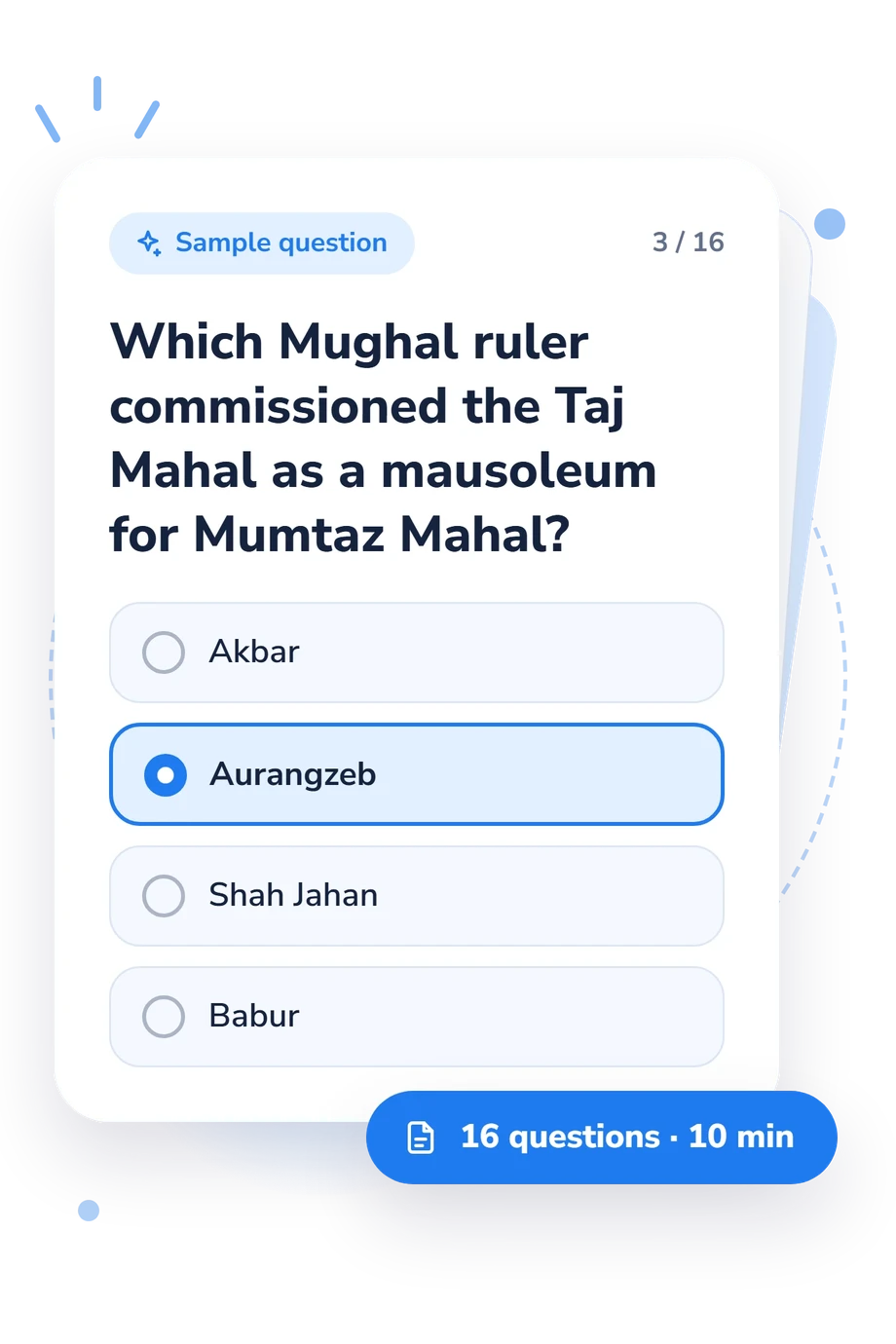
- Akbar
- Aurangzeb
- Shah Jahan
- Babur
- The genealogies of European colonial governors
- The boundaries of agricultural fields measured for taxation
- Relationships among islands, ocean swells, and navigation routes
- The elevation profiles of volcanic mountains
AP Art History Quiz - Description and methodology of the test
Students reviewing art across cultures and periods can use the AP Art History Quiz to test recall and connections between works and their historical settings. It suits learners who want a focused AP art history practice quiz before organizing revision. The result gives a quick overall indication of your knowledge level, while the question themes can guide later review.
What This Assessment Explores
Items connect recognition with interpretation across cultures, periods, and media. They ask about artists, rulers, monuments, materials, traditions, formal choices, patronage, ritual, technology, and political context. As an AP art history test, this questionnaire suits learners who want to check whether factual recall supports formal and historical reasoning.
The result uses one scale, AP Art History Knowledge (0-16), with Foundations to Review (0-6), Developing Knowledge (7-12), and Strong Knowledge (13-16). It is a study summary, not an official AP score or prediction.
The main content areas covered by the questions are:
- Artwork recognition shows how well you place works within cultures and periods.
- Formal interpretation shows how an artwork's features guide meaning.
- Context and function show how patronage, ritual, politics, and technology shape meaning.
- Interpretive reasoning shows how formal features and historical explanation work together.
Methodology and Evidence Base
Each item presents a text-based art-historical prompt with four answer choices. The format asks for identification or the best-supported interpretation, requiring recall and formal or contextual interpretation rather than personal opinion. One total is reported; its bands summarize study progress.
Its content is conceptually consistent with AP Art History CED (College Board, 2025), which connects works, cultures, contexts, materials, functions, and formal interpretation. The questionnaire is not an official College Board exam or an adaptation of that document. Stokstad and Cothren provide a survey framework for relating formal qualities to historical circumstances, while Archino's work on visual literacy supports treating interpretation and context as connected skills.
As an AP art history study guide companion, this questionnaire can help prioritize unfamiliar traditions or concepts for review. Preparation, memory, test-taking habits, and familiarity with selected artists, cultures, materials, and contexts can influence performance, so revisit missed themes alongside the reported band when planning study. The single total summarizes overall knowledge rather than each content area.
- College Board. AP Art History Course and Exam Description. New York: College Board, 2025.
- Stokstad, Marilyn, and Michael W. Cothren. Art History. 7th ed. Pearson, 2025.
- Archino, Sarah. "Addressing Visual Literacy in the Survey: Balancing Transdisciplinary Competencies and Course Content." Art History Pedagogy & Practice 5, no. 1 (2020). 10.14713/ahpp.v5i1.2175
Updated: